
Species · Tetras & rasboras
Black Neon Tetra
Hyphessobrycon herbertaxelrodi
Not the same fish as the Neon Tetra (Paracheirodon innesi).
If you remember one thing: this is a shoaling fish that needs a cycled tank and a group of at least 8-10, not a lonely trio in a small unfiltered bowl.
Difficulty: Beginner Tropical community tank ✓ Fact-checked care guide
Quick facts
| Adult size | Small: about 3.5 cm standard length, up to roughly 4 cm (1.6 in) overall. It looks a touch chunkier and taller-bodied than a regular neon tetra. |
|---|---|
| Minimum tank | Keeper-facing minimum: around 75 litres (about 20 US gallons). SeriouslyFish frames it as a tank with a base footprint of at least 80 x 30 cm (~72 L / ~19 US gal). You will see "10 gallons / ~38 L for six fish" quoted as a bare minimum, but that is a squeeze: bigger-is-better here because a longer footprint lets a proper shoal actually cruise and swim, which is when these fish look and behave their best. Prioritise swimming length over height. |
| Temperature | 20-28 C (68-82 F) is the tolerated range; aim for the community-tropical middle, roughly 22-26 C (72-79 F). |
| pH | 5.0-7.5. A near-neutral, stable reading is fine; they mind sudden swings far more than any exact number in that band. |
| Hardness | Soft to moderately hard: about 1-12 dGH. They are flexible on hardness as long as it stays steady. |
| Filtration & flow | Gentle to moderate flow. They come from slow, thickly planted margins, so aim for a well-filtered but not turbulent tank; baffle a strong filter outlet if the shoal is getting blown around. |
| Diet | Omnivore. A good-quality dried micro-flake or nano-pellet works as the staple, boosted with small frozen and live foods. |
| Social | Shoaling: keep at least 8-10 together, a mixed-sex group ideally. More is better: a bigger shoal is calmer, bolder and colours up more. Groups smaller than that get stressed, hide, and are more prone to nipping. Six is a bare minimum, not a target. |
| Temperament | Very peaceful. A calm, well-mannered community fish that spends most of its time in the upper and middle water column. |
| Lifespan | Around 5 years with good water and diet (commonly cited as roughly 3-5 years). |
Overview
The Black Neon Tetra is a hardy, genuinely peaceful little characin from the Paraguay basin of southern Brazil, and one of the most forgiving shoaling fish you can start a planted community with.
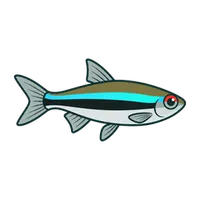
Do not confuse it with the (unrelated) common Neon Tetra: instead of red-and-blue, it wears a smoky greenish-black stripe under a bright greenish-white line, with a little red-and-gold flash over each eye. That contrast pops hardest over dark substrate and in a big group.
It is beginner-friendly on water chemistry but has real, non-negotiable needs: a fully cycled tank, a proper shoal, and enough horizontal swimming space. Those are where most first-time keepers go wrong, not on the pH number.
Almost every fish in the trade today is a tank-bred commercial strain, so you are buying a captive-adapted, tolerant animal, not a delicate wild import.
💷 Costing it out? See how much a black neon tetra really costs to keep — the black neon tetra itself is usually the cheapest part.
Water & tank
Water first: target roughly 22-26 C (72-79 F), pH 5.0-7.5 (near-neutral and stable is ideal), and soft-to-moderate hardness around 1-12 dGH. They tolerate a wide band, so consistency beats chasing a perfect number.
Cycle the tank before any fish go in. This species is peaceful and tolerant, but it is not immune to ammonia and nitrite: you want a filter that has grown its bacteria so ammonia and nitrite both read 0 ppm, with nitrate kept low by regular water changes. New-tank (uncycled) water is the single most common killer.
Footprint over litres: aim for a tank with a base of at least about 80 x 30 cm (roughly 75 L / 20 US gal) so a group of 8-10+ has real swimming length. A taller, narrower tank of the same volume is worse for them than a longer, shallower one.
Set it up like their home water: gentle-to-moderate flow, a darker substrate, and plenty of planting with some open lanes to swim. Dim or planted-shaded lighting shows off their stripe and helps them feel secure.
Keep it stable. They handle a range of parameters but dislike sudden shifts, so match temperature and chemistry when doing water changes and avoid big swings.
Feeding
Feed a quality dried staple (micro-flake or small/nano pellet) as the everyday base; they feed readily at the top and mid-water and are not fussy.
Rotate in small meaty foods a few times a week: frozen or live bloodworm (chironomid larvae), mosquito larvae, Daphnia, Moina, cyclops, and baby brine shrimp. Variety keeps colour and condition up.
Feed small amounts once or twice a day, only what the shoal clears in a minute or two. Overfeeding fouls the water faster than these small fish ever could.
They will happily eat baby shrimp and shrimp fry but ignore adult shrimp, so plan shrimp tankmates accordingly.
Behaviour & tankmates
An ideal, drama-free community fish: peaceful, active, and happiest cruising in a group in the upper-to-mid water.
Best kept in a shoal of 8-10 or more of its own kind first, then paired with other calm, similarly-sized community fish.
Good tankmates: other small tetras and rasboras, danios, Corydoras and other small peaceful catfish, dwarf/small gouramis, and peaceful bottom-dwellers. SeriouslyFish also lists similarly-sized characids, hatchetfish, pencilfish, small loricariids and non-predatory small-to-medium cichlids.
Avoid anything big enough to eat them or aggressive/fin-nipping tankmates. A mouth big enough to swallow a 3.5 cm tetra (larger cichlids, big catfish) makes them prey, not company. Angelfish are a size-and-personality gamble: some keepers succeed, but a large angel can view a small tetra as food.
Not a fin-nipper itself when kept in a proper group; nipping and skittishness usually appear when the shoal is too small.
What to expect
Set up and cycle the tank first, then add the whole shoal of 8-10+ at once if you can, so no small subgroup gets singled out.
Expect them to look shy and washed-out for the first day or two in a new tank, then settle, colour up, and start cruising together as a group.
Day to day they are low-drama: a quick feed once or twice daily, a weekly partial water change, and an occasional filter check is most of the work.
You will get the best colour and behaviour from a big group over dark substrate in a planted tank, not from a few fish in a bright bare tank.
Myths, kindly busted
“It is a colour variety of the common Neon Tetra.”
It is a separate species (Hyphessobrycon herbertaxelrodi) and is not closely related to the true Neon Tetra (Paracheirodon innesi). The similar name comes from the look, not the family.
“A few of them will be fine; they are just decoration.”
They are shoaling fish. Kept in ones, twos or threes they get stressed, hide, lose colour and are more likely to nip. Authority sources call for a mixed-sex group of at least 8-10.
“They are so hardy they can go in a small unfiltered bowl or a brand-new tank.”
Hardy means tolerant of a range of stable parameters, not immune to poison. They still need a cycled, filtered tank with 0 ppm ammonia and nitrite and enough swimming length; new-tank water is what usually kills them.
“You must nail acidic, very soft blackwater for them to survive.”
Wild fish come from soft, slightly acidic water, but the tank-bred strain in shops thrives across roughly pH 5-7.5 and 1-12 dGH. Very soft, acidic water is mainly needed for breeding, not day-to-day keeping. Stability matters more than hitting an extreme.
When to act
We triage, not diagnose — but these are worth a closer look (starting with a water test):
- Fish gasping at the surface, hanging near the filter outflow, or suddenly lethargic soon after adding them: test the water for ammonia and nitrite immediately. Any reading above 0 ppm means do a water change and confirm the tank is actually cycled.
- The shoal scattering, hiding constantly, colours washing out, or fins looking clamped: check for an oversized/aggressive tankmate, too-small a group, or a water-quality slip, and act on the cause rather than medicating blindly.
- White salt-like spots, cottony patches, ragged or reddened fins, or rapid gilling: isolate stress and poor water quality first, then seek a knowledgeable fishkeeping source or an aquatic vet for guidance. These are triage cues, not a diagnosis.
- Deaths after a water change: you likely swung temperature or chemistry too fast, or added unconditioned tap water; match parameters and use dechlorinator next time.
- New arrivals refusing food for more than a few days: recheck water parameters and give them a calm, planted, dimly lit space; persistent inappetence with other symptoms warrants advice from an experienced keeper or vet.
Heading to a vet? Print the Black Neon Tetra vet-prep sheet — what to bring, what to tell them, and the questions to ask.
Sources & further reading
- SeriouslyFish - Hyphessobrycon herbertaxelrodi (Black Neon Tetra) — Primary authority: 35 mm SL; base footprint 80 x 30 cm (~72 L / ~19 US gal); 20-28 C / 68-82 F; pH 5.0-7.5; 1-12 dGH; group of at least 8-10; diet and tankmate list.
- Aquarium Co-Op - Care Guide for Black Neon Tetras — Vendor care authority: adult ~2.5-3.8 cm; 72-80 F / 22-27 C; pH 5-8, soft to moderately hard; 6 as bare minimum but 10-15 recommended for 20 gal+; feeding and shrimp-fry note.
- Fishkeeping World - Black Neon Tetra Care & Species Guide — Corroborates ~5-year lifespan, up to 1.6 in, minimum 20 in long footprint, pH 5.5-7, peaceful, group of at least six, tankmate list.
- Wikipedia - Black neon tetra — Origin (Paraguay basin, southern Brazil), max ~4 cm / 1.6 in, distinct from true neon tetra, shoaling behaviour and stripe function; tap-water range 5.5-7.5, breeding needs soft acidic water.
Written & fact-checked by The Finfern Team against the sources above — kind, general guidance, not a diagnosis. If something looks wrong, test your water and, if it persists, contact a fish-savvy vet.

Get the free Black Neon Tetra Starter Kit
The essentials at a glance, a setup checklist and a first-30-days plan for your black neon tetra — what to get right and what to watch for. Join the shoal and we’ll send it over. Free sheets and tools always stay open, no gatekeeping.
Water-first tips and new guides the moment they land. No spam — unsubscribe anytime. See how we handle your data in our privacy notice.