
Species · Tetras & rasboras
Black Phantom Tetra
Hyphessobrycon megalopterus (now often placed as Megalamphodus megalopterus)
Get the water soft, warm and stable and keep a shoal of at least 6 (8-10+ is far better) in a long tank, and this peaceful tetra rewards you with non-stop male sparring displays instead of nervous hiding.
Difficulty: Beginner Tropical community tank ✓ Fact-checked care guide
Quick facts
| Adult size | About 3.5-4.5 cm (1.4-1.75 in). SeriouslyFish gives 36 mm standard length; other sources measure up to about 4.4 cm total length. A small, deep-bodied tetra. |
|---|---|
| Minimum tank | Keeper-facing minimum: a tank around 75 L / 20 US gal with a footprint of at least 80 x 30 cm (roughly 31 x 12 in). SeriouslyFish lists a minimum base of 80 x 30 cm (~72 L / ~19 US gal). Bigger-is-better reality: swimming LENGTH matters more than raw volume for a shoaling fish, so a longer 90 cm+ (3 ft) tank lets a proper group of 8-10+ spread out, display and settle far better than a tall or short tank of the same litreage. |
| Temperature | 20-28 C (68-82 F) is the full tolerated range (SeriouslyFish). Aim for the middle, roughly 23-26 C (73-79 F), which suits them and most community tankmates. This is a heated tropical fish, not a coldwater one. |
| pH | Soft and slightly acidic is ideal. SeriouslyFish gives pH 5.0-7.0; keeper guides commonly cite 6.0-7.5. Target roughly 6.0-7.0 and, above all, keep it stable rather than chasing a perfect number. |
| Hardness | Soft to moderately soft water. SeriouslyFish lists 1-12 dGH; other reputable guides tolerate up to about 18 dGH, with around 10 dGH often cited as a good middle. Aim for roughly 1-15 dGH (soft to medium). KH: a little carbonate hardness (roughly 3-8 dKH) helps hold pH steady. |
| Filtration & flow | Gentle to moderate flow. This is a slow-water fish from small, shaded margins, so use filtration that keeps the water clean and cycled without creating a strong current. Baffle a strong filter outlet if the fish are constantly fighting the flow; gentle circulation plus stable, well-filtered water is the goal. |
| Diet | Omnivore. In the wild it eats small invertebrates, insect larvae and bits of plant matter. In the tank it does well on a good-quality micro-flake or small pellet as the everyday staple, rotated with frozen and live foods. |
| Social | Shoaling: keep a group of at least 6, but 8-10 or more is strongly recommended. SeriouslyFish advises "at least 8-10 specimens" to see natural behaviour and colour. Bigger groups spread out male aggression, reduce stress and shyness, and bring out the constant sparring displays. Kept in ones and twos they hide, lose colour and are prone to nipping and disease. |
| Temperament | Peaceful and community-safe. Males stage frequent, harmless fin-flaring "duels" with each other, fanning out their black fins to spar over territory and court females. It is display, not real combat, and rarely causes injury when the group is big enough. Under-shoaled or crowded fish are the ones that turn to genuine fin-nipping. |
| Lifespan | Typically 3-5 years in a well-kept aquarium, with some individuals reaching 5-6 years. Stable, cycled water and a proper shoal are what actually get them there. |
Overview
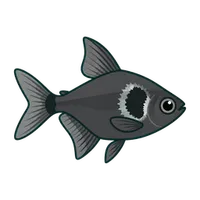
A small, peaceful South American characin (a 'tetra') with a tall black dorsal fin and a distinctive black, comma-shaped blotch edged in faint silver-blue just behind the gills.
Long sold as Hyphessobrycon megalopterus; a 2024 genomic study (Melo et al.) returned it to the genus Megalamphodus, so you will see both names. The fish and its care are identical either way.
Almost every black phantom in the trade today is captive-bred, so they are hardy and adaptable to a range of water as long as it is stable and truly cycled.
Best known for the males' theatrical fin-flaring 'duels' with each other, which is the payoff for keeping a proper-sized shoal.
Do not confuse it with the closely related Red Phantom Tetra (Megalamphodus/Hyphessobrycon sweglesi), which is reddish; they are similar in care but different species.
💷 Costing it out? See how much a black phantom tetra really costs to keep — the black phantom tetra itself is usually the cheapest part.
Water & tank
Water first: aim for soft, slightly acidic, warm and stable water. Target temperature around 23-26 C (73-79 F) within a tolerated 20-28 C (68-82 F); pH around 6.0-7.0 (tolerant roughly 5.0-7.5); hardness soft to medium, roughly 1-15 dGH. Steady beats 'perfect' every time.
A cycled tank is non-negotiable. Before any fish go in, run a fishless nitrogen cycle so the filter grows the bacteria that turn ammonia into nitrite then nitrate. On a stocked, mature tank you want to consistently read 0 ammonia, 0 nitrite, and low nitrate (keep it down with regular water changes). Adding a shoal to a brand-new, uncycled tank is the most common way they die.
Footprint over litres: because they shoal and the males need room to display, swimming LENGTH matters most. A minimum base of about 80 x 30 cm (31 x 12 in, ~75 L / 20 US gal) works for a starter group, but a 90 cm (3 ft) or longer tank is markedly better for a full group of 8-10+.
Scape it dark and planted. They show their best colour and confidence over a darker substrate with plenty of planting, some shade, and open water to swim in. Floating plants to dim the light and a few leaves or wood for tannins mimic their shaded, blackwater-tinged home.
Filtration should keep water pristine but flow should stay gentle to moderate; baffle strong outlets. Do routine partial water changes with dechlorinated, temperature-matched water to keep nitrate low and parameters steady.
Lid on: like most tetras they can be startled into jumping, so keep the tank covered.
Feeding
Staple: a good-quality micro-flake or small (nano) pellet sized for a tetra's small mouth, fed once or twice a day in amounts they finish in a couple of minutes.
Rotate in frozen and live foods for colour and condition: daphnia, cyclops, baby brine shrimp, micro-worms, and small/finely-chopped bloodworm or mosquito larvae. Use bloodworm in moderation as a treat, not a staple.
Feed small and often rather than one big meal; uneaten food fouls the water and spikes ammonia. It is safer to slightly underfeed than to overfeed.
A varied diet plus stable water is what keeps their black-and-silver contrast crisp; a monotonous dried-only diet leaves them duller.
A short weekly fast (one no-feed day) is fine and can help digestion in a lightly stocked, well-fed tank.
Behaviour & tankmates
Peaceful community fish. Ideal tankmates are other calm, similarly-sized species: other tetras and rasboras, pencilfish, hatchetfish, Corydoras and other small catfish, Otocinclus, honey/dwarf gouramis, and peaceful dwarf cichlids.
Keep them in a big enough shoal (6+, ideally 8-10+). Male sparring is normal and harmless in a proper group, but too few fish (or too little space) can tip into real fin-nipping directed at each other or at long-finned tankmates.
Be cautious with long-finned, slow-moving fish such as fancy bettas and fancy guppies, which can be nipped; and avoid large or aggressive fish that will bully or eat a small tetra.
Not shrimp- or fry-safe: they will happily eat dwarf shrimplets and newborn fish, so do not rely on this tetra to leave a breeding shrimp colony or livebearer fry alone.
Give them planted cover and open swimming lanes; secure, well-grouped fish are bold and active, while stressed or lonely ones hide and pale out.
What to expect
Once settled in a good-sized shoal, expect confident, active fish that hold together loosely and constantly interact, with males repeatedly squaring up and fanning their tall black fins at each other.
Colour deepens with maturity, stable soft water, a varied diet and a darker, planted tank; expect them to look their best a few weeks after settling in, not on day one.
Males are the showier, black-finned fish; females are a little deeper-bodied with a reddish tint to the pelvic, anal and adipose fins, which makes sexing fairly easy once mature.
They can spawn readily in a mature planted tank, but the adults eat the eggs, so seeing lots of surviving fry without a dedicated breeding setup is unlikely.
Myths, kindly busted
“It is a Hyphessobrycon and that name is settled.”
It was originally described in the genus Megalamphodus, spent decades lumped into the huge catch-all genus Hyphessobrycon, and a 2024 genomic study (Melo et al.) moved it back to Megalamphodus. Both names refer to the same fish; the care does not change.
“A handful, or even a pair, is enough.”
This is a shoaling fish. Kept in ones or twos it becomes shy, loses colour, and is more prone to nipping and disease. Keep at least 6, and 8-10+ is much better so males spread out their displays instead of harassing each other or tankmates.
“Tetras are hardy, so you can add them to a new tank right away.”
Captive-bred stock is adaptable, but they still need a fully cycled tank with 0 ammonia and 0 nitrite. Dropping a shoal into an uncycled 'new tank' is a leading cause of early losses; cycle first, stock gradually.
“It's peaceful, so it's safe with my shrimp and baby fish.”
Peaceful toward tankmates its own size does not mean safe for tiny animals. Black phantoms readily eat dwarf shrimplets and newborn fry, so don't count on them sparing a shrimp colony or livebearer babies.
“It needs a big tall tank because it's a 'nano' fish that barely swims.”
Volume matters less than swimming length. A long footprint (80 cm minimum, 90 cm+ better) lets the shoal move and the males display far better than a tall tank of the same litres.
When to act
We triage, not diagnose — but these are worth a closer look (starting with a water test):
- Fish gasping at the surface, hanging near the filter outflow, or suddenly hiding and pale: stop feeding and test the water for ammonia, nitrite and nitrate right away. Any ammonia or nitrite above 0 means do an immediate partial water change and check your cycle.
- Clamped fins, loss of the crisp black-and-silver colour, or lethargy across several fish usually points to a water-quality or stability problem (temperature swing, missed water changes, overstocking): test first, then correct the environment.
- White salt-grain spots on fins and body (a classic ich/white-spot appearance), or fungus/cottony patches, or torn and reddened fins: isolate the cause, keep water pristine and stable, and seek advice from a vet or an experienced fishkeeper before medicating rather than guessing.
- Persistent chasing and torn fins (not the brief harmless male displays) is a sign the group is too small or the tank too crowded: increase the shoal size and/or space and add cover.
- Flicking or rubbing against decor (flashing), rapid breathing, or fish going off food are early triage signals to check parameters and observe closely, not to self-diagnose a specific disease. When in doubt, ask for help early.
Heading to a vet? Print the Black Phantom Tetra vet-prep sheet — what to bring, what to tell them, and the questions to ask.
Sources & further reading
- SeriouslyFish - Hyphessobrycon megalopterus (Black Phantom Tetra) — Primary reference for size (36 mm SL), minimum tank base 80 x 30 cm / ~72 L / ~19 US gal, temperature 20-28 C / 68-82 F, pH 5.0-7.0, hardness 1-12 dGH, group of at least 8-10, diet, temperament and sexual dimorphism.
- Aquarium Co-Op - Care Guide for Red and Black Phantom Tetras — Adult size up to 1.5 in / 3.8 cm, 15-20 gal tank, temperature 70-82 F / 21-28 C, pH 6.0-7.5, group of at least 6, diet, tankmates, and the shrimp/fry-eating caution.
- AquariumStoreDepot - Black Phantom Tetra Care Guide — Lifespan 3-5 years, 20 gal / 75 L, temperature 72-82 F / 22-28 C, pH 6.0-7.5, hardness 2-18 dGH, group of 6-8 (8 minimum), fin-nipping / stress note.
- Aquarium Source - Black Phantom Tetra Care — Corroborates size 1.4-1.75 in / 3.6-4.4 cm, lifespan ~5-6 years, temperature 72-82 F, pH 6.0-7.5, hardness up to 18 dGH (~10 best), and the betta-tankmate caution.
- Wikipedia - Black phantom tetra — Taxonomy and Megalamphodus reclassification, native range (upper Guapore and Paraguay basins), max length ~4.4 cm, sexual dimorphism, and that nearly all trade fish are captive-bred.
Written & fact-checked by The Finfern Team against the sources above — kind, general guidance, not a diagnosis. If something looks wrong, test your water and, if it persists, contact a fish-savvy vet.

Get the free Black Phantom Tetra Starter Kit
The essentials at a glance, a setup checklist and a first-30-days plan for your black phantom tetra — what to get right and what to watch for. Join the shoal and we’ll send it over. Free sheets and tools always stay open, no gatekeeping.
Water-first tips and new guides the moment they land. No spam — unsubscribe anytime. See how we handle your data in our privacy notice.