
Species · Tetras & rasboras
Black Skirt Tetra
Gymnocorymbus ternetzi
An unfussy, hardy community tetra — keep a dozen or more and the "fin-nipper" reputation melts away. Avoid the dyed "colour" versions entirely.
Difficulty: Beginner Tropical community tank ✓ Fact-checked care guide
Quick facts
| Adult size | ~60 mm / 2.4 in SL |
|---|---|
| Minimum tank | ~68 L / ~18 US gal — a 75 × 30 cm base for a group, per SeriouslyFish |
| Temperature | 20–26 °C / 68–79 °F |
| pH | 6.0–7.0 |
| Hardness | 5–20 dGH |
| Filtration & flow | Undemanding; open swimming room plus planted areas; some floating cover for colour |
| Diet | Very unfussy omnivore — flakes/granules plus small live/frozen foods (Daphnia, bloodworm) |
| Social | A shoaling species — keep a group of at least 12 |
| Temperament | Generally peaceful and lively — fin-nipping fixed by keeping a proper shoal |
| Lifespan | Commonly cited at ~5 years in the hobby (not stated by the primary source) |
Overview
The black skirt tetra (also sold as black widow or butterfly tetra) is one of the most common fish in the trade for a reason: SeriouslyFish calls it one of the best choices for a newcomer. Every fish sold is captive-bred, and the source describes it as unfussy about both water chemistry and diet.
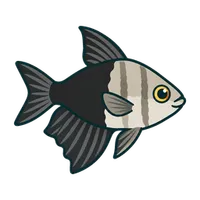
Its bold black juveniles fade to a subtle smoky grey as adults, giving a calm contrast to more colourful tankmates. It is a shoaling fish, and — as with most tetras — its personality depends heavily on being kept in a proper group.
💷 Costing it out? See how much a black skirt tetra really costs to keep — the black skirt tetra itself is usually the cheapest part.
Water & tank
Start with the numbers. SeriouslyFish lists temperature 20–26 °C (68–79 °F), pH 6.0–7.0, and hardness 5–20 dGH. That is a comfortable, mainstream tropical range that most tap water and standard heaters can hold without fuss.
For space, the source says a group can be kept in a standard 30 × 12 in (75 × 30 cm), roughly a 20-gallon-long / ~68-litre (~18 US gal) tank. It is an active fish that likes open swimming room alongside quieter, planted areas — some floating plants to dim the light bring out its best colour.
Feeding
Feeding is easy. SeriouslyFish describes a "most unfussy, omnivorous species" and recommends flakes and granules plus regular feedings of small live and frozen foods such as Daphnia and bloodworm. A quality dried staple with frozen treats a few times a week keeps them well-conditioned and coloured.
Behaviour & tankmates
Here is the myth-buster. The black skirt tetra has a reputation as a fin-nipper — but SeriouslyFish is explicit that this behaviour "can usually be rectified by keeping it in a shoal of at least 12", because at those numbers any squabbling stays contained within the group. Nipping is a symptom of too small a group, not of a mean fish.
The source calls it one of the better tetras for a general community tank: generally peaceful and lively, and a good match for livebearers, danios, rasboras, other tetras, and peaceful bottom-dwellers such as Corydoras. Its rounded shape even lets it hold its own with larger fish like angelfish. Keep the group big and long-finned tankmates become much lower-risk.
What to expect
Expect a durable, forgiving, long-lived community tetra that rewards a real shoal. In a group of a dozen it settles into its own hierarchy and largely ignores its tankmates; kept as a lonely three or four, it is far more likely to earn its fin-nipper reputation. Avoid the dyed "colour" versions entirely — the source says the dyeing process is very stressful and often shortens the fish’s lifespan considerably.
Myths, kindly busted
“Black skirt tetras are aggressive fin-nippers.”
SeriouslyFish says the nipping reputation "can usually be rectified by keeping it in a shoal of at least 12", at which point squabbling stays within the group.
“The bright pink/blue/green "colour" tetras are a natural variety.”
The source describes those as artificially injected dyes — a process it calls very stressful that often shortens the fish’s lifespan considerably.
“A few is fine for a community tank.”
It is a shoaling fish; the source’s whole fin-nipping fix depends on keeping it in a group of at least 12.
When to act
We triage, not diagnose — but these are worth a closer look (starting with a water test):
- Persistent fin-nipping or chasing — usually a sign the shoal is too small; increase the group and add sight-breaks rather than treating it as illness.
- A fish hanging alone, clamped, or off its food — recheck water parameters and group size before anything else.
- Recently bought "neon-coloured" stock looking faded, stressed, or dying early — a likely dyed fish; expect poor resilience and avoid buying them.
Heading to a vet? Print the Black Skirt Tetra vet-prep sheet — what to bring, what to tell them, and the questions to ask.
Sources & further reading
- SeriouslyFish — Gymnocorymbus ternetzi (Black Skirt / Black Widow Tetra) — Max ~60 mm SL; base 75 × 30 cm (~68 L / ~18 US gal); temperature 20–26 °C / 68–79 °F; pH 6.0–7.0; hardness 5–20 dGH; "one of the best choices for the newcomer"; fin-nipping "rectified by keeping it in a shoal of at least 12"; dyed specimens are stressed and short-lived — avoid.
Written & fact-checked by The Finfern Team against the sources above — kind, general guidance, not a diagnosis. If something looks wrong, test your water and, if it persists, contact a fish-savvy vet.

Get the free Black Skirt Tetra Starter Kit
The essentials at a glance, a setup checklist and a first-30-days plan for your black skirt tetra — what to get right and what to watch for. Join the shoal and we’ll send it over. Free sheets and tools always stay open, no gatekeeping.
Water-first tips and new guides the moment they land. No spam — unsubscribe anytime. See how we handle your data in our privacy notice.