
Species · Cichlids
Blood Parrot Cichlid
Hybrid cichlid (Cichlidae) — usually Amphilophus citrinellus x Vieja melanurus; no valid species name exists for a man-made hybrid
If you remember one thing: the blood parrot is a man-made hybrid whose "cute" beak-face is a permanent deformity, so buy an undyed, un-cut fish and give it a big, warm, gently-filtered tank with soft hardscape — it will live 10-15 years and needs you to plan for that.
Difficulty: Intermediate Cichlid setup ✓ Fact-checked care guide
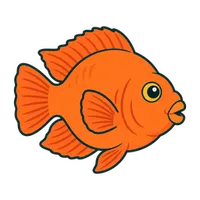
Quick facts
| Adult size | Around 15-20 cm (6-8 inches), males tending to the larger end. "King Kong" strains can reach roughly 30 cm (12 in). Plan for a fish the size of your hand, not the 3 cm baby you see in the shop. |
|---|---|
| Minimum tank | The often-quoted keeper minimum for one fish is about 110 L (30 US gal / 25 imp gal), but the honest, bigger-is-better reality for a hand-sized, messy fish that lives 10-15 years is roughly 200 L (55 US gal / 46 imp gal) or more for a single fish, and about 280 L (75 US gal / 62 imp gal) for a small group. Footprint (length x width) matters far more than height. Budget an extra 75-110 L (20-30 gal) per additional parrot. |
| Temperature | 24-28 °C (76-82 °F); a stable 24-26 °C (76-80 °F) is the sweet spot. Heated tank, always — this is a tropical fish. |
| pH | 6.5-8.0. They descend from hard-water Central American cichlids, so neutral to slightly alkaline is fine; stability matters more than chasing an exact number. |
| Hardness | GH roughly 6-18 dGH (about 100-320 ppm). Moderately hard, alkaline-friendly water suits their Central American parentage. They are not soft-water fish — no need to acidify or add peat/blackwater. |
| Filtration & flow | High-volume filtration (they are messy, sloppy eaters that drop a lot of food) but gentle, low-to-moderate flow — they are weak swimmers thanks to compressed vertebrae and sometimes a deformed swim bladder. Aim the outflow along the glass or use a spray bar so there is a calm resting zone. Oversize the biological media and keep up water changes. |
| Diet | Omnivore that leans carnivore. Because of the deformed mouth it can only scoop and gulp, not bite or tear, so it needs small, soft, slow-sinking or floating pellets it can swallow whole. |
| Social | Not an obligate shoaling fish. Keep singly, or in a group of 3 or more (5+ is better) so aggression is spread out. Avoid keeping exactly 2, because one almost always bullies the other. If you keep a group, the difference between 3 and 8+ is night and day. |
| Temperament | Semi-aggressive and territorial, but comically hampered: the deformed beak-mouth cannot close or bite properly, so they bluster and chase far more than they actually damage tankmates. Bolder around food and at spawning time. |
| Lifespan | 10-15 years with good water and diet. Dyed or poorly-bred fish often live noticeably shorter lives. |
Overview
The blood parrot is not a wild species — it is a Taiwanese aquarium hybrid first bred around 1986, most often from the Midas cichlid (Amphilophus citrinellus) crossed with a Vieja (redhead) cichlid. There is no scientific name because you cannot name a man-made hybrid.
Its trademark round body, beak-like mouth and big eyes are the visible signs of built-in deformities: a mouth that will not fully close, compressed spine, an oversized nuchal hump and sometimes a warped swim bladder.
Despite all that, it is genuinely hardy, long-lived (10-15 years), interactive and one of the more forgiving 'cichlids' for a beginner who commits to the space and the ethics — which is exactly why it is so popular and so controversial at the same time.
Their parents are Central American, hard-water fish, so this is a warm, neutral-to-alkaline, heated-tank cichlid, not a soft-water community fish.
💷 Costing it out? See how much a blood parrot cichlid really costs to keep — the blood parrot cichlid itself is usually the cheapest part.
Water & tank
Water first: aim for 24-26 °C (76-80 °F), pH 6.5-8.0 and GH around 6-18 dGH. Neutral-to-slightly-hard tap water usually suits them straight from the tap — no chasing soft, acidic parameters here.
Cycle the tank fully before the fish arrives. You want a stable 0 ppm ammonia, 0 ppm nitrite and nitrate kept low (ideally under ~20-40 ppm) through regular water changes. A common routine is around 25-50% weekly (or 50% fortnightly on a lightly-stocked tank); adjust to whatever keeps your test numbers down.
Give a single fish real floor space: think 200 L / 55 gal as a realistic minimum and 280 L / 75 gal or more for a group, prioritising a long, wide footprint over height so this weak swimmer isn't fighting current or climbing for the surface.
Aquascape for a beak that can't defend itself: smooth rocks, rounded driftwood and sturdy plants or caves. Avoid sharp rock and jagged decor, because they nose around the substrate and dent easily. Sand or smooth fine gravel is kinder than sharp gravel.
Break up the line of sight with hardscape and caves so territorial fish can't see (and chase) each other across an open tank. Multiple hiding spots and visual barriers do more to reduce aggression than tank size alone.
Filtration should be strong on volume but gentle on flow. They are sloppy eaters, so you need good mechanical and biological filtration, but they tire in strong current, so soften the outflow and leave a calm zone.
Feeding
Feed small, soft pellets sized to be swallowed whole — mini or 'baby' pellets, or standard pellets pre-soaked to soften. A large hard pellet is a choking and starvation risk for that beak.
A good staple is a quality cichlid or omnivore pellet, supplemented a few times a week with frozen or thawed bloodworms, brine shrimp, daphnia or chopped seafood for variety and colour.
Colour-enhancing foods (with natural carotenoids like astaxanthin/spirulina) help maintain that orange-red without any dye or injection.
Feed small amounts once or twice a day and watch that everyone actually gets food — a slower or bullied parrot can lose out. Remove uneaten food, since they drop a lot and it fouls the water.
Because they gulp rather than bite, sinking/slow-sinking food often works better than fast-floating food they can't grab at the surface.
Behaviour & tankmates
Semi-aggressive but mostly bluff: they will claim a territory and chase, yet their unclosable beak means they rarely land real damage. Still, don't rely on that — house them with fish that can hold their own.
Good tankmates are similarly-sized, robust but not vicious fish: Severums, blue acaras, larger tetras/silver dollars, Congo tetras, medium plecos and loaches, and of course other blood parrots.
Avoid two extremes: tiny fish (guppies, neons, small tetras, shrimp) that get eaten or stressed, and genuinely aggressive tankmates (large Central American cichlids, red devils, adult Oscars in a tight tank) that will out-compete a fish that can't bite back.
A single parrot is perfectly happy alone. In groups keep 3+ (ideally 5+) to diffuse squabbling; a pair usually turns into one bully and one victim.
They dig, rearrange substrate and 'redecorate', especially when in breeding mood — anchor plants and decor, and expect some landscaping.
What to expect
A genuinely interactive, 'dog-like' fish that learns to beg at the glass and recognises its keeper — a big part of why they're loved.
A long commitment: 10-15 years, a hand-sized adult, and a lot of mess to filter and water-change away.
Some awkward swimming and clumsy, gulping feeding — that's the hybrid anatomy, not necessarily illness, though it can shade into real swim-bladder or feeding problems.
An ethical choice at the point of purchase: pick a naturally-coloured, full-bodied, un-cut fish from a seller who doesn't dye or mutilate them.
Myths, kindly busted
“Blood parrots are a natural wild species you can find in the Amazon.”
They are a 100% man-made hybrid first produced in Taiwan around 1986, most likely Midas cichlid x Vieja. There is no wild population and no valid scientific species name — and their parents are Central American, not South American.
“The bright purple, blue, pink or 'jellybean' parrots and the love-heart-shaped ones are natural colours/shapes.”
Those colours are injected or dye-dipped, and heart shapes come from cutting the tail off a juvenile. Both are widely condemned as inhumane, stress the fish and shorten its life. A naturally-coloured parrot is orange, red or yellow — buy those and skip anything neon or heart-shaped.
“They only need a small tank because they're 'not that big' and don't swim much.”
They reach 15-20 cm (6-8 in), are messy, and live 10-15 years. A cramped tank means poor water and stress. One fish realistically wants ~200 L (55 gal), and groups need more — the small-tank claim is an outdated pet-shop minimum.
“Their weird mouth is just cosmetic, so feeding is no different from any other fish.”
The beak literally cannot close or bite. They gulp and crush with throat muscles, so large or hard food is a genuine malnutrition and choking risk. Use small, soft, swallowable food and make sure slower fish get their share.
“Keeping blood parrots is automatically cruel, so a caring keeper should never own one.”
The ethics of *creating* them is a fair, real debate — the deformities affect feeding, swimming and breathing, and culling rates in breeding are high. But the fish already exist, are hardy and can thrive for 10-15 years. The responsible middle ground: refuse dyed/cut fish, don't fund those practices, and give the standard fish excellent care.
When to act
We triage, not diagnose — but these are worth a closer look (starting with a water test):
- Fish hangs at the surface gasping, breathes rapidly, or all the fish are lethargic: stop feeding, test the water for ammonia/nitrite/nitrate and temperature straightaway, and do a water change — this is usually a water-quality or oxygen problem, not a coincidence.
- A parrot that won't or can't eat, is visibly thinning, or spits food repeatedly: check that the pellets are small and soft enough to swallow and that it isn't being outcompeted; a fish that stays off food needs attention and, if it persists, an aquatic vet.
- Floating, sinking, tilting or swimming upside-down (buoyancy trouble): this hybrid is prone to swim-bladder issues — review water quality, temperature and feeding (soaked food, don't overfeed) and seek experienced/vet advice if it doesn't settle.
- White spots like grains of salt, cotton-wool patches, fungus, red sores or clamped fins: isolate if you can, test and improve water quality, and get a proper diagnosis before medicating — don't guess.
- You spot a neon/unnatural colour fading, or a 'love-heart'/finless fish sickening: these dyed or surgically-altered fish are fragile; focus on pristine, stable water and low stress, and see an aquatic vet if health declines.
- Constant relentless bullying (torn fins on a tankmate, a fish permanently hiding or not eating): rework the hardscape to break sightlines, rehome the aggressor or the target, or increase the group size — chronic stress kills.
Heading to a vet? Print the Blood Parrot Cichlid vet-prep sheet — what to bring, what to tell them, and the questions to ask.
Sources & further reading
- Aquarium Co-Op — Care Guide for Blood Parrot Cichlids — Adult size up to 8 in (20 cm); tank size 30 gal single / 55 gal for 3 / 75 gal for 5-6, ~20-30 gal per fish; temperature 72-82°F (22-28°C); pH 6.5-8.0; diet/feeding via deformed mouth; temperament and tankmates; keep singly or in groups of 3-5+.
- Wikipedia — Blood parrot cichlid — Hybrid parentage (Amphilophus citrinellus x Vieja melanurus), first bred in Taiwan ~1986; size 8 in (20 cm) and 10-15 year lifespan; deformities (mouth that won't close, compressed vertebrae, nuchal hump, swim bladder, eyes); male infertility; dyeing and love-heart tail-cutting as inhumane; ethics controversy.
- Aquarium Store Depot — Blood Parrot Cichlid Care Guide (The Honest Take) — Size 6-8 in (King Kong to 12 in); 55 gal single, +20-30 gal per fish; temp 72-82°F (22-28°C); pH 6.5-8.0; hardness 6-18 dGH; lifespan 10-15 yr; high-volume low-flow filtration; deformed non-closing mouth and messy feeding; dyeing condemned.
- Fish Tank Advisor — Blood Parrot Cichlid Care Guide — Size 6-8 in; temp 76-80°F (24-26°C); pH 6.5-7.4; hardness 6-18 dGH; lifespan 10-15 yr; moderate current filtration; group and tankmate guidance.
- Practical Fishkeeping — Ethical Debate: Parrot Cichlids — Balanced welfare/ethics debate: deformities that would not survive in the wild, breathing issues and higher culling vs. resilience, low space needs and the 'least worst' community-cichlid argument.
- Seriously Fish — Amphilophus citrinellus (Midas Cichlid) — Profile of the primary parent species (Midas cichlid): Central American origin, hard-water preference, large size and strong territorial aggression — context for the blood parrot's care needs and temperament.
Written & fact-checked by The Finfern Team against the sources above — kind, general guidance, not a diagnosis. If something looks wrong, test your water and, if it persists, contact a fish-savvy vet.

Get the free Blood Parrot Cichlid Starter Kit
The essentials at a glance, a setup checklist and a first-30-days plan for your blood parrot cichlid — what to get right and what to watch for. Join the shoal and we’ll send it over. Free sheets and tools always stay open, no gatekeeping.
Water-first tips and new guides the moment they land. No spam — unsubscribe anytime. See how we handle your data in our privacy notice.