
Species · Rainbowfish
Boesemani Rainbowfish
Melanotaenia boesemani
A farm-bred beauty that ships drab — hard, warm water, a real shoal and a year of patience turn the grey juvenile into the two-tone blue-and-orange fish on the box.
Difficulty: Beginner–Intermediate Tropical community tank ✓ Fact-checked care guide
Quick facts
| Adult size | ~110 mm / 4 in SL |
|---|---|
| Minimum tank | ~108 L / ~29 US gal — a 120 × 30 × 30 cm base (needs swimming length), per SeriouslyFish |
| Temperature | 27–30 °C / 81–86 °F (strictly tropical) |
| pH | 7.0–8.0 (will not do well in soft, acidic water) |
| Hardness | 10–20 dGH |
| Filtration & flow | An active fish that needs horizontal length and moderate flow; hard, alkaline water |
| Diet | Unfussy omnivore — dried, frozen and live foods; live foods bring out the best colour |
| Social | A skittish shoaler — keep at least 6–8, preferably more; males colour up among rivals |
| Temperament | Very peaceful, but fast — can unsettle timid, slow-moving nano fish |
| Lifespan | Commonly cited at ~5 years in the hobby (not stated by the primary source) |
Overview
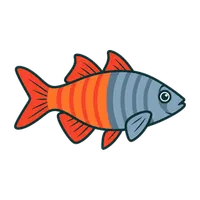
The Boesemani rainbowfish is one of the most recognisable fish in the hobby — a two-tone body that fades from blue-grey at the head to burnt orange at the tail. Almost every one for sale is farm-bred, because the wild fish comes from just a few lakes in Indonesia and is on the IUCN red list.
Here is the honest part most shops will not tell you: the drab little fish in the tank is not broken. SeriouslyFish notes "it’s the much drabber juvenile fish that are almost always offered for sale", and that "full colour development can take over 12 months" even on a good diet. You are buying a promise — and it only pays off if you get the water, the group and the swimming room right first.
💷 Costing it out? See how much a boesemani rainbowfish really costs to keep — the boesemani rainbowfish itself is usually the cheapest part.
Water & tank
Lead with the numbers, because this is a hard-water fish and people get it wrong. SeriouslyFish lists temperature 27–30 °C (81–86 °F) and calls it "strictly a tropical species", pH 7.0–8.0 with the blunt warning that "it will not do well in soft, acidic conditions", and hardness 10–20 dGH. If your tap water is soft and acidic, this is not your fish unless you commit to remineralising every change.
On space, SeriouslyFish sets the minimum at a 120 × 30 × 30 cm tank, about ~108 litres (~29 US gal). Note the base is 120 cm long — rainbowfish need swimming length, not just volume, so a tall, short tank will not do. Give them the runway.
Feeding
Feeding is the easy part. SeriouslyFish describes the diet as "unfussy" — they "will accept most dried, frozen and live foods". The one thing worth doing on purpose: regular feedings of live/frozen foods "will help to ensure the fish exhibit their best colours". A quality dried staple plus rotating frozen or live foods is what turns that drab juvenile into the fish on the box.
Behaviour & tankmates
Temperament-wise these are "very peaceful", but SeriouslyFish flags that they "can disturb smaller or slow-moving fish with its rapid movements and relatively large size" — so pair them with fish that can keep up, not timid nanos. Good company: other similarly-sized rainbowfish, characins, danios, barbs and Corydoras; their hard-water tolerance also lets them share with many Rift Lake cichlids.
Group size is not optional. SeriouslyFish says they "can be quite skittish and do far better when kept in a shoal of at least 6-8, preferably more", and that males "will be encouraged to display their best colours in the company of conspecifics". A lone or paired rainbowfish is a stressed, washed-out rainbowfish — buy the group, and the tank length to hold it.
What to expect
Expect a slow reveal. A well-kept group in hard, warm, well-filtered water will colour up over the first year — SeriouslyFish says full colour "can take over 12 months". Mature males grow larger, deeper-bodied and brighter than females, and display hardest when there are rivals to show off to. If your fish stay pale past a year, look at group size, diet and water hardness before blaming the fish.
Myths, kindly busted
“The washed-out fish at the shop is a dud.”
SeriouslyFish says the drab juveniles are what is almost always sold, and "full colour development can take over 12 months" on a good diet. It is a juvenile, not a defect.
“Rainbowfish are fine in soft, acidic "tropical" water like most community fish.”
The profile is explicit: pH 7.0–8.0, hardness 10–20 dGH, and "it will not do well in soft, acidic conditions". This is a hard-water fish.
“A couple of rainbowfish is enough.”
SeriouslyFish recommends a shoal of "at least 6-8, preferably more" — skittish in small numbers, and males only colour up among their own kind.
🐟 Did you know? — Boesemani Rainbowfish fun facts
Little true delights about the boesemani rainbowfish — each one checked against a named source, no pet-shop myths.
- Boesemani rainbowfish are found naturally only in the Ayamaru lakes of the remote Vogelkop Peninsula in Indonesian New Guinea. SeriouslyFish
- Despite being a hobby staple, the species is genuinely rare in the wild and listed on the IUCN Red List. SeriouslyFish
When to act
We triage, not diagnose — but these are worth a closer look (starting with a water test):
- Colour never develops and fins stay clamped past the first year — often too small a group, soft/acidic water, or a thin diet; review group size and the hardness reading first.
- A fish hanging alone in a corner, hiding, or off its food — a skittish shoaler kept in too few numbers or too small a tank shows exactly this; check group size and swimming length.
- Rapid breathing, faded colour, or listing after a water change — check the temperature is holding in the 27–30 °C band and that a soft-water change did not crash the hardness; test the water.
Heading to a vet? Print the Boesemani Rainbowfish vet-prep sheet — what to bring, what to tell them, and the questions to ask.
Sources & further reading
- SeriouslyFish — Melanotaenia boesemani (Boeseman’s Rainbowfish) — Max ~110 mm SL; minimum 120 × 30 × 30 cm (~108 L / ~29 US gal); temperature 27–30 °C / 81–86 °F ("strictly tropical"); pH 7.0–8.0 ("will not do well in soft, acidic conditions"); hardness 10–20 dGH; very peaceful but fast; skittish — keep 6–8+; juveniles drab, full colour "can take over 12 months".
Written & fact-checked by The Finfern Team against the sources above — kind, general guidance, not a diagnosis. If something looks wrong, test your water and, if it persists, contact a fish-savvy vet.

Get the free Boesemani Rainbowfish Starter Kit
The essentials at a glance, a setup checklist and a first-30-days plan for your boesemani rainbowfish — what to get right and what to watch for. Join the shoal and we’ll send it over. Free sheets and tools always stay open, no gatekeeping.
Water-first tips and new guides the moment they land. No spam — unsubscribe anytime. See how we handle your data in our privacy notice.