
Species · Tetras & rasboras
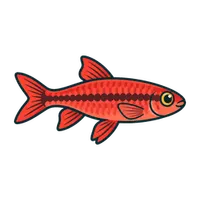
Cherry Barb
Puntius titteya
The peaceful barb — a hardy, adaptable little shoaler whose males glow ruby-red. Keep it in a group and it is one of the easiest, most good-natured beginner community fish there is.
Difficulty: Beginner Tropical community tank ✓ Fact-checked care guide
Quick facts
| Adult size | ~5 cm / 2 in SL |
|---|---|
| Minimum tank | ~54 L / 14 US gal — SeriouslyFish recommends a 60 × 30 cm base |
| Temperature | 20–27 °C / 68–81 °F |
| pH | 6.0–8.0 (farm-raised stock is adaptable) |
| Hardness | 2–20 dGH (wild fish do best towards the lower end) |
| Filtration & flow | Cycled tank; appreciates gentle-to-moderate flow, not a torrent |
| Diet | Omnivore forager — quality dried food plus small live/frozen (Daphnia, Artemia, bloodworm) for colour |
| Social | Shoaling — keep a group (a common guide is 6+); males colour up in company |
| Temperament | Peaceful — the calm exception among barbs |
| Lifespan | Commonly cited at ~4–6 years in the hobby (not stated by the primary source) |
Overview
The cherry barb (Puntius titteya) is the barb for people who have heard barbs are fin-nippers. Endemic to the shaded rainforest streams of southwestern Sri Lanka, it is a small, slender, good-natured fish whose males flush a deep ruby-red, especially when displaying to one another.
It is hardy, adaptable and easy — an excellent beginner community fish — with the usual shoaling caveat: it is happier, bolder and far more colourful kept in a group than as one or two nervous individuals.
💷 Costing it out? See how much a cherry barb really costs to keep — the cherry barb itself is usually the cheapest part.
Water & tank
The farm-raised fish in shops are unfussy on chemistry — pH 6.0–8.0 and 2–20 dGH suit them — at 20–27 °C / 68–81 °F (wild stock prefers slightly acidic, soft, cooler water). Cycle the tank first, as always.
It shows its best colour in a heavily-planted tank with a dark substrate, some floating plants, driftwood and leaf litter. Give it a 60 × 30 cm base (~54 L / 14 US gal) or more; filtration need not be strong but a little water movement is appreciated.
Feeding
An easy-going omnivore forager. In the wild it picks at diatoms, algae, detritus, small insects, worms and crustaceans; in the tank it takes quality dried food readily.
For the best red colour and condition, add small live and frozen foods — Daphnia, Artemia and bloodworm — alongside the staple.
Behaviour & tankmates
A genuinely peaceful community fish — safe with other calm tankmates and, unlike many barbs, not a habitual fin-nipper. It mixes well with small tetras, rasboras, corys, gouramis and similar.
Keep it as a group (6 or more is a common guide): shoaling brings out its confidence and its colour, and males display their best red competing with one another rather than harassing tankmates.
What to expect
Newly-added fish are often pale and shy for the first week or two — this is normal; colour and confidence build as the group settles into a planted, stable tank. Males intensify to ruby-red as they mature.
Myths, kindly busted
“Barbs are all fin-nippers, so cherry barbs will harass my other fish.”
The cherry barb is the peaceful exception — kept in a proper group it is a calm, well-behaved community fish.
“A single cherry barb or a pair is fine.”
It is a shoaling fish; kept in ones or twos it is nervous and washed-out. A group is bolder, healthier and far more colourful.
“The pale fish in the shop tank is unhealthy.”
Cherry barbs routinely lose colour when stressed, shipped, or under bright bare-tank lighting; a settled fish in a planted tank colours up.
🐟 Did you know? — Cherry Barb fun facts
Little true delights about the cherry barb — each one checked against a named source, no pet-shop myths.
- The cherry barb is endemic to Sri Lanka and listed as Vulnerable on the IUCN Red List, threatened by habitat loss and past over-collection. Wikipedia
- Its natural streams flow through Sri Lanka's rainforest “wet zone”, which receives 2,000–3,000 mm of rain a year in the south-west monsoons. SeriouslyFish
- The brightest wild cherry barbs are reportedly becoming scarcer, as selective collection for the trade may have altered wild populations. SeriouslyFish
When to act
We triage, not diagnose — but these are worth a closer look (starting with a water test):
- A fish that stays pale, clamped and hiding once the group is settled — check water parameters and stress sources.
- Rapid gilling, gasping at the surface, or sitting on the bottom — test the water for ammonia/nitrite and oxygen.
- White spots, ragged fins, or reddened patches — signs of a water or health problem; review conditions and, if it persists, seek fish-savvy advice.
Heading to a vet? Print the Cherry Barb vet-prep sheet — what to bring, what to tell them, and the questions to ask.
Sources & further reading
- SeriouslyFish — Puntius titteya (Cherry Barb) — Adult ~50 mm SL; recommended 60 × 30 cm base (~54 L / 14 US gal); temperature 20–27 °C / 68–81 °F; pH 6.0–8.0 (farm-raised adaptable); hardness 2–20 dGH; peaceful shoaling community fish; omnivore forager (diatoms, algae, detritus, small invertebrates).
Written & fact-checked by The Finfern Team against the sources above — kind, general guidance, not a diagnosis. If something looks wrong, test your water and, if it persists, contact a fish-savvy vet.

Get the free Cherry Barb Starter Kit
The essentials at a glance, a setup checklist and a first-30-days plan for your cherry barb — what to get right and what to watch for. Join the shoal and we’ll send it over. Free sheets and tools always stay open, no gatekeeping.
Water-first tips and new guides the moment they land. No spam — unsubscribe anytime. See how we handle your data in our privacy notice.