
Species · Tetras & rasboras
Chili Rasbora
Boraras brigittae
One of the smallest, most intensely red nano fish — stunning in a shoal, but too tiny and timid for a rough-and-tumble community; it wants a mature, gently-filtered, well-planted nano tank.
Difficulty: Intermediate Tropical community tank ✓ Fact-checked care guide
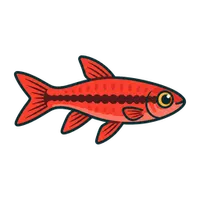
Quick facts
| Adult size | ~2 cm / 0.8 in SL |
|---|---|
| Minimum tank | ~41 L / ~11 US gal for a shoal — SeriouslyFish suggests a base of at least 45 × 30 cm |
| Temperature | 20–28 °C / 68–82 °F |
| pH | 4.0–7.0 (soft, acidic-to-neutral) |
| Hardness | 1–10 dGH (soft) |
| Filtration & flow | Gentle filtration and low flow; a mature, densely-planted, dimly-lit tank |
| Diet | Micropredator — small live/frozen foods plus suitably tiny dried foods |
| Social | Shoaling — keep a group (8–10+ shows the best colour and behaviour) |
| Temperament | Very peaceful but timid — a poor competitor |
| Lifespan | Commonly cited at ~4–8 years in the hobby (not stated by the primary source) |
Overview
The chili rasbora (Boraras brigittae) — also sold as the mosquito rasbora — is one of the smallest fish in the hobby at barely 2 cm, and one of the most striking: a shoal of glowing red slivers over green plants is a nano-tank showpiece.
It comes from black-water peat-swamp streams in southwestern Borneo, so it is built for soft, acidic, dimly-lit, gently-flowing water — and it is sensitive to a tank that is not yet mature and stable.
💷 Costing it out? See how much a chili rasbora really costs to keep — the chili rasbora itself is usually the cheapest part.
Water & tank
Chili rasboras want soft, acidic-to-neutral water: pH 4.0–7.0, 1–10 dGH, over a broad 20–28 °C / 68–82 °F temperature range. Above all, do not add them to a biologically immature aquarium — they are susceptible to swings in water chemistry, so a mature, cycled, stable tank is essential.
Recreate the black-water swamp: a densely-planted tank with floating plants and driftwood to diffuse the light, ideally over a soft sandy substrate with some leaf litter (which stains the water tea-brown and seeds tiny food organisms). Keep the flow gentle — this fish comes from sluggish water and struggles in a strong current. A base of at least 45 × 30 cm (~41 L) gives a shoal room to swim.
Feeding
In the wild the chili rasbora is a micropredator, picking off tiny insects, worms, crustaceans and zooplankton. Its mouth is minuscule, so food must be small: daily meals of small live and frozen fare (daphnia, baby brine shrimp) plus good-quality flakes and granules of a suitably tiny size.
Do not feed dried food exclusively — a varied diet of small live/frozen foods brings out the best colour and breeding condition.
Behaviour & tankmates
The chili rasbora is very peaceful but, because of its tiny size and timid nature, it does NOT make an ideal general community fish — it is easily out-competed for food and stressed by boisterous tankmates. It is best kept alone as a species tank or with other diminutive, gentle nano species.
Keep a decent-sized shoal; a bigger group means bolder fish and better colour, and dominant males form temporary spawning territories that a group absorbs harmlessly.
What to expect
Newly-added chili rasboras are often pale and shy for the first week or two — colour deepens as they settle into a mature, planted tank and feel secure in a shoal. Persistent paleness, hiding or wasting usually means the tank is too new, too bright, too fast-flowing, or the food is too big.
Myths, kindly busted
“Chili rasboras are an easy beginner community fish.”
They are tiny, timid poor-competitors that need a mature, stable, gently-run nano tank — not a busy general community, and not a brand-new tank.
“They are too small to need much food, and flakes are enough.”
They are micropredators with tiny mouths that need small live/frozen foods for colour and condition; a dried-food-only diet is not adequate.
“Their washed-out colour in the shop is how they look.”
Shop and newly-added fish are often pale from stress; in a settled, planted, well-fed shoal they colour up to intense red.
🐟 Did you know? — Chili Rasbora fun facts
Little true delights about the chili rasbora — each one checked against a named source, no pet-shop myths.
- The tiny chili rasbora tops out around 20 mm and comes from black-water peat-swamp streams where the water can be as acidic as pH 4.0. SeriouslyFish
- Its genus name Boraras is an anagram of Rasbora, coined to reflect the reversed ratio of abdominal to caudal vertebrae in these nano fish. SeriouslyFish
- The species name brigittae honours the wife of describer E. Vogt, who named it in 1978. SeriouslyFish
When to act
We triage, not diagnose — but these are worth a closer look (starting with a water test):
- Persistent pale colour, hiding or wasting weeks after settling in — check the tank is mature and stable, the flow gentle, and the food small enough.
- Fish being out-competed and thin while bigger tankmates thrive — the tankmates are too large/boisterous; move the rasboras to a species or nano tank.
- Rapid breathing or fish hanging at the surface — test the water; Boraras are sensitive to chemistry swings and immature tanks.
Heading to a vet? Print the Chili Rasbora vet-prep sheet — what to bring, what to tell them, and the questions to ask.
Sources & further reading
- SeriouslyFish — Boraras brigittae (Mosquito/Chili Rasbora) — Adult ~20 mm SL; recommended base of at least 45 × 30 cm (~41 L / ~11 US gal) for a shoal; temperature 20–28 °C / 68–82 °F; pH 4.0–7.0; hardness 1–10 dGH (soft); very peaceful but timid micropredator — needs a mature tank, gentle flow, and small foods; best in a species/nano tank.
Written & fact-checked by The Finfern Team against the sources above — kind, general guidance, not a diagnosis. If something looks wrong, test your water and, if it persists, contact a fish-savvy vet.

Get the free Chili Rasbora Starter Kit
The essentials at a glance, a setup checklist and a first-30-days plan for your chili rasbora — what to get right and what to watch for. Join the shoal and we’ll send it over. Free sheets and tools always stay open, no gatekeeping.
Water-first tips and new guides the moment they land. No spam — unsubscribe anytime. See how we handle your data in our privacy notice.