
Species · Loaches
Clown Loach
Chromobotia macracanthus
Sold as a cute juvenile, but it reaches ~40 cm, lives 20+ years and must be kept in a shoal — a huge-tank, decades-long commitment the hobby routinely mis-sells.
Difficulty: Advanced Tropical community tank ✓ Fact-checked care guide
Quick facts
| Adult size | ~400 mm / 16 in SL |
|---|---|
| Minimum tank | Base of 180 × 60 cm (~648 L / ~171 US gal) is the absolute minimum for a group, per SeriouslyFish |
| Temperature | 24–30 °C / 75–86 °F |
| pH | 5.0–7.0 |
| Hardness | 1–12 dGH |
| Filtration & flow | Strong filtration and spotless water; a tight-fitting lid (it jumps); smooth substrate |
| Diet | Chiefly carnivorous — quality dried foods, live/frozen bloodworm, Tubifex, plus fresh vegetables |
| Social | Intensely social — keep in groups of at least 5–6, preferably 10 or more |
| Temperament | Not especially aggressive, but big, active, and unsuitable with much smaller fish |
| Lifespan | In excess of 20 years if properly cared for (stated by SeriouslyFish) |
Overview
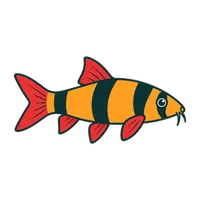
The clown loach (Chromobotia macracanthus) is one of the hobby’s great mismatches between how it is sold and what it needs. Bright orange with bold black bands, it is usually offered as a 5–8 cm juvenile — but SeriouslyFish records a maximum standard length of 400 mm (16 in) and calls it "arguably one of the most misunderstood in the hobby since it’s wholly unsuitable for smaller aquaria despite its ubiquitous availability".
It is also a long-term commitment in the most literal sense: SeriouslyFish states that, if properly cared for, "typical life span is in excess of twenty years". This is a decades-long, big-tank, group-living fish — plan for the adult, not the shop juvenile.
💷 Costing it out? See how much a clown loach really costs to keep — the clown loach itself is usually the cheapest part.
Water & tank
Get the water right first. SeriouslyFish gives temperature 24–30 °C (75–86 °F), pH 5.0–7.0 and hardness 1–12 dGH — soft, warm, slightly acidic to neutral water. These loaches "require spotless water in order to thrive", so they should never go into an immature tank; routine 30–50% weekly water changes are the norm.
On space, the numbers are unforgiving. SeriouslyFish lists a base of 180 × 60 cm (~648 L / ~171 US gal) as "the absolute minimum required to house a group". A tight-fitting lid is essential — the profile flags that "this species is known to jump" — and a smooth substrate protects the barbels.
Feeding
SeriouslyFish describes the clown loach as "chiefly carnivorous", though it eats plant matter too. Offer a varied menu: quality dried foods, live or frozen bloodworm, Tubifex and Artemia, plus fresh vegetables such as cucumber, melon, blanched spinach or courgette. One honest caveat from the source: although clown loaches eat snails, they are "not an obligate molluscivore" and "should never be considered the answer to an infestation".
Behaviour & tankmates
Clown loaches are "not especially aggressive", but two things drive their care. First, they get big and active, so SeriouslyFish warns against keeping them with much smaller fish that "may be intimidated by its size", and against slow-moving, long-finned species whose "trailing fins can be nipped". Better company is peaceful open-water cyprinids and, in large tanks, other robust fish and bottom-dwellers.
Second — and this is non-negotiable — they are intensely social. SeriouslyFish says the clown loach "is gregarious, forms complex social hierarchies and should be maintained in groups of at least 5 or 6 specimens, preferably 10 or more". Kept singly it "can become withdrawn or aggressive". A group is not optional decoration; it is a welfare requirement.
What to expect
Expect slow growth but a genuinely large, long-lived fish, and expect quirks: "greying out" during dominance displays, clicking sounds, and resting at odd angles wedged in décor — all normal, per SeriouslyFish. Handle with care: they have sharp, erectable sub-ocular spines that can catch in nets and even break skin. This is a fish for keepers who can commit a very large tank for 20+ years.
Myths, kindly busted
“Clown loaches stay small — they’re fine in a community tank.”
SeriouslyFish records a max of 400 mm (16 in) and calls the species "wholly unsuitable for smaller aquaria", listing a ~648 L (180 × 60 cm) tank as the absolute minimum for a group.
“One clown loach is fine on its own.”
The profile says they should be kept in "groups of at least 5 or 6 specimens, preferably 10 or more"; kept singly they "can become withdrawn or aggressive".
“Get a clown loach to clear a snail infestation.”
SeriouslyFish says it "should never be considered the answer to an infestation since it is not an obligate molluscivore".
🐟 Did you know? — Clown Loach fun facts
Little true delights about the clown loach — each one checked against a named source, no pet-shop myths.
- Clown loaches produce audible clicking sounds that grow louder when the fish are excited, thought to come from grinding their throat teeth. SeriouslyFish
- It has sharp, motile sub-ocular spines hidden in skin pouches that erect when the fish is stressed — and can even break human skin. SeriouslyFish
- Properly cared for, clown loaches can live over twenty years, and wild spawning fish measure a hefty 12–20 cm. SeriouslyFish
When to act
We triage, not diagnose — but these are worth a closer look (starting with a water test):
- Visible, ongoing weight loss or a pinched, hollow belly ("skinny disease") — SeriouslyFish flags this as common in newly imported fish; review diet and water quality and seek qualified advice.
- A loach that stays hidden, stops eating, or is being harassed — often a sign the group is too small or a tankmate is unsuitable; reassess numbers and companions.
- Clamped fins, spots, laboured breathing, or "greying" that does not recover after a dominance display — general early warning signs; check and correct water quality first, then consult a knowledgeable source.
Heading to a vet? Print the Clown Loach vet-prep sheet — what to bring, what to tell them, and the questions to ask.
Sources & further reading
- SeriouslyFish — Chromobotia macracanthus (Clown Loach) — Max ~400 mm SL; absolute minimum base 180 × 60 cm (~648 L / ~171 US gal) for a group; temperature 24–30 °C / 75–86 °F; pH 5.0–7.0; hardness 1–12 dGH; life span "in excess of twenty years"; gregarious, keep 5–6+ (preferably 10+); jumps (needs a lid); not a snail-control fish.
Written & fact-checked by The Finfern Team against the sources above — kind, general guidance, not a diagnosis. If something looks wrong, test your water and, if it persists, contact a fish-savvy vet.

Get the free Clown Loach Starter Kit
The essentials at a glance, a setup checklist and a first-30-days plan for your clown loach — what to get right and what to watch for. Join the shoal and we’ll send it over. Free sheets and tools always stay open, no gatekeeping.
Water-first tips and new guides the moment they land. No spam — unsubscribe anytime. See how we handle your data in our privacy notice.