
Species · Catfish & bottom-dwellers
Common Pleco
Pterygoplichthys pardalis
Sold as a 3-inch "cleaner", it grows into a nearly 2-foot, high-waste giant that is almost impossible to rehome — for most tanks the honest answer is a bristlenose instead.
Difficulty: Intermediate Tropical community tank ✓ Fact-checked care guide
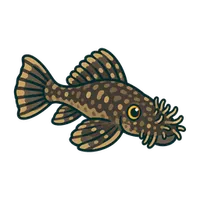
Quick facts
| Adult size | Grows to nearly 2 ft / ~60 cm (Aquarium Co-Op) |
|---|---|
| Minimum tank | Aquarium Co-Op: start at 75 US gal, moving up to 180 or even 500 US gal for an adult |
| Temperature | ~23–27 °C / 74–80 °F (Aquarium Co-Op, plecos generally) |
| pH | 6.5–7.8 (Aquarium Co-Op, plecos generally) |
| Hardness | Not stated by the source |
| Filtration & flow | Heavy filtration and a big water-change routine sized to a giant catfish; hides/cover |
| Diet | Not a cleaner — must be fed a regular diet of quality foods (plus algae/vegetables and gel foods) |
| Social | Kept singly; a large, high-waste catfish, not a community cleanup crew |
| Temperament | Peaceful, nocturnal — but its adult size and waste load are the real problem |
| Lifespan | Commonly cited at ~10–15+ years in the hobby (not stated by the source) |
Overview
The "common pleco" is the fish the hobby most consistently sells to the wrong people. It arrives as a cute 3-inch algae-eater and, per Aquarium Co-Op, "eventually grows up to be a nearly 2-foot beast with a surprisingly large appetite (and matching waste load)". Whether the fish in the bag is Hypostomus plecostomus or the Amazon sailfin Pterygoplichthys pardalis, the buyer usually cannot tell them apart and the outcome is the same: an enormous, high-waste catfish.
Plecostomus is the common name for the Loricariidae — armored suckermouth catfish from Central and South America. They are genuinely hardy and long-lived, which is exactly the problem: the mistake of buying one for a small tank does not go away, it grows for years.
💷 Costing it out? See how much a common pleco really costs to keep — the common pleco itself is usually the cheapest part.
Water & tank
Water-wise these fish are undemanding: Aquarium Co-Op lists plecos generally at 74–80 °F (23–27 °C) and a broad pH of 6.5–7.8 (they do not state a hardness figure). The chemistry is the easy part.
Size is the hard part, and it is non-negotiable. The guide’s own recommendation is blunt: "The common pleco should probably start in a 75-gallon tank and eventually move up to 180 or even 500 gallons." It then says plainly that "these enormous aquariums are not feasible for the average fish keeper, which is why we strongly recommend the smaller species." If you cannot house a nearly 2-foot fish for its whole life, this is not your fish.
Feeding
Do not treat it as a cleanup crew. "Although plecos are known as cleaner fish, scavengers, and algae eaters, they must be fed a regular diet consisting of high-quality fish foods," including variety such as frozen bloodworms and Repashy gel food. A big pleco has a big appetite and a matching waste load, so feeding it properly also means a filter and water-change routine sized for that output.
Behaviour & tankmates
Most plecos are nocturnal and "greatly appreciate any hides or cover you provide to keep them out of the light", so a cave or driftwood is essential. The real cautions from Aquarium Co-Op are about commitment and ethics, not aggression: "We strongly advise against getting monster fish unless you are prepared to keep them for their entire lives because they are nearly impossible to rehome," and "Do not release your common pleco into the wild because they are a highly invasive species."
If you want the pleco look at a sane size, the guide points to bristlenose, rubber lip, and clown plecos, which "stay between 4 to 6 inches" and "can be housed in 20 to 29 gallons of water or more". For most keepers, that is the honest answer.
What to expect
Expect a hardy, decades-capable fish that will outgrow almost every tank it is sold for. In a large enough system it is an impressive, peaceful giant; in a standard community tank it becomes a waste-producing problem that is nearly impossible to rehome and dangerous to release. The single most important decision happens at the shop: buy the fish that fits your tank (a bristlenose), not the one that will fit your tank for six months.
Myths, kindly busted
“A common pleco will keep my small tank clean.”
Aquarium Co-Op says plecos "must be fed a regular diet of high-quality fish foods" — they are not a cleanup crew, and this one grows to nearly 2 feet.
“It only gets as big as the tank you keep it in.”
The guide describes a 3-inch baby growing into a nearly 2-foot beast and recommends starting at 75 gallons, moving to 180–500 — stunting it in a small tank is harm, not a size cap.
“If it gets too big I’ll just rehome it or let it go.”
The guide warns big plecos are "nearly impossible to rehome" and must never be released — they are "a highly invasive species".
🐟 Did you know? — Common Pleco fun facts
Little true delights about the common pleco — each one checked against a named source, no pet-shop myths.
- The Amazon sailfin catfish can reach nearly 58 cm (about 23 inches) long, far bigger than most home tanks can hold. FishBase
- It is a facultative air-breather, able to gulp atmospheric air to survive in low-oxygen water. FishBase
- A native of the Amazon basin, this catfish has been introduced to warm rivers well outside its natural range. FishBase
When to act
We triage, not diagnose — but these are worth a closer look (starting with a water test):
- A rapidly growing pleco in a tank under ~75 gallons — a housing emergency in slow motion; plan the upgrade or the right species before it is a crisis.
- Cloudy water, nitrate spikes, or a struggling filter after adding a pleco — the "matching waste load" outpacing your maintenance; increase filtration and water changes.
- A pleco constantly out in the open, refusing hides, or scraping/gasping — check for lack of cover and test water quality; get a diagnosis before treating.
Heading to a vet? Print the Common Pleco vet-prep sheet — what to bring, what to tell them, and the questions to ask.
Sources & further reading
- Aquarium Co-Op — Pleco Care Guide — Common pleco: 3-inch baby grows to "a nearly 2-foot beast"; start at 75 US gal, up to 180–500 US gal; plecos generally 74–80 °F / 23–27 °C, pH 6.5–7.8; must be fed (not a cleaner); nocturnal (needs hides); "nearly impossible to rehome", never release (invasive); smaller alternatives (bristlenose/rubber lip/clown) stay 4–6 in for 20–29 US gal. NOTE: SeriouslyFish has no P. pardalis species profile; trade sells H. plecostomus and P. pardalis interchangeably as "common/sailfin pleco".
Written & fact-checked by The Finfern Team against the sources above — kind, general guidance, not a diagnosis. If something looks wrong, test your water and, if it persists, contact a fish-savvy vet.

Get the free Common Pleco Starter Kit
The essentials at a glance, a setup checklist and a first-30-days plan for your common pleco — what to get right and what to watch for. Join the shoal and we’ll send it over. Free sheets and tools always stay open, no gatekeeping.
Water-first tips and new guides the moment they land. No spam — unsubscribe anytime. See how we handle your data in our privacy notice.