
Species · Cichlids
Convict Cichlid
Amatitlania nigrofasciata
Small, bombproof and cheap — but "not a community fish". Convicts are a species-tank cichlid that turn downright violent when breeding.
Difficulty: Beginner–Intermediate Cichlid setup ✓ Fact-checked care guide
Quick facts
| Adult size | ~150 mm / 6 in SL |
|---|---|
| Minimum tank | A 90 × 30 cm base is adequate for a single pair, per SeriouslyFish (no volume stated) |
| Temperature | 24–28 °C / 75–82 °F |
| pH | 6.0–8.0 (alkaline side of neutral is ideal) |
| Hardness | 5–25 dGH |
| Filtration & flow | Robust filtration; rockwork and caves for spawning; expect avid digging |
| Diet | Very unfussy omnivore — accepts most foods; keep the diet varied |
| Social | A single pair in a species tank; a community only in a very big tank of robust Central American cichlids |
| Temperament | Aggressive and territorial — "downright violent when breeding" |
| Lifespan | Commonly cited at ~8–10 years in the hobby (not stated by the primary source) |
Overview
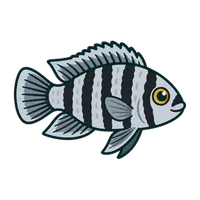
The convict cichlid is small, tough, cheap and almost impossible to kill — which is exactly why it gets so many keepers into trouble. It tops out around 15 cm (6 in), wears bold black-on-grey "convict" bars, and breeds so readily that SeriouslyFish calls it "one of the most easily-bred species in the hobby".
That easy reputation hides the catch. SeriouslyFish is blunt: "not a good community fish. Unfortunately it’s often sold as such." This is a fish you keep because you want cichlid behaviour and breeding, not because you want a peaceful centrepiece for a mixed tank.
💷 Costing it out? See how much a convict cichlid really costs to keep — the convict cichlid itself is usually the cheapest part.
Water & tank
Water is the simple part. SeriouslyFish recommends 24–28 °C (75–82 °F) for long-term care, a pH of 6.0–8.0 ("somewhere on the alkaline side of neutral is ideal"), and hardness of 5–25 dGH — an easy, forgiving range that most tap water hits.
Space is where you plan for behaviour, not just size. The profile gives a base of 90 × 30 cm as "adequate for a single pair" (it declines to state a fixed volume), and warns that multiple pairs or other cichlids mean "something substantially bigger". Aquascape with rocks, bogwood, roots and clay flowerpot caves for spawning sites — and expect plants to be uprooted, because these are avid diggers.
Feeding
Feeding is genuinely easy: "very unfussy and will accept most foods offered". Keep the diet varied for best condition and colour. There is no special requirement here — the difficulty with convicts is never getting them to eat, it is their behaviour.
Behaviour & tankmates
This is the whole reason to read a care sheet before buying. SeriouslyFish: "an aggressive, territorial species that becomes downright violent when breeding. It will take on fish several times its own size and win with ease." It is best kept in a species tank — a single pair, on its own. Only "in a very big tank" can it live in a community, and even then only with "robust Central American cichlids".
Breeding turns the aggression up, not down. A spawning pair will defend a territory against everything, guard as many as 300 eggs, and are "surprisingly aggressive" — they will even attack a hand in the tank. If a pair forms in a shared tank, be ready to move the surplus fish out. The honest summary: this is not a community fish, however it is marketed.
What to expect
Expect a hardy little fish that will breed almost by accident and then defend that brood like it is ten times its size. If you go in wanting to watch genuine cichlid parenting in a dedicated tank, it is an unreserved joy. If you dropped a "cute" pair into a community tank, expect casualties and a fish that reorganises the whole aquarium around itself.
Myths, kindly busted
“Convicts are a great beginner community fish.”
SeriouslyFish: "not a good community fish. Unfortunately it’s often sold as such… best maintained in a species tank." Great for learning cichlids — in their own tank.
“It’s small, so it’s not much of a threat.”
At ~15 cm it "will take on fish several times its own size and win with ease", and is "downright violent when breeding" — even attacking a hand.
“Breeding them is an advanced project.”
It is "one of the most easily-bred species in the hobby" — often as simple as putting a male and female together; the challenge is managing the aggression and the fry, not triggering the spawn.
🐟 Did you know? — Convict Cichlid fun facts
Little true delights about the convict cichlid — each one checked against a named source, no pet-shop myths.
- A famously devoted parent: the female tends up to about 300 eggs while the male patrols the territory, and a pair will even attack an unwary finger. SeriouslyFish
- Its name comes from the Latin for “black-banded” (nigro + fasciatus), a nod to the vertical stripes that also earned it the “convict” nickname. SeriouslyFish
- Pound for pound remarkably tough, a breeding convict will take on fish several times its own size and win with ease. SeriouslyFish
When to act
We triage, not diagnose — but these are worth a closer look (starting with a water test):
- Sudden fin damage, a chased fish hiding in a top corner, or a fish penned away from food usually means territorial aggression — separate before injuries escalate (very likely once a pair starts breeding).
- A normally ravenous convict that stops eating (they are "very unfussy") is an early sign something is wrong — check water parameters first.
- Rapid gilling, listlessness or hanging at the surface points to water quality — test and correct conditions rather than reaching for medication.
Heading to a vet? Print the Convict Cichlid vet-prep sheet — what to bring, what to tell them, and the questions to ask.
Sources & further reading
- SeriouslyFish — Amatitlania nigrofasciata (Convict Cichlid) — Max ~150 mm SL; a 90 × 30 cm base suits a single pair (no volume stated); temperature 24–28 °C / 75–82 °F; pH 6.0–8.0 (alkaline side of neutral); hardness 5–25 dGH; "not a good community fish", aggressive/territorial, "downright violent when breeding", "will take on fish several times its own size"; one of the most easily-bred cichlids.
Written & fact-checked by The Finfern Team against the sources above — kind, general guidance, not a diagnosis. If something looks wrong, test your water and, if it persists, contact a fish-savvy vet.

Get the free Convict Cichlid Starter Kit
The essentials at a glance, a setup checklist and a first-30-days plan for your convict cichlid — what to get right and what to watch for. Join the shoal and we’ll send it over. Free sheets and tools always stay open, no gatekeeping.
Water-first tips and new guides the moment they land. No spam — unsubscribe anytime. See how we handle your data in our privacy notice.