
Species · Cichlids
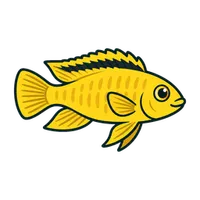
Electric Yellow Lab
Labidochromis caeruleus
The "beginner’s mbuna" — a brilliant-yellow Lake Malawi cichlid that is peaceful only by mbuna standards, and only thrives in hard, alkaline water with the right male-to-female ratio.
Difficulty: Intermediate Cichlid setup ✓ Fact-checked care guide
Quick facts
| Adult size | ~100 mm / 3.9 in SL |
|---|---|
| Minimum tank | ~154 L / ~41 US gal — a 90 × 45 cm base, per SeriouslyFish |
| Temperature | 24–28 °C / 75–82 °F |
| pH | 7.7–8.6 (hard, alkaline Rift Lake water) |
| Hardness | 10–25 dGH |
| Filtration & flow | Strong filtration; rock caves over sand; hard alkaline water is non-negotiable |
| Diet | Largely herbivorous — spirulina/vegetable matter should form a large part of the diet |
| Social | Keep in groups with several females to each male; can mix with other mbuna in an overstocked tank |
| Temperament | Relatively peaceful for a mbuna, but territorial when spawning |
| Lifespan | Commonly cited at ~6–10 years in the hobby (not stated by the primary source) |
Overview
The electric yellow lab is the friendly face of the Malawi mbuna world — a small, brilliant-yellow Rift Lake cichlid that SeriouslyFish calls "the ideal beginner’s mbuna". It stays modest at 10 cm (3.9 in) and, by mbuna standards, is "relatively peaceful", which is why it is one of the most popular Rift Lake cichlids in the hobby.
But "peaceful for a mbuna" is not "peaceful community fish". This is a hard-water Lake Malawi specialist, and getting the water chemistry and the group structure right is what separates a thriving colony from a stressed, scrappy tank.
💷 Costing it out? See how much a electric yellow lab really costs to keep — the electric yellow lab itself is usually the cheapest part.
Water & tank
Get the water right first — and for this fish that means hard and alkaline, not neutral community water. SeriouslyFish lists pH 7.7–8.6, hardness 10–25 dGH, and temperature 24–28 °C (75–82 °F). That high, stable pH and mineral hardness is non-negotiable Rift Lake chemistry; soft, acidic tap water is the wrong home for this fish.
For space, the profile gives a base of 90 × 45 cm (~154 L / ~41 US gal). Aquascape it like the lake: piles of rock built into caves with open water between them, over a sandy substrate. The rockwork is not decoration — it is the territory system that keeps a mbuna group functioning.
Feeding
Diet leans vegetarian. It "will accept most foods offered", but SeriouslyFish is clear that vegetable matter — spirulina flakes, blanched spinach and the like — "should form a large proportion of the diet", supplemented with live and frozen foods. Overloading a mbuna on rich, meaty foods is a classic mistake; keep the greens front and centre.
Behaviour & tankmates
Yellow labs are among the mildest mbuna, but they are still mbuna. They can be kept in groups, but "become territorial when spawning", and males are "quite vigorous in their pursuit of mates" — so SeriouslyFish recommends keeping several females to each male to spread that pressure. That male-to-female ratio is the single most important stocking decision.
For tankmates, think Lake Malawi biotope: peaceful Haps, and it also mixes with hard-water rainbowfish and some Cyprinids, or other mbuna. One honest, counter-intuitive point straight from the source: in a mbuna community "the tank should be overcrowded to reduce aggression and territory formation" — a deliberate mbuna technique paired with strong filtration, not an excuse for careless overstocking. And do not mix colour forms or other Labidochromis species, as they may hybridise.
What to expect
Expect a hardy, glowing-yellow cichlid that rewards correct hard water with strong colour and even some accessible breeding — it is a maternal mouthbrooder, and a female carrying a brood of 5–30 eggs in her mouth is a genuine highlight. Expect real territorial behaviour around spawning, and expect to manage a group (right sex ratio, right rockwork) rather than keep a single "pet" fish.
Myths, kindly busted
“It’s peaceful, so it’s fine in a normal community tank.”
It is "relatively peaceful" only by mbuna standards; it is a hard-water Lake Malawi fish (pH 7.7–8.6, 10–25 dGH) that belongs in a Rift Lake / hard-water setup, not a soft-water community.
“One male with a few random tankmates is fine.”
Males are "quite vigorous in their pursuit of mates" and turn territorial when spawning — SeriouslyFish recommends "several females to each male". The sex ratio is the setup.
“Overcrowding a tank is always bad.”
For a mbuna community SeriouslyFish specifically advises the tank "should be overcrowded to reduce aggression and territory formation" — a deliberate technique for this group of fish, paired with strong filtration.
🐟 Did you know? — Electric Yellow Lab fun facts
Little true delights about the electric yellow lab — each one checked against a named source, no pet-shop myths.
- The electric yellow lab is a cichlid endemic to just the central-western coast of Lake Malawi in East Africa, found nowhere else on Earth. Wikipedia
- It's a maternal mouthbrooder: the female carries the eggs in her mouth, where they hatch and develop for about three weeks. Wikipedia
- The bright yellow aquarium fish is a natural colour morph from Lion's Cove, one of many wild variants of this species. Wikipedia
When to act
We triage, not diagnose — but these are worth a closer look (starting with a water test):
- A yellow lab that is suddenly pale, dark or hiding with clamped fins often means stress from wrong water chemistry (too soft/acidic) or from being bullied — check pH/hardness and the sex ratio.
- Flicking, scratching on rocks or laboured breathing points to water-quality or gill irritation — test and correct rather than medicate blindly.
- A single fish repeatedly chased off food and cornered signals a broken pecking order (often too few females per male) — rebalance the group before it starves or is injured.
Heading to a vet? Print the Electric Yellow Lab vet-prep sheet — what to bring, what to tell them, and the questions to ask.
Sources & further reading
- SeriouslyFish — Labidochromis caeruleus (Electric Yellow / Caeruleus) — Max ~100 mm SL; base 90 × 45 cm (~154 L / ~41 US gal); temperature 24–28 °C / 75–82 °F; pH 7.7–8.6; hardness 10–25 dGH; "ideal beginner’s mbuna" but hard-water Lake Malawi fish; keep several females per male; mbuna communities "should be overcrowded to reduce aggression"; maternal mouthbrooder (5–30 eggs); do not mix colour forms (hybridise).
Written & fact-checked by The Finfern Team against the sources above — kind, general guidance, not a diagnosis. If something looks wrong, test your water and, if it persists, contact a fish-savvy vet.

Get the free Electric Yellow Lab Starter Kit
The essentials at a glance, a setup checklist and a first-30-days plan for your electric yellow lab — what to get right and what to watch for. Join the shoal and we’ll send it over. Free sheets and tools always stay open, no gatekeeping.
Water-first tips and new guides the moment they land. No spam — unsubscribe anytime. See how we handle your data in our privacy notice.