
Species · Tetras & rasboras
Emperor Tetra
Nematobrycon palmeri
If you remember one thing: buy them in a real group of 6+ (ideally 10) for a cycled, gently filtered, planted tank with soft, slightly acidic water, and give them swimming length rather than height.
Difficulty: Beginner–Intermediate Tropical community tank ✓ Fact-checked care guide
Quick facts
| Adult size | About 4.2 cm / 1.7 in standard length (body only, the figure SeriouslyFish uses). With the male's trailing dorsal, anal and central tail-fin rays the total length runs roughly 4-5 cm, and hobby guides often quote up to around 7.6 cm / 3 in tip-to-tail. In practice, plan for a slim ~4-5 cm fish. |
|---|---|
| Minimum tank | Keeper-facing minimum for a small single-species shoal is about 76 L / 20 US gal, on a footprint of at least ~90 x 30 cm (36 x 12 in) as SeriouslyFish specify. Bigger-is-better reality: for a full group of 6-10 in a mixed community, aim for 110 L / 30 US gal or more. Swimming length matters more than raw volume, so a "long" tank beats a "tall" one of the same litres. |
| Temperature | 23-27 C (73-81 F); the mid-70s F, roughly 24-26 C, is the sweet spot. This is a heated tropical fish and needs a stable, cycled, heated tank. |
| pH | 5.0-7.5 (SeriouslyFish). Most tank-bred fish are happiest and colour up best around pH 6.0-7.0, slightly acidic. A stable value matters more than chasing an exact number. |
| Hardness | Soft to moderately hard: GH 1-12 dGH (SeriouslyFish). They tolerate a range but prefer the softer end. |
| Filtration & flow | Gentle to moderate flow. These are calm-water fish; a gently rated filter (SeriouslyFish suggest roughly 325-405 lph turnover for a tank this size) or a sponge filter is ideal. Avoid a strong current that blows them around the tank. |
| Diet | Omnivorous micropredator. In the wild it hunts tiny invertebrates, so it does best on a varied diet rather than flake alone. |
| Social | Shoaling species: keep a minimum of 6, and ideally 10 or more. In ones or twos they get stressed, drab and nippy. If you want multiple males, a larger group (10+) with several females lets them display and settle a pecking order without picking on one fish. |
| Temperament | Peaceful and lively toward the wider community, but males are mildly territorial with each other and will squabble and flare over status. A single male among a group of females keeps the peace; a good-sized mixed group spreads out any aggression so it rarely turns into real fin-nipping. |
| Lifespan | Around 5-6 years with good water and diet (several care guides cite roughly 6 years as an average); some live a little longer, and many fall short if kept cold, in dirty water, or alone. |
Overview
The Emperor Tetra is a small, hardy, peaceful characin from western Colombia (the San Juan and Atrato river basins), and one of the classic beginner-friendly community tetras.
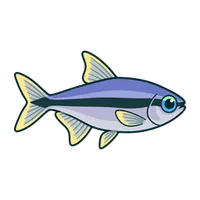
Males are the showstoppers: deeper colour, a blue iris, and long trailing dorsal, anal and central tail-fin rays that give a 'tri-tail' look. Females are a touch smaller, plainer, and have a green iris.
Almost every fish in the trade today is captive-bred, which makes them unfussy about exact water chemistry and diet compared with wild imports. That is what earns them their beginner reputation.
They are an active mid-to-upper water swimmer that looks its best over dark substrate in a planted tank, kept in a proper group so their natural shoaling and gentle sparring behaviour comes out.
💷 Costing it out? See how much a emperor tetra really costs to keep — the emperor tetra itself is usually the cheapest part.
Water & tank
Water first: aim for 23-27 C (73-81 F, mid-70s F is ideal), pH 5.0-7.5 (happiest around 6.0-7.0, slightly acidic), and soft-to-moderate hardness of GH 1-12 dGH. Keep whatever you have STABLE rather than chasing perfect numbers.
This is a tropical fish, so it needs a heater and a thermometer. Do not keep it at unheated room temperature.
Never add them to a tank that is not fully cycled. Run the nitrogen cycle first so ammonia and nitrite read 0 ppm before any fish go in; then keep nitrate low with regular water changes.
Footprint over volume: SeriouslyFish give a minimum base of about 90 x 30 cm (36 x 12 in), roughly 76-81 L / 20-21 US gal, for a small single-species group. For a group of 6-10 in a community, 110 L / 30 US gal or more is much better. A 'long' tank gives more swimming length than a 'tall' one of the same litres.
Use gentle to moderate flow (a sponge filter or a modestly rated filter, around 325-405 lph turnover here) and give them plenty of planting, some driftwood and a darker substrate so they feel secure and show their colours.
Feeding
Feed a good-quality small tropical flake or micro-pellet as the everyday staple.
Supplement regularly with small live or frozen foods such as daphnia, brine shrimp (Artemia) and bloodworm; SeriouslyFish note they show their best colour and condition when they get live/frozen fare rather than dried food alone.
Feed small amounts once or twice a day, only what they finish in a minute or two, to keep water quality up and avoid pollution.
Because they occupy the middle and upper levels, choose foods that stay in the water column long enough for them to grab before it sinks.
Behaviour & tankmates
Excellent peaceful community fish for other calm species of similar size: other tetras, rasboras, danios, Corydoras and other small peaceful catfish, peaceful gouramis, and gentle livebearers.
Keep them in a group of 6+ (ideally 10+). A proper shoal reduces stress and stops them from turning their occasional nippiness on tankmates.
Male-to-male: expect harmless flaring and chasing as they sort out status. Give them room and a big enough group so it stays display, not damage.
Care with very small shrimp and shrimplets, and possibly tiny snails, which an opportunistic tetra may eat; adult shrimp in a well-planted tank are usually fine but not guaranteed.
Avoid large or aggressive tankmates that could eat or bully them, and avoid long-finned slow fish that a bored tetra might nip.
What to expect
Bought in a proper group in a cycled, planted, gently filtered tank, they settle fast and become confident mid-water swimmers within days.
Males will develop richer colour and longer fin trails as they mature and will flare and gently spar with each other; this is normal and looks impressive in a good-sized shoal.
Expect their best colour once the tank is mature, the water is stable and slightly acidic, and they are getting some live or frozen food alongside flake.
They are hardy and forgiving for beginners, but they still reward the basics: stable warm water, a real group, and steady maintenance.
Myths, kindly busted
“Emperor tetras only need a group of 2 or 3, or can live singly.”
They are a shoaling species. The welfare consensus is a minimum of 6 and ideally 10 or more. Understocked fish are stressed, washed-out and more likely to nip.
“A 5-10 gallon nano tank is fine for a shoal of them.”
A single-species group wants about 20 US gal / 76 L on a ~90 cm long footprint, and a mixed community group is better at 30 US gal / 110 L or more. Swimming length matters more than the litre number on the box.
“They are a coldwater or room-temperature fish.”
They are tropical and need a heater, ideally the mid-70s F (about 24-26 C). Kept cold they become sluggish, dull and prone to disease.
“You must have very soft, acidic, blackwater to keep them.”
Because they are almost all captive-bred now, they adapt to a wide range (pH 5.0-7.5, GH 1-12 dGH). Stable, clean, cycled water beats chasing exact blackwater numbers, though soft and slightly acidic shows their best colour.
When to act
We triage, not diagnose — but these are worth a closer look (starting with a water test):
- Fish gasping at the surface, hovering near the filter outflow, or suddenly all hiding: stop feeding and test the water for ammonia, nitrite and nitrate right away. Ammonia or nitrite above 0 means do a water change and check your cycle.
- Colours gone pale and fins clamped, especially in a small group: usually stress from too few fish, wrong temperature, or poor water. Review group size, heater and parameters.
- Persistent hard chasing where one fish is cornered, cannot eat, or shows torn fins: rehome or rebalance the group (add more females, enlarge the shoal, or increase space).
- White salt-like spots, cottony fuzz, rapid breathing, or fish scraping against decor: signs of a possible parasite or infection. Isolate if needed, keep water pristine, and seek advice from an aquatic vet or an experienced fishkeeping resource rather than guessing at medications.
- A sudden death or a fish looking bloated/listless: test water first, then quarantine new arrivals in future. If deaths continue, get help from a knowledgeable source; do not just add more fish.
Heading to a vet? Print the Emperor Tetra vet-prep sheet — what to bring, what to tell them, and the questions to ask.
Sources & further reading
- SeriouslyFish - Nematobrycon palmeri (Emperor Tetra) — Primary authority: 42 mm SL, 90 x 30 cm minimum footprint, 23-27 C, pH 5.0-7.5, GH 1-12 dGH, group of 6 minimum (10+ preferred), diet, sexual dimorphism, gentle filtration.
- Aquariadise - Care Sheet: Emperor Tetra — Vet/expert-style care sheet: ~20 gal / 38 L minimum, 73-81 F / 23-27 C, pH 5.0-7.5, shoal of at least 10, peaceful community temperament, tankmate and shrimp cautions.
- Fish Laboratory - Emperor Tetra Care Guide — Adult size ~4-5 cm (males ~4.5 cm), ~6-year lifespan, 23-27 C, pH 5-7, group 5-8 optimum, varied omnivore diet, peaceful with male dominance sparring.
- Aquarium Source - Emperor Tetra 101 Care Guide — ~6-year lifespan, 20 gal single-species / 30 gal community minimum, 73-81 F, pH 5.0-7.8, KH 3-8, peaceful, single-male recommendation, omnivore feeding.
Written & fact-checked by The Finfern Team against the sources above — kind, general guidance, not a diagnosis. If something looks wrong, test your water and, if it persists, contact a fish-savvy vet.

Get the free Emperor Tetra Starter Kit
The essentials at a glance, a setup checklist and a first-30-days plan for your emperor tetra — what to get right and what to watch for. Join the shoal and we’ll send it over. Free sheets and tools always stay open, no gatekeeping.
Water-first tips and new guides the moment they land. No spam — unsubscribe anytime. See how we handle your data in our privacy notice.