
Species · Cichlids
Firemouth Cichlid
Thorichthys meeki
Its fiery throat is mostly bluff — a 5-inch bluffer that needs a mature tank, real space, and tankmates too big to eat.
Difficulty: Intermediate Cichlid setup ✓ Fact-checked care guide
Quick facts
| Adult size | ~120 mm / 5 in SL |
|---|---|
| Minimum tank | ~108 L / ~29 US gal — a 120 × 30 cm base for a single pair, per SeriouslyFish |
| Temperature | 20–32 °C / 68–90 °F |
| pH | 6.5–8.5 |
| Hardness | 2–15 dGH |
| Filtration & flow | Pristine water in a fully mature tank; sand + rocks/caves for territories |
| Diet | Substrate-sifting omnivore — fine prepared foods plus live/frozen; some vegetable/Spirulina content |
| Social | A pair, or a group of 8+ in a large tank; not a general community fish |
| Temperament | Not especially aggressive — territorial when breeding; may eat much smaller fish |
| Lifespan | Commonly cited at ~8–10 years in the hobby (not stated by the primary source) |
Overview
The Firemouth looks like a firecracker — that glowing red-orange throat — and it bluffs like one. SeriouslyFish is refreshingly blunt: it is "not especially aggressive", but it is "territorial when breeding and may eat much smaller fishes", and its quick-facts flag it as "not a community fish". It stays modest at 120 mm / 5 in SL, which fools people into treating it like a community fish it is not.
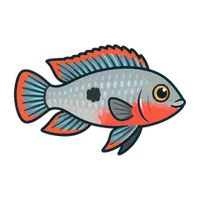
Most of the Firemouth’s famous "aggression" is theatre: it flares that red throat and gill covers to look bigger and win standoffs without fighting. Understand that and it becomes a rewarding, characterful cichlid rather than a bully.
💷 Costing it out? See how much a firemouth cichlid really costs to keep — the firemouth cichlid itself is usually the cheapest part.
Water & tank
Target pH 6.5–8.5, hardness 2–15 dGH, and a wide 20–32 °C (68–90 °F) — an adaptable range, but the non-negotiable is maturity: "water quality is of the utmost importance, and the fish should never be introduced to a biologically immature aquarium". Cycle fully and keep up maintenance before this fish goes in; SeriouslyFish rates it Moderate and marks it "wants a mature tank".
On space, a base of 120 × 30 cm (~108 L / ~29 US gal) is "acceptable for a single pair, but it generally does best in larger aquaria". Give it a sandy substrate with rocks, driftwood and caves so each fish can claim a shady territory.
Feeding
It is a substrate-sifting omnivore ("benthophagous"): offer high-quality fine-grade prepared foods plus live or frozen bloodworm, Tubifex, Artemia and mosquito larvae, and make sure some of the dried food carries vegetable matter such as Spirulina. Watching it take mouthfuls of sand and sift them is normal, natural behaviour.
Behaviour & tankmates
Read the source carefully: "not especially aggressive", but "territorial when breeding and may eat much smaller fishes". It can live with similarly-sized Central American cichlids "provided enough space to allow each species to form an adequate territory", and peaceful upper-water livebearers work as dither fish. The two mistakes are tiny tankmates that fit in its mouth, and too little space, which turns bluffing into real fighting.
There is a nuance worth planning for: unless spawning, "Thorichthys species are quite gregarious and do best when maintained in groups of 8 or more individuals". So a single stressed Firemouth in a mixed tank can behave worse than a proper group in a large tank. Match the stocking to the tank you actually have.
What to expect
A characterful, mostly-bluff cichlid that colours up beautifully, sifts sand, defends a territory hard when breeding, and needs a fully mature tank and enough space. Kept with the right sized tankmates, it is manageable at Moderate difficulty; crammed in with small fish, it earns its "not a community fish" label.
Myths, kindly busted
“The Firemouth is an aggressive cichlid you can’t keep with anything.”
SeriouslyFish says it is "not especially aggressive" — the flaring throat is largely a bluff display; it needs space and correctly-sized tankmates, not isolation.
“It’s small (5 in), so it’s a community fish.”
Its own quick-facts label it "not a community fish"; it is "territorial when breeding and may eat much smaller fishes".
“It’s hardy, so you can add it to a new tank.”
The source insists it "should never be introduced to a biologically immature aquarium" — water quality is "of the utmost importance".
🐟 Did you know? — Firemouth Cichlid fun facts
Little true delights about the firemouth cichlid — each one checked against a named source, no pet-shop myths.
- The firemouth flashes the bright red-to-orange underside of its head — most vivid in adults — giving the species both its name and its dramatic bluff. SeriouslyFish
- Its genus Thorichthys comes from the Greek for “to leap” plus “fish”, literally “leaping fish”. SeriouslyFish
- The species honours American ichthyologist Seth Eugene Meek, who compiled the first book on Mexican freshwater fishes. SeriouslyFish
When to act
We triage, not diagnose — but these are worth a closer look (starting with a water test):
- Relentless real chasing or fin damage (not just flaring) — usually too little space or wrong-sized tankmates; reassess territory and stocking.
- A new Firemouth hiding, clamped, off food, or breathing hard shortly after adding — often an immature/unstable tank, which the source warns strongly against.
- Smaller tankmates going missing — likely predation; the source states it "may eat much smaller fishes".
Heading to a vet? Print the Firemouth Cichlid vet-prep sheet — what to bring, what to tell them, and the questions to ask.
Sources & further reading
- SeriouslyFish — Thorichthys meeki (Firemouth Cichlid) — Max ~120 mm SL; base 120 × 30 cm (~108 L / ~29 US gal) for a pair; temperature 20–32 °C / 68–90 °F; pH 6.5–8.5; hardness 2–15 dGH; "not especially aggressive" (the fiery throat is a bluff) but territorial when breeding, "may eat much smaller fishes"; "not a community fish"; needs a mature tank; gregarious in groups of 8+.
Written & fact-checked by The Finfern Team against the sources above — kind, general guidance, not a diagnosis. If something looks wrong, test your water and, if it persists, contact a fish-savvy vet.

Get the free Firemouth Cichlid Starter Kit
The essentials at a glance, a setup checklist and a first-30-days plan for your firemouth cichlid — what to get right and what to watch for. Join the shoal and we’ll send it over. Free sheets and tools always stay open, no gatekeeping.
Water-first tips and new guides the moment they land. No spam — unsubscribe anytime. See how we handle your data in our privacy notice.