
Species · Catfish & bottom-dwellers
Glass Catfish
Kryptopterus vitreolus
If you remember one thing: the glass catfish lives or dies by its group and its water - keep at least 6 (ideally 8-10+) in a mature, cycled, gently-flowing tank, never alone.
Difficulty: Intermediate Tropical community tank ✓ Fact-checked care guide
Quick facts
| Adult size | Around 6.5 cm (2.6 in) standard length, occasionally up to ~8 cm (3.1 in) total. A slim, delicate fish - far smaller than the 15 cm "glass catfish" (K. bicirrhis) it was confused with in the trade for years. |
|---|---|
| Minimum tank | Keeper-facing minimum for a small shoal: about 110-115 L / 30 US gal, with a base footprint of roughly 90 x 30 cm (36 x 12 in). SeriouslyFish lists 90 x 30 cm (~81 L / ~21 gal) as the smallest sensible dimensions; but because they need a real group AND open midwater swimming space, most keepers aim for ~113 L / 30 gal for six and add ~18-20 L (~5 gal) per extra fish. Bigger is genuinely better - swimming LENGTH matters more than raw volume. |
| Temperature | 20-26°C (68-79°F) per SeriouslyFish. In a planted community a stable ~23-25°C (73-77°F) sits comfortably in that range. They react badly to sudden swings, so a reliable heater and stable temperature matter more than hitting an exact number. |
| pH | 4.0-7.0 in the wild (soft, acidic blackwater). In a typical planted community, aim for roughly 6.0-7.5 and, above all, keep it STABLE. |
| Hardness | Soft water: GH about 1-10 dGH (SeriouslyFish). They come from soft, slightly acidic streams, so very hard water is not ideal. (Some care sites quote "8-12 KH" - that is carbonate hardness, a different measurement, and should not be mistaken for GH.) |
| Filtration & flow | Excellent water quality with gentle-to-moderate flow. SeriouslyFish suggests turnover around 4-5x tank volume per hour (e.g. a filter rated ~325-405 lph on an ~81 L tank), but diffuse the outflow - they come from slow-moving streams and strong current stresses them. |
| Diet | Carnivore-leaning omnivore (micro-predator) |
| Social | Shoaling - keep a MINIMUM of 6, and ideally 8-10 or more. This is non-negotiable: SeriouslyFish calls them "highly gregarious," and kept in ones and twos they become reclusive, stop eating, and waste away. A tight, confident shoal is the whole point of this fish. |
| Temperament | Peaceful, timid and gentle. Not aggressive at all, but easily out-competed and stressed by boisterous or much larger tankmates. Prone to hiding, fading colour, and refusing food when unhappy - usually a sign the group is too small or the water is not right. |
| Lifespan | Commonly cited at about 6-8 years with good, stable care; stress, poor water, or too small a group cut it short. (SeriouslyFish gives no figure; the 6-8 year range comes from keeper care guides.) |
Overview
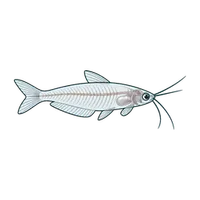
The glass catfish (Kryptopterus vitreolus) is famous for one thing: you can see straight through it. Lacking scales and body pigment, its transparent body shows the spine and a small silvery organ sac, so a shoal drifting midwater looks like living glass.
It is a genuine shoaling, midwater fish - unusual for a catfish, which people expect to skulk on the bottom. Instead it hovers and glides in the middle of the tank in a loose, coordinated group, angled slightly head-up.
Here is the honesty part: it looks like an easy novelty fish and is not. It is timid, sensitive to water quality and sudden change, almost always wild-caught, and utterly dependent on being in a proper group. Get the water and the shoal right and it is peaceful and long-lived; get them wrong and it fades fast.
The name is a mess of mistaken identity. For years the trade sold this fish as Kryptopterus bicirrhis, then as K. minor; it was only described as its own species, K. vitreolus, in 2013. The true K. bicirrhis grows to ~15 cm and is a different, cloudier fish - so old care sheets under those names can be misleading.
💷 Costing it out? See how much a glass catfish really costs to keep — the glass catfish itself is usually the cheapest part.
Water & tank
Water first: this fish is a water-quality specialist dressed up as a novelty. Test for ammonia and nitrite (both must read 0) and keep nitrate low with regular water changes - they do not tolerate a dirty tank. SeriouslyFish is explicit: do NOT add them to a biologically immature aquarium, as they are susceptible to swings in water chemistry. Cycle the tank fully and let it mature before they go in.
Target numbers: temperature 20-26°C (68-79°F), pH soft and stable (wild 4.0-7.0; ~6.0-7.5 is fine in a community), GH ~1-10 dGH (soft). Stability beats precision - avoid sudden shifts in temperature, pH or hardness, which are a classic trigger for stress and sudden losses.
Tank footprint: swimming LENGTH matters more than gallons. Give them a base of at least ~90 x 30 cm (36 x 12 in) - roughly 110-115 L / 30 gal - so a shoal has open midwater room to glide, then scale up for larger groups (about +18-20 L / +5 gal per extra fish).
Flow and filtration: excellent filtration but gentle-to-moderate output. Aim for around 4-5x turnover per hour but spread and soften the current (spray bar, or aim the outflow at the glass) - they are from slow streams and strong flow pins and stresses them.
Aquascape for security: plant the edges and back densely, add floating plants to dim the light (they dislike bright, bare tanks), and leave the middle open for swimming. A confident shoal in a shaded, planted tank spends far more time out in view than a nervous one in a bright empty box.
Two hard rules that are really water/husbandry rules: they must be added to a MATURE cycled tank, and they are highly sensitive to copper - so be very cautious with copper-based medications, which can kill them.
Feeding
Feed small, meaty foods: live or frozen brine shrimp (Artemia), Moina/daphnia, bloodworms, grindal and micro worms, and mosquito larvae are ideal. SeriouslyFish lists Artemia nauplii, Moina and grindal worm as staples.
They will learn to take good-quality dried food (small sinking pellets, micro-granules, quality flake) once settled, but many refuse dry food at first - keep some frozen food on hand while they adjust.
They eat in open water, not off the substrate, and are slow, polite feeders. In a busy community, fast fish (barbs, danios, larger tetras) can strip the food before the catfish get any - target-feed them or feed a portion once the lights dim.
Feed small amounts once or twice a day, only what is eaten in a few minutes. A shoal that hides and refuses food is telling you something is wrong (group too small, flow too strong, or water quality off) - check those before assuming it is just fussy.
Behaviour & tankmates
Ideal for a calm, soft-water community. Peaceful shoalers and small non-boisterous fish are perfect: small tetras (neon, cardinal, rummy-nose, ember), harlequin and other small rasboras, celestial pearl danios, pygmy/dwarf corydoras, otocinclus, kuhli loaches, and peaceful dwarf gouramis.
Because they are timid and slow to feed, avoid anything large, fast, nippy or aggressive: tiger barbs, larger/boisterous barbs and danios, cichlids (including angelfish and oscars), and any big predator that could bully, out-compete or eat them.
They are peaceful themselves but are micro-predators - very small shrimp fry and tiny fry may be eaten. Adult Amano and cherry shrimp are generally fine.
Give them their group first, tankmates second. A well-sized shoal (8-10+) in gentle company will hang confidently in the open midwater; a lone or tiny group hides in the plants and slowly declines no matter how peaceful the tankmates are.
What to expect
A shoal of living glass drifting in the open midwater, angled slightly head-up - one of the most distinctive sights in the hobby when they feel secure.
Shy, watchful behaviour at first; they settle and come out into the open once the group is big enough and the tank is planted and shaded.
A fish that rewards patience and good water, and punishes shortcuts (too few fish, a new tank, strong flow) with hiding, fading, and losses.
Myths, kindly busted
“Glass catfish are a hardy, easy beginner novelty fish.”
They are one of the more demanding community fish: timid, sensitive to water quality and sudden changes, sensitive to copper, and almost always wild-caught. They belong in an established, well-cycled tank with a keeper who tests water - not a brand-new setup.
“You can keep one or two as a curiosity because they're small and peaceful.”
They are highly gregarious shoalers. Kept alone or in twos and threes they become reclusive, stop eating, and fade away. Keep a minimum of 6, ideally 8-10+, or don't keep them at all.
“As catfish, they'll clean the tank and scavenge leftovers off the bottom.”
They are midwater micro-predators, not bottom scavengers. They need to be actively fed small meaty foods in open water - they will not survive on leftovers, and in a busy tank faster fish out-compete them.
“The scientific name is Kryptopterus bicirrhis (or K. minor).”
The fish in the trade is Kryptopterus vitreolus, only described in 2013; it was long mislabelled as those two. True K. bicirrhis grows to ~15 cm and is a different, cloudier fish - so care info under the old names can be wrong on size and needs.
When to act
We triage, not diagnose — but these are worth a closer look (starting with a water test):
- Fish hiding constantly, hanging listlessly, or refusing food: most often the group is too small or the water is off. Test ammonia/nitrite/nitrate and pH, do a water change, and consider whether the shoal needs to be larger.
- A fish looking cloudy or milky, or its transparent body turning opaque/whitish: this can signal stress or illness - test the water first and seek advice; do not medicate blindly.
- Rapid breathing (gilling), gasping at the surface, or the whole shoal darting/clamping fins: check temperature and flow, test for ammonia and nitrite, and check the water hasn't swung suddenly.
- Sudden deaths soon after adding them: usually an immature/uncycled tank or a sharp parameter swing during acclimatisation - drip-acclimate slowly and only add them to a mature tank.
- Be extremely cautious with copper-based medications - glass catfish are especially sensitive to them. If treatment is needed, research a fish-safe approach or ask an aquatic vet or experienced keeper before dosing.
Heading to a vet? Print the Glass Catfish vet-prep sheet — what to bring, what to tell them, and the questions to ask.
Sources & further reading
- SeriouslyFish - Kryptopterus vitreolus — Primary authority: size (65 mm SL), tank base 90 x 30 cm / ~81 L, temperature 20-26°C, pH 4.0-7.0, hardness 1-10 dGH, keep 6+ ('highly gregarious'), diet, ~4-5x turnover filtration, and the warning not to add to an immature tank.
- Aquarium Store Depot - Glass Catfish Care Guide — Lifespan 6-8 years, 30 gal / ~114 L for a school, group of 6+ minimum, tankmate lists, and myth-busting on keeping too few and treating them as passive tank-cleaners.
- Aquariadise - Glass Catfish Care Sheet — Adult ~6.4 cm, 30 gal / ~113 L for a school (+5 gal per extra fish), minimal flow, keep 6+, sensitivity to parameter swings, and the K. vitreolus vs K. bicirrhis distinction.
- Wikipedia - Kryptopterus vitreolus — Endemic to Thailand; up to 8 cm (usually ~6.5 cm); the species actually in the trade (mislabelled as K. bicirrhis until 1989 and K. minor until 2013); generally wild-caught, not commercially bred.
- Fishkeeping World - Glass Catfish Care — Corroborates lifespan 7-8 years, 30 gal minimum, temperature 75-80°F, must be added to a cycled/established tank, and warns a lone fish will likely die of stress.
Written & fact-checked by The Finfern Team against the sources above — kind, general guidance, not a diagnosis. If something looks wrong, test your water and, if it persists, contact a fish-savvy vet.

Get the free Glass Catfish Starter Kit
The essentials at a glance, a setup checklist and a first-30-days plan for your glass catfish — what to get right and what to watch for. Join the shoal and we’ll send it over. Free sheets and tools always stay open, no gatekeeping.
Water-first tips and new guides the moment they land. No spam — unsubscribe anytime. See how we handle your data in our privacy notice.