
Species · Danios & minnows
Glowlight Danio
Danio choprae (syn. Celestichthys choprae)
A tiny hill-stream shoaler that shines in a properly cycled, gently-flowing planted tank with 8-10+ of its own kind and a tight-fitting lid — it prefers stable warmth (~24 °C) but tolerates cool-to-subtropical water down to about 16 °C, hardier in the cool than its reputation suggests.
Difficulty: Beginner Tropical community tank ✓ Fact-checked care guide
Quick facts
| Adult size | About 3 cm (1.2 in) standard length at most; many stay closer to 2.5 cm / 1 in in the aquarium. A true nano fish. |
|---|---|
| Minimum tank | Keeper-facing minimum for a proper shoal is around 60 L (roughly 16 US gal) with a footprint of at least 60 cm (24 in) of swimming length. SeriouslyFish sets the bar at an 80 x 30 cm base (about 72 L / 19 US gal). You will see 38 L / 10 US gal "nano" minimums quoted, but the reality is that swimming length matters more than raw volume for these restless, fast little fish, and bigger is calmer, so treat 60 cm of length as the real floor and go longer if you can. |
| Temperature | SeriouslyFish gives 16-26 °C (61-79 °F). It prefers warmer, stable water — around 23-25 °C (73-77 °F) is ideal, and wild fish were recorded at ~24.8 °C — but it tolerates cool-to-subtropical conditions down to ~16 °C, so a heater is sensible for stability rather than strictly essential. |
| pH | 6.0-7.5 (tolerates up to about 8.0). Stable is more important than chasing a number. |
| Hardness | Soft to moderately hard: roughly 1-12 dGH (most guides land in the 2-12 dGH band). |
| Filtration & flow | Gentle to moderate flow suits their hill-stream origin. They like well-oxygenated water and a little movement, but not a washing-machine current; aim the filter return along the glass or spread it so there are calm zones and a flowing lane. |
| Diet | Omnivore, insectivore-leaning in the wild. Takes most prepared foods; colour and condition improve with small live/frozen items. |
| Social | Shoaling: keep at least 8-10 together (SeriouslyFish is explicit on 8-10+). Groups of 6 are the bare survivable minimum; understocked fish get nervous, dull-coloured and nippy. |
| Temperament | Peaceful and active. Males spar and set up a gentle pecking order, which is normal; a big enough group spreads that energy out so no single fish gets picked on. |
| Lifespan | Typically 3-5 years with good, stable water; occasionally longer. |
Overview
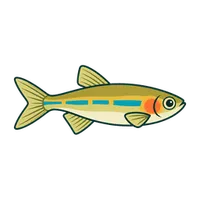
The Glowlight Danio (Danio choprae) is a small, peaceful danionin from clear hill streams in northern Myanmar (the Mogaung Chaung / Irrawaddy system). It only entered the hobby in the early 2000s and quickly became a nano-tank favourite for its neon-gold bars and orange spots.
It is a shoaling fish first and foremost: colour, confidence and natural sparring behaviour only show up when it is kept in a real group with room to swim.
Reputation as an easy, bulletproof 'danio' is only half true. It is hardy once settled, but it is more temperature-particular and slightly more sensitive than the zebra danio it gets shelved next to, so water quality and a sensible group size do the heavy lifting.
💷 Costing it out? See how much a glowlight danio really costs to keep — the glowlight danio itself is usually the cheapest part.
Water & tank
Water first: get the tank fully cycled before any fish go in. You want ammonia 0, nitrite 0, and nitrate kept low with routine water changes. Aim for temperature 16-26 °C (61-79 °F; ~24 °C is ideal, warmer and stable is better), pH 6.0-7.5, and hardness around 1-12 dGH. These fish reward stability far more than any 'perfect' number.
Footprint over volume: give them length to swim. At least 60 cm (24 in) of swimming length is the practical floor; SeriouslyFish's 80 x 30 cm base (~72 L / 19 US gal) is a better target. The 10-gal/38-L 'minimum' you will see online technically fits a small group but cramps a fast, active shoaler, so treat length as the real constraint and size up if you can.
Flow and oxygen: they come from flowing hill streams, so they appreciate gentle-to-moderate current and well-oxygenated water. A standard filter is plenty, but leave calm pockets as well as a flowing lane rather than blasting the whole tank.
Aquascape: a planted tank with fine gravel or sand, some smooth rocks or driftwood, and open water down the middle mimics their habitat and shows off the colour. Planting also gives lower-ranking fish somewhere to duck away from sparring males.
Non-negotiable lid: Glowlight Danios are accomplished jumpers. A tight-fitting cover with no gaps around cords and filters is essential, or you will lose fish over the edge.
Feeding
Feed a good-quality staple (micro pellet or crushed flake sized for a tiny mouth) as the everyday base.
Supplement several times a week with small live or frozen foods, daphnia, baby brine shrimp, cyclops or finely chopped bloodworm, which brings out the best colour.
Little and often beats one big meal: small pinches once or twice a day, only what they clear in a couple of minutes, to avoid leftovers fouling the water.
Include some plant-based/spirulina content in the rotation since they are omnivores, not pure carnivores.
Behaviour & tankmates
Excellent peaceful community fish for similarly sized, gentle tankmates: small tetras, rasboras, pygmy/Corydoras and other small danios, dwarf rasboras and peaceful bottom dwellers all work well.
Best kept as a shoal of 8-10+; in a proper group the males' harmless sparring is spread out and fins stay intact.
Avoid long-finned, slow tankmates (fancy bettas, guppies with trailing fins) because active danios can nip trailing fins; avoid anything big or aggressive enough to eat or bully a 3 cm fish.
Not a safe choice as tankmates for dwarf shrimp shrimplets or tiny fry, which small danios will treat as food; adult shrimp and snails are usually fine.
Give them the mid-to-upper water column; they spend most of their time cruising open water in the middle of the tank.
What to expect
A shimmering, fast-moving shoal that flashes gold and orange along the middle of the tank once it settles in.
Gentle male sparring and a loose pecking order, which is normal and harmless in a big enough group.
A hardy little fish once the water is stable, but one that will let you know quickly (faded colour, nerves) if the group is too small or the water slips.
Myths, kindly busted
“It is a cold-water fish you can keep in an unheated tank like a zebra danio.”
It does come from warmer hill streams and does best at a stable ~23-25 °C, so a heater is sensible. But it is not delicate in the cool either — SeriouslyFish rates it down to 16 °C — so it handles cooler, subtropical rooms better than a strict 'must be tropical' reading suggests. Aim for warm and stable rather than fearing every cool spell.
“A few is enough, they will be fine in a group of three or four.”
This is a shoaling species that really should be in 8-10+. Undersized groups leave them stressed, washed-out and prone to fin-nipping; a full shoal is what makes them relaxed and colourful.
“Any 'danio' is bombproof, so it is a beginner fish you can add to a fresh tank.”
It is hardy once settled but a bit more sensitive than the average danio, and it still needs a fully cycled tank. Adding it to an un-cycled or unstable tank is a common way to lose them.
“It is a nano fish so a tiny cube is plenty.”
Small does not mean sedentary. These are fast, active swimmers that need swimming length (60 cm+ footprint), not just a few litres of water. Length and stable water matter more than a small headline volume.
When to act
We triage, not diagnose — but these are worth a closer look (starting with a water test):
- Fish gasping at the surface, clamped fins, or sudden lethargy: stop feeding and test the water immediately for ammonia, nitrite and nitrate; a spike (usually from an un-cycled or overstocked tank) is the most common cause, so do a water change and re-check.
- Faded colour, hiding, and flicking/darting against decor: often a sign of stress from too-small a group, poor water, or too much flow; check the shoal size, parameters and current before assuming disease.
- Persistent chasing with torn or ragged fins: the group is likely too small or the tank too short; add numbers and swimming length so aggression disperses.
- White spots, cottony patches, or rapid breathing in several fish: treat as a possible outbreak, quarantine if you can and seek advice from a fish-savvy vet or a trusted aquatic source. This is triage, not a diagnosis, get eyes on the fish.
- A missing fish: check the floor and behind the tank; they jump, so confirm your lid has no gaps.
Heading to a vet? Print the Glowlight Danio vet-prep sheet — what to bring, what to tell them, and the questions to ask.
Sources & further reading
- SeriouslyFish - Celestichthys (Danio) choprae species profile — Authority source: 30 mm SL max, 80 x 30 cm base (~72 L), 16-26 C tolerance, pH 6.0-8.0, 1-12 dGH, group of at least 8-10, insectivore-leaning omnivore, jumper, wild water 24.8 C, natural habitat in northern Myanmar.
- Wikipedia - Glowlight danio (Danio choprae) — Cross-check on size (3-4 cm max), Myanmar distribution, described 1928 (Hora), schooling behaviour, diet (insects/larvae), lifespan ~3+ years.
- AquariumStoreDepot - Glowlight Danio Care Guide — Keeper guide: 68-79 F (20-26 C), pH 6.0-7.5, 2-12 dGH, lifespan 3-5 yrs, 24 in / 60 cm minimum length, group 8-10+, jumper/tight lid, avoid bettas and larger/aggressive tankmates, gentle-moderate flow.
- Shrimp and Snail Breeder (AquariumBreeder) - Glowlight Danio Detailed Guide — Cross-check: adult 2.2-2.5 cm, temp ~20-24 C optimal (16-28 C tolerance), pH 6.0-8.0, GH 4-10, lifespan up to 5 yrs, group 6-8+, slow-to-moderate current, unsafe with dwarf shrimp shrimplets, fine with snails.
- en.aqua-fish.net - Glowlight Danio care — Cross-check: mid-water active schooler, gets on with other Danio species except giant danio, diet of insects/larvae/small foods, soft-to-medium water, Myanmar origin.
Written & fact-checked by The Finfern Team against the sources above — kind, general guidance, not a diagnosis. If something looks wrong, test your water and, if it persists, contact a fish-savvy vet.

Get the free Glowlight Danio Starter Kit
The essentials at a glance, a setup checklist and a first-30-days plan for your glowlight danio — what to get right and what to watch for. Join the shoal and we’ll send it over. Free sheets and tools always stay open, no gatekeeping.
Water-first tips and new guides the moment they land. No spam — unsubscribe anytime. See how we handle your data in our privacy notice.