
Species · Tetras & rasboras
Glowlight Tetra
Hemigrammus erythrozonus
One of the genuinely easy beginner tetras — a hardy, peaceful shoaler whose glowing orange stripe reads best in a dim, planted tank with a proper group of six or more.
Difficulty: Beginner Tropical community tank ✓ Fact-checked care guide
Quick facts
| Adult size | ~40 mm / 1.6 in SL |
|---|---|
| Minimum tank | Base of 60 × 38 cm (~68 L / ~18 US gal) for a small group, per SeriouslyFish |
| Temperature | 24–28 °C / 75–82 °F |
| pH | 5.5–7.5 (more colourful in soft, slightly acidic water) |
| Hardness | 2–15 dGH |
| Filtration & flow | Gentle flow; a dim, planted, mature tank shows the best colour |
| Diet | Easy omnivore — small live/frozen foods (bloodworm, Daphnia, brine shrimp) plus dried flakes/granules |
| Social | A shoaling species — always keep at least 6, preferably 10 or more |
| Temperament | Peaceful and lively — one of the best tetras for a general community |
| Lifespan | Commonly cited at ~4–5 years in the hobby (not stated by the primary source) |
Overview
The glowlight tetra (Hemigrammus erythrozonus) is one of the genuinely easy fish — SeriouslyFish calls it "one of the best choices for the newcomer to fishkeeping, being both hardy and inexpensive". Its glowing orange stripe reads best in a dimmed, planted tank; in a bare, bright setup it can "appear a little washed out". Almost every fish sold is commercially bred and adaptable.
It is a small, peaceful shoaler that asks for very little beyond stable water and company of its own kind. Get the tank and the group size right and this is a fish that mostly takes care of itself.
💷 Costing it out? See how much a glowlight tetra really costs to keep — the glowlight tetra itself is usually the cheapest part.
Water & tank
Aim for 24–28 °C (75–82 °F), a pH of 5.5–7.5, and hardness of 2–15 dGH. It will survive in slightly alkaline water but colours up best in soft, slightly acidic conditions — so if your tap water is soft, lean into it rather than fighting it. Get these numbers steady before you worry about anything else.
For space, SeriouslyFish lists a minimum base of 60 × 38 cm (24 × 15 in) and notes a ~68-litre (~18 US gal) tank "could house a small group of these comfortably". That is a real small group, not a single fish in a nano — plan the volume around the shoal.
Feeding
Feeding is easy: it "will readily accept just about anything offered". For the best condition and colour, rotate small live and frozen foods — bloodworm, Daphnia, brine shrimp — alongside good-quality dried flakes and granules. Variety, not quantity, is what brings the colour up.
Behaviour & tankmates
This is "one of the best tetras for the ‘general’ community setup" — lively, colourful and peaceful. SeriouslyFish pairs it happily with livebearers, danios, rasboras, other tetras, and peaceful bottom-dwellers like Corydoras or small loricariids, plus most common gouramis and dwarf cichlids.
The one hard rule is numbers: "Always buy a group of at least 6 of these, preferably 10 or more. It is a shoaling species by nature." Kept in a trio it looks sparse and acts nervy; kept in a proper shoal it relaxes and shines. Obviously skip tankmates big enough to eat it, such as angelfish.
What to expect
Expect a calm, undemanding fish that rewards you for getting the basics right rather than for fancy equipment. In a dim, planted tank with a shoal of ten and soft, acidic water you will see the full glowing stripe; in a bright, empty tank with three fish you will wonder what the fuss was about. It is hardy enough to forgive early mistakes, which is exactly why it is a classic beginner fish.
Myths, kindly busted
“Glowlight tetras are happy in a small group of two or three.”
SeriouslyFish says to always buy at least 6, preferably 10 or more — it is a shoaling species and does noticeably better in numbers.
“They need bright light to show their colour.”
The opposite — the profile recommends fairly dim lighting and a planted tank; they can look washed out in bright, spartan setups.
“They must have acidic water or they will die.”
They tolerate a range of 5.5–7.5 and will survive in slightly alkaline water; acidic conditions just bring out better colour.
🐟 Did you know? — Glowlight Tetra fun facts
Little true delights about the glowlight tetra — each one checked against a named source, no pet-shop myths.
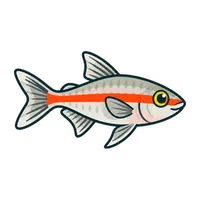
- The glowlight tetra wears a single bright iridescent orange-to-red stripe running the whole length of its silver body, snout to tail. Wikipedia
- The species is known only from the Essequibo river system in Guyana, so every one in the hobby is farm-bred, never wild-caught. SeriouslyFish
When to act
We triage, not diagnose — but these are worth a closer look (starting with a water test):
- Fish clamping fins, hiding, and losing the glow stripe’s colour — often points to unstable water or too small a group; test parameters and check shoal size.
- One fish hanging alone, gasping, or not feeding while the others school — isolate-and-observe and re-check water quality.
- White spots, cottony patches, or rapid breathing across the group — a water-quality/stress signal; recheck temperature stability and get a diagnosis before treating.
Heading to a vet? Print the Glowlight Tetra vet-prep sheet — what to bring, what to tell them, and the questions to ask.
Sources & further reading
- SeriouslyFish — Hemigrammus erythrozonus (Glowlight Tetra) — Max ~40 mm SL; minimum base 60 × 38 cm (~68 L / ~18 US gal); temperature 24–28 °C / 75–82 °F; pH 5.5–7.5 (more colourful when acidic); hardness 2–15 dGH; peaceful community shoaler; always keep 6+, preferably 10+.
Written & fact-checked by The Finfern Team against the sources above — kind, general guidance, not a diagnosis. If something looks wrong, test your water and, if it persists, contact a fish-savvy vet.

Get the free Glowlight Tetra Starter Kit
The essentials at a glance, a setup checklist and a first-30-days plan for your glowlight tetra — what to get right and what to watch for. Join the shoal and we’ll send it over. Free sheets and tools always stay open, no gatekeeping.
Water-first tips and new guides the moment they land. No spam — unsubscribe anytime. See how we handle your data in our privacy notice.