
Species · Catfish & bottom-dwellers
Julii Cory
Corydoras julii (now often Hoplisoma julii)
Almost every "julii cory" in a shop is actually the false julii (Corydoras trilineatus) — but the care is the same: give this peaceful shoaling catfish a group of 6+, a long sand-bottomed cycled tank, and stable soft-to-medium water, and it will thrive.
Difficulty: Beginner Tropical community tank ✓ Fact-checked care guide
Quick facts
| Adult size | Small: about 5.5 cm / 2.2 in standard length (commonly cited as 2-2.5 in / 5-6 cm total). Females grow a little larger and deeper-bodied than males. |
|---|---|
| Minimum tank | Keeper-facing minimum for a starter group of 6 is around 75 litres (20 US gal / ~17 imp gal). SeriouslyFish recommends a tank with a base footprint of at least 90 x 30 cm (36 x 12 in), i.e. roughly 80+ litres (~21 US gal) — and honestly, a "20-long" style tank with more floor space beats a taller 20 gal every time, because these are bottom-foraging fish that use swimming LENGTH, not height. Bigger footprint = bigger, calmer group. |
| Temperature | 20-26 C (68-79 F). They sit on the cooler end for tropical fish, so a heater set around 22-25 C suits them; avoid the high-80s F that some old care sheets list. |
| pH | 5.5-7.5. They are adaptable but happiest in soft, slightly acidic to neutral water; a stable value matters more than chasing a perfect number. |
| Hardness | Soft to moderately hard: about 2-12 dGH (SeriouslyFish). Stability trumps precision — big swings stress them more than a steady "wrong" number. |
| Filtration & flow | Cycled, well-oxygenated filtration with gentle-to-moderate flow. They come from flowing streams so they tolerate a decent current and appreciate oxygen, but they should not be blasted around the tank; aim a spray bar or nozzle to break the flow. A mature filter and clean substrate are more important than raw current. |
| Diet | Omnivore / foraging bottom-feeder. Give sinking foods: quality sinking pellets or wafers, plus frozen/live bloodworm, daphnia, brine shrimp, Tubifex. They are NOT algae eaters and must be fed directly — do not rely on "leftovers" from other fish. |
| Social | Shoaling — keep a group of at least 6 (SeriouslyFish says a minimum of 4-6; Aquarium Co-Op and modern welfare consensus say 6 or more). More is genuinely better: a bigger group is bolder, out in the open more, and far less stressed. Never keep just one or two. |
| Temperament | Peaceful, busy, and completely non-aggressive — a classic community "clean-up looking" bottom dweller that is in fact an active social forager, not a doormat and not a bully. |
| Lifespan | Roughly 5 years with good care, and sometimes longer in stable, cycled water. Short lifespans usually trace back to poor water quality, sharp gravel, or being kept alone. |
Overview
The Julii cory is a small, silvery, spotted armoured catfish from northeastern Brazil, beloved as a peaceful bottom-dweller for planted community tanks.
Here's the honest headline: the true Corydoras julii is only rarely imported. The vast majority of fish sold as 'julii cory' are actually its lookalike cousin, the false julii / three-lined cory (Corydoras trilineatus). Good news — you don't need to panic, because their care is essentially identical.
They are social, gregarious fish that must be kept in a group, and they spend their day sifting fine sand for food with delicate whisker-like barbels.
Like all cories they are facultative air-breathers: seeing one dash to the surface for a gulp of air now and then is completely normal behaviour, not a sign of a problem (though constant surface-gasping by the whole group IS — see red flags).
💷 Costing it out? See how much a julii cory really costs to keep — the julii cory itself is usually the cheapest part.
Water & tank
Water first: get the tank fully cycled BEFORE any cory goes in. That means an established biological filter reading 0 ppm ammonia and 0 ppm nitrite, with nitrate kept low by regular water changes. Cories are sensitive to poor water and to ammonia/nitrite spikes — a new, uncycled tank is the most common way to kill them.
Target parameters (from SeriouslyFish): temperature 20-26 C / 68-79 F, pH 5.5-7.5, hardness 2-12 dGH. They are adaptable, so aim for STABLE values rather than a perfect number — sudden swings are the real danger.
Footprint over volume: these are floor-foragers, so swimming LENGTH matters more than litres. SeriouslyFish recommends a base of at least 90 x 30 cm (36 x 12 in). A group of 6 needs roughly 75+ litres (20+ US gal), and a long, low tank beats a tall one.
Substrate is a welfare issue, not decor: use soft, fine sand (or very smooth rounded gravel kept scrupulously clean). Sharp or dirty gravel wears down and infects their barbels, which they need to find food. Worn-away barbels are a classic sign of the wrong substrate or dirty sand.
Provide gentle-to-moderate, well-oxygenated flow and some cover (plants, wood, shaded spots) so the group feels secure and comes out to forage.
Keep nitrate down with routine partial water changes; matched temperature and dechlorinated water on top-ups keeps this soft-water fish stress-free.
Feeding
Feed sinking foods that reach the bottom: quality sinking pellets/wafers as a staple, rotated with frozen or live bloodworm, daphnia, brine shrimp and Tubifex for condition.
Feed them directly and watch that they actually get their share — fast mid-water fish often snatch food before it lands. Cories can slowly starve in a busy tank if you assume they'll 'clean up'.
They are NOT clean-up crew and NOT algae eaters. Never buy them to 'eat the leftovers' or scrub the tank — that is a myth that leads to malnourished fish.
Feed small amounts once or twice a day; remove uneaten food so it doesn't foul the sand they forage in.
Behaviour & tankmates
Model tankmates: small, peaceful, temperature-compatible community fish — small tetras, rasboras, danios, peaceful dwarf gouramis, honey gouramis, guppies/platies, and other Corydoras species. They also do fine with peaceful shrimp and snails.
Keep them in a same-species group of 6+; while different cory species will loosely mingle, they shoal tightest and behave most naturally with their own kind.
Avoid: large or aggressive fish that see a 5 cm catfish as a snack or a target (big cichlids, aggressive barbs that fin-nip, anything predatory).
Handle with care: their stiffened pectoral-fin spines can lock out and deliver a genuinely painful 'sting', and can tangle in nets. Catch them with a container rather than a fine net where possible.
A well-kept group is a joy to watch — synchronised sand-sifting, 'winking' eye rolls, and playful darts to the surface for air.
What to expect
A tidy, active little catfish that spends most of the day sifting sand at the bottom in a busy group — genuinely fun to watch once settled.
Peaceful with everything its own size; a reliable, beginner-friendly community fish AS LONG AS you keep a real group and feed it properly.
Occasional dashes to the surface for a gulp of air (normal), 'winking' eye movements, and synchronised foraging.
A long-lived pet if you get the basics right: cycled water, fine sand, a group of 6+, and its own sinking food.
Myths, kindly busted
“The fish in the shop labelled 'Corydoras julii' is a true julii cory.”
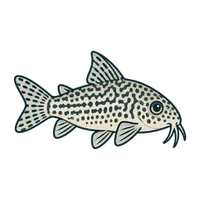
Almost certainly not. True C. julii is rarely imported; most 'julii' on sale are the false julii / three-lined cory, C. trilineatus, which is far easier to collect and breed. True julii have small, separate SPOTS (especially on the head) and a broken mid-body stripe; false julii have those spots joining into wavy LINES / a reticulated (net-like) pattern. It's honestly hard to be 100% sure without collection data — and the good news is the care is the same either way.
“Cory catfish are a clean-up crew that eat algae and leftovers, so you don't need to feed them.”
False. Cories are omnivorous foragers, not algae eaters, and they will slowly starve on scraps. They need their own sinking food every day. 'Buy a cory to clean the tank' is one of the most harmful myths in the hobby.
“One or two cories are fine as a peaceful bottom feeder.”
No — they are shoaling fish and become stressed, shy and short-lived when kept alone or in pairs. Keep a group of at least 6 (more is better); a proper group is bolder, more active, and much healthier.
“Any gravel is fine for the bottom of a cory tank.”
Not really. Sharp or dirty gravel damages and infects the delicate barbels they use to find food. Fine, soft, clean sand (or very smooth rounded gravel kept spotless) is strongly preferred and protects those barbels.
“A cory gasping at the surface means the water is bad.”
Usually not, on its own. Cories are facultative air-breathers and naturally dart up for an occasional gulp of air — that single dash is normal. What IS a warning sign is the WHOLE group hanging at the surface gasping constantly, which points to low oxygen or a water-quality problem to test for.
When to act
We triage, not diagnose — but these are worth a closer look (starting with a water test):
- Whole group constantly gasping at the surface (not just the odd quick gulp of air): test water and check aeration/oxygen and filter flow immediately.
- Ammonia or nitrite reading above 0 ppm, or a sudden pH/temperature swing: do a water change with dechlorinated, temperature-matched water and confirm the tank is actually cycled — this is the top cause of cory deaths.
- Barbels ('whiskers') worn down, stubby or eroded: usually sharp or dirty substrate, or poor water quality — switch to clean fine sand and tighten up maintenance, and seek help if they don't recover.
- Red, inflamed or streaky patches, clamped fins, cotton-wool tufts, or rapid weight loss: signs of disease/infection or malnutrition — improve water quality and diet and consult an aquatic vet or an experienced fishkeeping source. (Triage, not a diagnosis.)
- A fish lying on its side, breathing heavily and not foraging with the group: isolate the cause via water testing first, then get species-appropriate help fast.
Heading to a vet? Print the Julii Cory vet-prep sheet — what to bring, what to tell them, and the questions to ask.
Sources & further reading
- SeriouslyFish — Corydoras julii (Julii Cory) — Primary source for size (55mm SL), tank base 90x30cm / ~81L, temp 20-26C, pH 5.5-7.5, hardness 2-12 dGH, group of at least 4-6, diet, and the C. julii vs C. trilineatus identity note.
- Aquarium Co-Op — Care Guide for Cory Catfish — Group of six or more (same species); 20 gal typical minimum; cories are not algae eaters and must be fed directly; smooth sand/gravel for barbels; julii prefer the cooler end.
- Fishkeeper.co.uk (Maidenhead Aquatics) — Three-lined / False Julii Cory — UK retailer care sheet confirming the false-julii (C. trilineatus) is commonly sold as julii; spot-vs-reticulation ID; social species of 5+; sandy substrate.
- Aquariadise — False Julii Cory vs Julii Cory: How To Tell Them Apart — ID differences (isolated spots + zigzag mid-body stripe vs reticulated pattern), true julii rarely in trade, lifespan 'five years or longer', group 'at least four or five, ideally more', ~20 gal.
- Wikipedia — Hoplisoma julii (formerly Corydoras julii) — Taxonomy/genus move to Hoplisoma, ~5.2 cm size, native range, fine-spotting vs threestripe reticulation, confusion with the false julii.
Written & fact-checked by The Finfern Team against the sources above — kind, general guidance, not a diagnosis. If something looks wrong, test your water and, if it persists, contact a fish-savvy vet.

Get the free Julii Cory Starter Kit
The essentials at a glance, a setup checklist and a first-30-days plan for your julii cory — what to get right and what to watch for. Join the shoal and we’ll send it over. Free sheets and tools always stay open, no gatekeeping.
Water-first tips and new guides the moment they land. No spam — unsubscribe anytime. See how we handle your data in our privacy notice.