
Species · Cichlids
Kribensis
Pelvicachromis pulcher
A colourful, adaptable West African dwarf cichlid and one of the easiest first cichlids — just remember a breeding pair becomes fiercely territorial, so give it caves and space.
Difficulty: Beginner–Intermediate Cichlid setup ✓ Fact-checked care guide
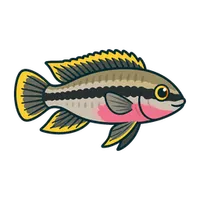
Quick facts
| Adult size | ~10 cm / 3.9 in SL (males larger than females) |
|---|---|
| Minimum tank | ~71 L / ~19 US gal for a single pair — SeriouslyFish suggests a 60 × 37.5 × 30 cm tank |
| Temperature | 24–27 °C / 75–81 °F |
| pH | 5.0–7.5 |
| Hardness | 0–12 dGH |
| Filtration & flow | Cycled, gentle-to-moderate filtration; sand or fine gravel and plenty of caves |
| Diet | Omnivore — a good cichlid pellet as staple, varied with live and frozen foods |
| Social | Best kept as a bonded pair; more than one pair needs a large tank |
| Temperament | Peaceful in a community — but very territorial when breeding |
| Lifespan | Commonly cited at ~5 years in the hobby (not stated by the primary source) |
Overview
The Kribensis (Pelvicachromis pulcher) — "krib" to most keepers — is one of the most popular dwarf cichlids in the hobby, and for good reason: it is colourful, manageable in size, entertaining, and famously easy to breed. It has been a hobby favourite since the 1950s.
Almost every krib sold today is captive-bred, which makes them far more adaptable to tap-water chemistry than wild fish and generally less aggressive when breeding. That combination makes the krib one of the best introductions to both cichlids and fish-breeding.
💷 Costing it out? See how much a kribensis really costs to keep — the kribensis itself is usually the cheapest part.
Water & tank
Kribs are refreshingly unfussy on chemistry: pH 5.0–7.5, 0–12 dGH, and 24–27 °C / 75–81 °F all suit captive-bred stock. As always, cycle the tank fully before they go in.
The décor matters more than the exact numbers. Give them plenty of hiding places and potential spawning sites — clay pots, caves, roots and driftwood — over a sand or fine-gravel substrate they can excavate (they dig pits when breeding). Around 71 L / 19 US gal (a ~60 cm tank) suits a single pair; more pairs need more space so each can hold a territory.
Feeding
Kribs will accept most foods. Use a good-quality cichlid pellet as the staple, and keep the diet varied with regular live and frozen foods (bloodworm, brine shrimp, daphnia) for condition and colour.
Behaviour & tankmates
Outside of breeding, the krib is a shy, retiring, generally peaceful fish that suits a general community tank. Good tankmates include small characins, barbs, danios, rasboras, Corydoras, gouramis and plecos/loricariids. Do not house it with very large or boisterous species that will bully it.
The caveat is breeding: a pair becomes very territorial and defends its cave hard. Keep it as a pair (the reliable way to get a compatible pair is to grow on a group of six young and let them pair off naturally), and give any second pair a big tank so territories do not overlap. During a spawn, keep other bottom-dwellers out — they may predate the eggs/fry, and the pair will harass them.
What to expect
A settled krib pair is confident and colourful, the female flashing a deep purple belly when in spawning condition. Kribs often breed unprompted in a community tank — the first sign is usually a cloud of fry being shepherded around by both parents. Pale colour or constant hiding usually points to bullying or unstable water; test first.
Myths, kindly busted
“Kribensis are aggressive cichlids unsuitable for a community tank.”
Captive-bred kribs are peaceful and shy most of the time and do well in a community — the aggression is specific to a breeding pair defending its cave.
“Just buy a male and a female and you have a breeding pair.”
There is no guarantee a random male and female are compatible, and an unwilling partner can be killed. Grow on a group of six young fish and let a pair form naturally.
“You need special soft, acidic water to keep kribs.”
Wild fish prefer soft water, but captive-bred kribs are adaptable across pH 5.0–7.5 and 0–12 dGH. (Water chemistry does skew the sex ratio of a brood, but it is not needed just to keep them.)
🐟 Did you know? — Kribensis fun facts
Little true delights about the kribensis — each one checked against a named source, no pet-shop myths.
- In kribensis, water chemistry skews the brood's sex ratio: more alkaline water produces mostly males, more acidic water mostly females. SeriouslyFish
- Kribensis form monogamous pairs and spawn inside caves, the female often initiating by dancing and flashing her deep-purple breeding belly. SeriouslyFish
- A West African dwarf cichlid, the kribensis has been a hobby favourite since its introduction back in the 1950s. SeriouslyFish
When to act
We triage, not diagnose — but these are worth a closer look (starting with a water test):
- A fish being relentlessly chased or pinned into a corner — usually a breeding pair defending territory; rehome or add cover/space so the victim can escape.
- Sudden loss of colour, clamped fins or hiding in an otherwise peaceful tank — check water parameters and for bullying before anything else.
- A fish sitting apart, off its food, with reddened or fuzzy patches — test the water and, if it persists, seek fish-savvy advice.
Heading to a vet? Print the Kribensis vet-prep sheet — what to bring, what to tell them, and the questions to ask.
Sources & further reading
- SeriouslyFish — Pelvicachromis pulcher (Kribensis) — Adult ~100 mm SL (males larger); ~71 L / a 60 × 37.5 × 30 cm tank suits a single pair; temperature 24–27 °C / 75–81 °F; pH 5.0–7.5; hardness 0–12 dGH; peaceful dwarf cichlid but very territorial when breeding; keep as a pair.
Written & fact-checked by The Finfern Team against the sources above — kind, general guidance, not a diagnosis. If something looks wrong, test your water and, if it persists, contact a fish-savvy vet.

Get the free Kribensis Starter Kit
The essentials at a glance, a setup checklist and a first-30-days plan for your kribensis — what to get right and what to watch for. Join the shoal and we’ll send it over. Free sheets and tools always stay open, no gatekeeping.
Water-first tips and new guides the moment they land. No spam — unsubscribe anytime. See how we handle your data in our privacy notice.