
Species · Tetras & rasboras
Lemon Tetra
Hyphessobrycon pulchripinnis
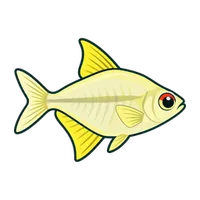
Get the water right and give them a real shoal of 8-10 in a tank with proper swimming length, and the Lemon Tetra glows sunshine-yellow with black-and-lemon fins and a ruby-red eye; skimp on the group and they turn pale, timid, and nippy.
Difficulty: Beginner Tropical community tank ✓ Fact-checked care guide
Quick facts
| Adult size | About 4 cm standard length (SeriouslyFish quotes 40 mm SL), so roughly 4-5 cm / 1.6-2 in once you include the tail. A genuinely small, nano-friendly tetra. |
|---|---|
| Minimum tank | Keeper-facing minimum is around 75 L / 20 US gal, but footprint matters more than the raw number. SeriouslyFish recommends a tank of at least 80 x 30 cm (about 72 L / 19 gal), and roughly 60 cm of swimming LENGTH is the practical floor. Bigger and longer is genuinely better: a low, long tank lets a proper shoal spread out and behave naturally, whereas a tall, short tank of the same volume gives them less room to swim. |
| Temperature | 20-28 C (68-82 F). SeriouslyFish gives the full 20-28 C range; most keepers settle around 23-26 C (73-79 F), which suits a typical peaceful community. |
| pH | 5.0-7.5 (SeriouslyFish). They lean soft and slightly acidic in the wild, but tank-bred stock adapts across this range as long as the value is STABLE. Around neutral (6.5-7.0) is an easy, safe target. |
| Hardness | Soft to moderately hard. SeriouslyFish lists 1-12 dGH; other reputable guides extend to roughly 2-15 dGH. Aim for the soft-to-medium end (about 3-12 dGH) and, above all, keep it steady rather than chasing a perfect number. KH of a few degrees helps hold pH stable. |
| Filtration & flow | Gentle to moderate flow. They come from calm, slow waters, so a gently filtered, well-oxygenated tank suits them. Avoid a strong current that blasts them around; a mature, fully cycled filter matters far more than a powerful one. |
| Diet | Omnivore. Thrives on a varied menu, not just flakes. |
| Social | Shoaling fish: keep a group of at least 8-10 (SeriouslyFish recommends a mixed-sex group of 8-10 specimens). Six is a bare minimum some sources cite, but in small groups they are pale, shy, and more likely to nip; more is better and a bigger shoal both looks and behaves best. |
| Temperament | Peaceful and community-safe. SeriouslyFish calls it very peaceful and an ideal resident of a well-planned community tank. Males form harmless, temporary sparring and dominance displays within the group, which is normal and actually part of the fun to watch. |
| Lifespan | Commonly 4-8 years, with around 6 years typical when water quality and diet are good. Reaching 8+ years is realistic for well-kept fish, so this small tetra is a genuine multi-year commitment. |
Overview
The Lemon Tetra is a small, hardy South American characin (from the Tapajos basin in Brazil) that has been an aquarium staple for decades and is now almost entirely tank-bred.
Its signature look is a translucent lemon-yellow body, an anal fin edged in bold black and bright yellow, and a striking red-to-orange upper half of the eye. That colour is a health and mood gauge, not a fixed paint job.
It is one of the more forgiving, beginner-friendly tetras: peaceful, adaptable to a range of stable water values, and long-lived for its size.
The single biggest thing people get wrong is treating it as a fish you can keep in twos and threes. It is a shoaling species that only truly comes alive, in colour and confidence, in a decent-sized group.
💷 Costing it out? See how much a lemon tetra really costs to keep — the lemon tetra itself is usually the cheapest part.
Water & tank
Water first, always: Lemon Tetras need a fully CYCLED tank before they move in. Cycling grows the bacteria that turn toxic ammonia and nitrite into far-safer nitrate. Target 0 ppm ammonia, 0 ppm nitrite, and low nitrate at all times, kept there with regular partial water changes.
Aim for temperature 20-28 C / 68-82 F (a steady 23-26 C is a comfortable middle), pH 5.0-7.5 (neutral is easy and fine), and soft-to-moderate hardness around 1-15 dGH depending on source, ideally the softer-to-medium end. Stability beats hitting any exact figure.
Footprint over volume: give them a tank of at least about 80 x 30 cm (roughly 72 L / 19 gal per SeriouslyFish), with 60 cm of swimming length as a practical floor. A longer, lower tank beats a tall, short one of the same litres because these are active mid-water swimmers.
Aquascape for confidence: a darker substrate and some planting, shade, or even leaf-litter/tannins make them feel secure and bring out their yellow. On bright, pale gravel under harsh light they look washed-out even when perfectly healthy.
Keep flow gentle to moderate and the tank covered; like many small tetras they can be startled. Do not add them to a brand-new, uncycled setup, and add the whole shoal together rather than a few at a time where you can.
Feeding
Feed a varied omnivore diet: a good-quality micro/small flake or small pellet as the staple, rotated with frozen and live foods.
SeriouslyFish specifically recommends live and frozen bloodworm (chironomid larvae), mosquito larvae, Daphnia and Moina to keep them in top condition and colour.
Feed small amounts once or twice a day, only what they clear in a couple of minutes. Overfeeding fouls the water far faster than these little fish need.
Carotenoid-rich foods (and the frozen/live items above) help support their yellow-and-red colour; a monotonous flake-only diet leaves them duller.
Their small upturned mouths suit small foods taken in mid-water; make sure slower or bottom feeders in the tank still get their share.
Behaviour & tankmates
Peaceful, active, mid-water shoaler. Kept in a proper group of 8-10+, males display and spar harmlessly and the whole shoal is bolder and brighter.
Excellent community fish. SeriouslyFish pairs them well with similarly sized characins (other tetras), hatchetfish, pencilfish, small Corydoras or other small catfish, and non-predatory small-to-medium cichlids.
Great tankmates in practice: other small tetras, harlequin and other rasboras, Corydoras, small peaceful loaches, dwarf cichlids like Apistogramma, and shrimp (adult shrimp are usually fine; tiny shrimplets may be eaten).
Avoid large or aggressive fish that will eat or bully them (big cichlids like oscars/Jack Dempseys, and boisterous fish), and avoid known fin-nippers such as tiger barbs or serpae tetras kept in too-small numbers.
Lemon Tetras are not typical fin-nippers, but understocked groups (under about 6) can turn nippy toward long-finned, slow tankmates. The fix is almost always a bigger shoal, not removing the tetras.
What to expect
Once settled in a good group, expect bright yellow bodies, bold black-and-yellow anal fins, and a vivid red upper eye, with males showing off and gently sparring.
New arrivals are often pale and shy for a few days to a couple of weeks; colour comes up as they cycle-safe water, a real shoal, and a planted, dimmer tank let them relax.
They spend most time in the middle of the tank, actively swimming, and are easy, undemanding feeders.
With good care they will be with you for many years (commonly around 6, sometimes 8+), so plan the tank as a long-term home.
Myths, kindly busted
“A few Lemon Tetras is fine; small fish do not need a big group.”
They are a shoaling species. SeriouslyFish advises a mixed-sex group of at least 8-10. In small numbers they go pale, hide, and are more prone to nipping. A proper shoal is what makes them colourful and confident.
“They must have soft, acidic blackwater or they will not survive.”
Wild fish come from soft, acidic water, but modern stock is tank-bred and adaptable across roughly pH 5-7.5 and a wide hardness range. Stable, clean, cycled water matters far more than chasing a perfect pH.
“A pale or washed-out Lemon Tetra is just its natural colour.”
Fading is usually a message: stress from too-small a group, poor or unstable water, a bright/pale bare tank, a poor diet, or just being newly added. Healthy, settled fish in a good shoal show strong yellow and a bright red upper eye.
“You can drop them straight into a new tank because they are hardy.”
Hardy does not mean immune to ammonia and nitrite. An uncycled tank poisons even tough fish. Cycle first, target 0 ammonia / 0 nitrite / low nitrate, and acclimate them slowly.
When to act
We triage, not diagnose — but these are worth a closer look (starting with a water test):
- Fish looking pale, colourless, or clamped-finned and hiding: check the shoal size first, then test the water (ammonia/nitrite/nitrate) and check temperature. Treat it as a stress signal, not just cosmetics.
- Any detectable ammonia or nitrite, or a sudden pH swing: do an immediate partial water change and confirm the tank is truly cycled; these are the fastest killers of otherwise-hardy fish.
- Gasping at the surface, rapid gill movement, or lethargy: test water and check temperature and oxygenation, do a water change, and seek fish-keeping/vet help if it persists.
- White spots (like grains of salt), cotton-wool tufts, rapid breathing, flicking/scratching on decor, or clamped fins: signs of a possible parasite or infection. Quarantine if you can, review water quality, and consult a vet or a trusted fish-health resource, do not guess at medications.
- One fish suddenly bloated, hollow-bellied and wasting, or with frayed fins: isolate/observe, review water and diet, and get species-appropriate advice rather than self-diagnosing.
Heading to a vet? Print the Lemon Tetra vet-prep sheet — what to bring, what to tell them, and the questions to ask.
Sources & further reading
- SeriouslyFish - Hyphessobrycon pulchripinnis (Lemon Tetra) — Primary authority. Source for 40 mm SL adult size, 80 x 30 cm / ~72 L minimum tank, 20-28 C temperature, pH 5.0-7.5, 1-12 dGH hardness, group of at least 8-10, diet, temperament and tankmate compatibility.
- Fishkeeping World - Lemon Tetra Care Guide — Keeper care guide corroborating ~2 in adult size, 20 gal minimum, 72-82 F temperature, and 6-8 year lifespan.
- Aquarium Store Depot - Lemon Tetra Care Guide — Corroborates 5 cm size, 20 gal / 76 L, 23-28 C, pH 5.5-7.5, 2-15 dGH, 4-8 year lifespan, group of 8 (pale/shy under 6), dark-substrate colour advice and tankmates to avoid.
- Guidarium - Lemon Tetra Care Guide & Profile — Corroborates 5 cm size, 60 L / 60 cm minimum, 22-28 C, pH 5.5-7.5, 2-15 dGH, peaceful temperament, red upper eye colour feature and soft-water preference.
Written & fact-checked by The Finfern Team against the sources above — kind, general guidance, not a diagnosis. If something looks wrong, test your water and, if it persists, contact a fish-savvy vet.

Get the free Lemon Tetra Starter Kit
The essentials at a glance, a setup checklist and a first-30-days plan for your lemon tetra — what to get right and what to watch for. Join the shoal and we’ll send it over. Free sheets and tools always stay open, no gatekeeping.
Water-first tips and new guides the moment they land. No spam — unsubscribe anytime. See how we handle your data in our privacy notice.