
Species · Rainbowfish
Madagascar Rainbowfish
Bedotia madagascariensis
If you remember one thing: this is a peaceful, active, long-bodied shoaling fish that needs a group of 8-10+, a long tank (a 120 cm / 4 ft footprint), and clean, soft, gently-moving water more than it needs anything fancy.
Difficulty: Beginner–Intermediate Tropical community tank ✓ Fact-checked care guide
Quick facts
| Adult size | Around 8-10 cm (3.5-4 in). SeriouslyFish lists 100 mm (10 cm) standard length; FishBase records a maximum of about 8.6 cm SL. Slender and torpedo-shaped, so it looks bigger in motion than the number suggests. (Some care sites quote 12-15 cm or even "6 inches" - treat those as errors; the authority consensus is ~8-10 cm.) |
|---|---|
| Minimum tank | Keeper-facing minimum ~110-120 L (about 29-32 US gal) - but the number that actually matters is the LENGTH. SeriouslyFish gives a minimum base of 120 x 30 cm (48 x 12 in), and Fishkeeper.co.uk recommends "at least 4 ft" long. These are fast, restless open-water swimmers, so a long 120 cm / 4 ft tank is the real floor. Bigger-is-better reality: a full shoal of 8-10+ is far happier in 150-200 L+ with a long footprint; extra length beats extra height every time. |
| Temperature | Best kept around 22-26°C (72-79°F). The species is genuinely adaptable - SeriouslyFish quotes a wild range of 23-32°C (73-90°F) and Fishkeeper 23-29°C - but it does NOT need to be kept hot, and steadier, slightly cooler water in the low-to-mid 20s suits it well long-term. It is a heated tropical fish, not a coldwater one; keep it stable. |
| pH | Acidic to neutral, roughly 6.0-7.5. SeriouslyFish gives 4.5-7.5 and Fishkeeper 5.0-7.0. Aim for stable readings in this band rather than chasing an exact number; it adapts to most soft-to-neutral tap water. Avoid hard, high-pH (8+) water. |
| Hardness | Soft to moderately hard: about 2-15 dGH. SeriouslyFish lists 0-15 dGH and Fishkeeper "up to 15 degrees." Very soft, slightly acidic water mirrors its Madagascan stream habitat, but it is not fussy within this range. |
| Filtration & flow | Efficient filtration but GENTLE-to-moderate flow. It comes from slow-flowing, shaded streams, so keep water movement calm - strong current stresses it. Good biological filtration plus regular partial water changes to keep nitrate low is the priority; it is sensitive to poor water quality and to sudden parameter swings. |
| Diet | Omnivore, leaning insectivore. In the wild it feeds mainly on terrestrial insects and other small invertebrates that fall onto the water, so it takes food readily from the surface and mid-water. |
| Social | Shoaling - keep a minimum of 6, but 8-10+ is strongly recommended (SeriouslyFish and Fishkeeper both advise 8-10 or more). Bigger groups make them bolder, more colourful and far less nervous, and they spread out any male sparring. Skew the group toward females (more females than males). |
| Temperament | Peaceful and non-aggressive toward other species - a genuine community fish. The one nuance is between rival males, which can spar and get a little territorial. This is normal and rarely harmful if you keep females in the majority and provide plenty of plants and visual break-up so no male can dominate open space. |
| Lifespan | Typically around 5 years with good care; commonly cited as 3-5 years, and well-kept fish in clean, stable water reach the upper end. Poor water quality and unstable parameters shorten it dramatically. |
Overview
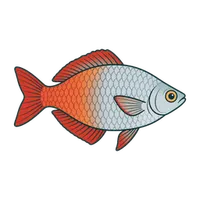
A slender, restless, iridescent open-water swimmer from the streams of eastern Madagascar - understated at rest, but the fins flush with red, yellow and black edging when a group is settled and males are displaying.
One of the more genuinely peaceful, adaptable 'proper community' fish, but it has two non-negotiables: it must be in a real group, and it wants swimming LENGTH, not a tall box.
Widely (and wrongly) sold under the wrong name for decades - almost every 'Madagascar rainbow' or 'Zona' in the hobby is actually Bedotia madagascariensis, not Bedotia geayi.
A great fish for a keeper who has a long tank and is ready to keep water clean and stable, rather than someone after a single showpiece for a nano tank.
💷 Costing it out? See how much a madagascar rainbowfish really costs to keep — the madagascar rainbowfish itself is usually the cheapest part.
Water & tank
Water first: aim for around 22-26°C (72-79°F), pH roughly 6.0-7.5, and soft-to-moderately-hard water about 2-15 dGH. It's adaptable within these bands - stability matters more than hitting an exact figure.
This fish MUST go into a fully cycled tank. It is sensitive to poor water quality and to sudden swings, so a mature filter and an established nitrogen cycle are the foundation, not an optional extra. If you don't yet understand cycling, sort that before you buy the fish.
Keep nitrate low with regular partial water changes (e.g. 20-30% weekly). Watchful, consistent maintenance is what gets you the 5-year lifespan; neglected water is the single biggest killer.
Footprint over volume: give it length. SeriouslyFish sets a minimum base of 120 x 30 cm (48 x 12 in, ~108 L / ~29 US gal) and Fishkeeper recommends at least a 4 ft tank. A long tank for a shoal of 8-10+ realistically means ~150 L+ - prioritise a long footprint over a tall one.
Filtration should be effective but flow gentle-to-moderate - these are slow-stream fish, so avoid blasting current. Plant heavily with open swimming lanes down the middle and shaded, densely planted edges for cover and to break up male sightlines.
A tight-fitting lid is wise: they are active, surface-oriented feeders and can be jumpy.
Feeding
Feed a good-quality flake or micropellet as the staple - they feed readily at the surface and in mid-water.
Supplement regularly with small live and frozen foods: bloodworm, daphnia and brine shrimp (artemia) are all readily taken and bring out colour.
Include some plant/algae content (e.g. spirulina or green flake) to round out the omnivorous diet.
Feed small amounts once or twice a day - only what the group clears in a couple of minutes - to keep water clean and nitrate low.
Their natural diet is largely insects that land on the water, so floating and surface-oriented foods suit their feeding style well.
Behaviour & tankmates
Excellent, peaceful community fish for tankmates of similar size and temperament - it will not bully others.
Good companions include other rainbowfish, peaceful barbs, larger tetras/characins, calm catfish/loaches and easygoing cichlids.
Avoid very small fish and shrimp that could be seen as food - a 10 cm insect-eater will treat tiny tankmates as snacks - and avoid fin-nippers or aggressive/boisterous species that will out-compete or harass it.
Manage male-on-male sparring by keeping a group of 8-10+ skewed toward females, with plenty of plants and decor to break line-of-sight; sparring in a good group is normal and usually harmless.
Give it space to swim - it uses the open mid-to-upper water and needs room to move, so don't cram the swimming lanes with too many competing mid-water species.
What to expect
A shoal that patrols the open middle-to-upper water most of the day - active but not frantic once settled.
Understated silver-gold bodies that light up with red/yellow/black-edged fins as the group matures and males display to each other.
Some harmless male-to-male sparring and fin-flaring, especially at feeding time - a sign of a healthy, confident group rather than a problem.
A responsive surface feeder that quickly learns to greet you at the glass at feeding time.
Myths, kindly busted
“It's a Bedotia geayi, aka the 'Zona'.”
Almost every Madagascar rainbowfish in the hobby is Bedotia madagascariensis. It was imported in the 1950s and mislabelled as B. geayi for decades; true B. geayi is uncommon in the trade and differs in fin colour and striping (it shows two longitudinal stripes; the aquarium fish typically shows one). So the popular name is a long-standing ID mix-up.
“A single one, or a pair, is fine in a small community tank.”
It's a shoaling species. Kept alone or in twos it becomes nervous and drab; keep a minimum of 6 and ideally 8-10+ for it to feel secure and colour up. Understocking causes stress - the opposite of the calm, confident fish you're aiming for.
“It's a big rainbowfish, so it needs a big TALL tank.”
It only reaches ~8-10 cm, but it's an active horizontal swimmer - what it needs is LENGTH (a 120 cm / 4 ft footprint), not height. Swimming distance matters far more than raw litres or a tall silhouette.
“Rainbowfish are hardy, so water quality doesn't matter much.”
It's adaptable to a range of pH and hardness, but it's genuinely sensitive to poor water quality and to sudden swings. A cycled tank plus regular water changes to keep nitrate low is essential - 'hardy' is not the same as 'neglect-proof'.
When to act
We triage, not diagnose — but these are worth a closer look (starting with a water test):
- Fish gasping at the surface, clamped fins, or suddenly listless: stop feeding and TEST THE WATER right away (ammonia, nitrite, nitrate) - these usually point to a water-quality or cycling problem, not the fish itself.
- Any detectable ammonia or nitrite: do an immediate partial water change and keep testing daily - the tank is not (or no longer) properly cycled.
- Colours washing out and nervous, skittish hiding in an otherwise healthy tank: often a group that's too small or too many males - review shoal size and the male-to-female ratio.
- Persistent chasing that leaves a fish battered, hiding constantly, or unable to feed: add more visual barriers and rebalance toward more females; if it continues, seek help on a reputable fishkeeping forum.
- White spots, cottony patches, ulcers, rapid breathing or unusual swimming: isolate if you can, review water conditions, and seek advice from a vet or an experienced fishkeeping community - this is triage, not a diagnosis.
Heading to a vet? Print the Madagascar Rainbowfish vet-prep sheet — what to bring, what to tell them, and the questions to ask.
Sources & further reading
- Seriously Fish - Bedotia madagascarensis — Core parameters: 100 mm SL; min tank 120 x 30 cm (~108 L); 23-32°C; pH 4.5-7.5; 0-15 dGH; keep 8-10+; gentle flow; taxonomy note vs B. geayi.
- Fishkeeper.co.uk - Madagascar Rainbowfish — UK aquatics retailer care sheet: 10 cm; at least 4 ft tank; 23-29°C; pH 5.0-7.0; up to 15 dGH; groups of 10+; community with no small fish.
- FishBase - Bedotia madagascariensis — Scientific reference: max 8.6 cm SL; IUCN status Endangered (assessed 2016).
- Fish Laboratory - Madagascar Rainbowfish care guide — Lifespan up to ~5 years; omnivore diet detail (flakes/pellets + bloodworm, daphnia, brine shrimp, spirulina); minimum group and tankmate guidance.
- Practical Fishkeeping - Madagascan rainbows redescribed — Background on the long-standing B. geayi vs B. madagascariensis trade mislabelling ('Zona').
Written & fact-checked by The Finfern Team against the sources above — kind, general guidance, not a diagnosis. If something looks wrong, test your water and, if it persists, contact a fish-savvy vet.

Get the free Madagascar Rainbowfish Starter Kit
The essentials at a glance, a setup checklist and a first-30-days plan for your madagascar rainbowfish — what to get right and what to watch for. Join the shoal and we’ll send it over. Free sheets and tools always stay open, no gatekeeping.
Water-first tips and new guides the moment they land. No spam — unsubscribe anytime. See how we handle your data in our privacy notice.