
Species · Tetras & rasboras
Odessa Barb
Pethia padamya
A subtropical, ruby-flanked barb that is peaceful and easy — as long as you keep it in a real shoal of 8–10, not a token few.
Difficulty: Beginner Tropical community tank ✓ Fact-checked care guide
Quick facts
| Adult size | ~46 mm / 1.8 in SL |
|---|---|
| Minimum tank | ~72 L / ~19 US gal — a 80 × 30 cm base, per SeriouslyFish |
| Temperature | 16–25 °C / 61–77 °F (subtropical-tolerant) |
| pH | 6.5–8.5 |
| Hardness | 5–20 dGH |
| Filtration & flow | Undemanding; appreciates some flow; a planted, dark-substrate tank shows the best colour |
| Diet | Foraging omnivore — dried flake/granule (with plant content) plus small live/frozen foods |
| Social | A schooling species — buy a mixed-sex group of at least 8–10 |
| Temperament | Generally very peaceful — an ideal community barb when kept in numbers |
| Lifespan | Commonly cited at ~5 years in the hobby (not stated by the primary source) |
Overview
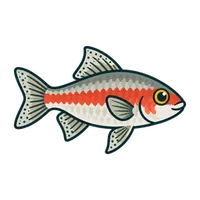
The Odessa barb is a small, ruby-flanked cyprinid that only reached a confirmed wild origin (central Myanmar) in the 2000s — for decades it was a trade mystery some even assumed was dyed. In an aquarium it stays modest, around 46 mm (1.8 in) SL, and the males earn their name with a bright red-orange band that flares brightest when they have rivals to show off against.
It is one of the easier "first schooling barb" choices, but it is still a schooling barb — which means it is a fish you buy by the group, not the individual. Get the water right and give it company, and it settles into a calm, colourful community resident rather than a nippy troublemaker.
💷 Costing it out? See how much a odessa barb really costs to keep — the odessa barb itself is usually the cheapest part.
Water & tank
Aim for a temperature of 16–25 °C (61–77 °F), a pH of 6.5–8.5, and hardness of 5–20 dGH — a genuinely wide, tap-water-friendly window that makes this a forgiving species chemically. The temperature range is worth noticing: this is a subtropical-tolerant barb that is happy in unheated or cooler rooms, so it does not need to be pushed to tropical warmth.
SeriouslyFish states a tank base of at least 80 × 30 cm (~72 L / ~19 US gal). Filtration need not be strong, though the fish appreciates some water movement; a heavily planted tank with a dark substrate and some floating plants shows off its colour best.
Feeding
Treat it as a foraging omnivore. SeriouslyFish notes it is "easily-fed" — a good-quality dried flake or granule (ideally one with some plant/algal content) works as the staple, supplemented with regular small live and frozen foods such as bloodworm, Daphnia and Artemia for the best condition and colour.
Behaviour & tankmates
This is a very peaceful, community-suitable barb — but the peace depends on numbers. SeriouslyFish is explicit: buy a mixed-sex group of at least 8–10 specimens and include other schooling fishes for security. Kept in a proper group, males redirect their energy into displaying to each other and to females, which is where the best colour comes from; kept in twos and threes, a bored barb is far more likely to pester tankmates.
Good companions are comparably-sized, open-water cyprinids and peaceful bottom-dwellers (various loaches, Garra, Crossocheilus). As always, research the specific mix before you buy — "peaceful" is a starting point, not a guarantee for every tankmate.
What to expect
Expect an active, mid-water shoal that intensifies in colour as the group settles and the males compete — and expect that colour to be brighter still in a planted, dimly lit tank. It is hardy, undemanding on chemistry, and comfortable at cooler subtropical temperatures, which makes it a strong beginner schooler. What it will not do is look its best or behave its best kept in small numbers.
Myths, kindly busted
“Odessa barbs are dyed/artificially coloured fish.”
Some early hobbyists did suspect the fish was artificially dyed, but after wild populations were found and the species was formally described (2008) it was confirmed a genuine, naturally red-flanked species — the colour is real.
“A barb is a barb — a few is fine.”
SeriouslyFish specifically advises a mixed-sex group of at least 8–10; smaller numbers leave the fish more nervous and less colourful (and males more inclined to bother tankmates).
“Barbs need a heated tropical tank.”
The stated range is 16–25 °C (61–77 °F), so this is a subtropical-tolerant species that does fine at cooler, even room-temperature conditions.
🐟 Did you know? — Odessa Barb fun facts
Little true delights about the odessa barb — each one checked against a named source, no pet-shop myths.
- Despite being an aquarium favourite for decades, the Odessa barb wasn't scientifically described until 2008. Wikipedia
- Its name comes from Odesa, Ukraine, where the fish first appeared in pet-enthusiast circles in the early 1970s. Wikipedia
- The species name padamya is Burmese for “ruby”, chosen for the vivid red lateral stripe of the male. Wikipedia
When to act
We triage, not diagnose — but these are worth a closer look (starting with a water test):
- A normally bright male losing his red-orange colour and hanging away from the group — often a sign of stress, water-quality slippage, or too small a shoal; re-check the group size and test the water.
- Persistent chasing, torn fins, or one fish hiding constantly — usually a symptom of too-few-barbs or an unsuitable tankmate mix rather than "aggression by nature".
- Rapid or laboured gilling, clamped fins, or loss of appetite across the group — treat as a water-quality warning first; test parameters and review recent changes.
Heading to a vet? Print the Odessa Barb vet-prep sheet — what to bring, what to tell them, and the questions to ask.
Sources & further reading
- SeriouslyFish — Pethia padamya (Odessa Barb) — Max ~46 mm SL; base 80 × 30 cm (~72 L / ~19 US gal); temperature 16–25 °C / 61–77 °F (subtropical-tolerant); pH 6.5–8.5; hardness 5–20 dGH; "generally very peaceful" community barb; buy a mixed-sex group of at least 8–10; a genuine naturally-coloured species (not dyed).
Written & fact-checked by The Finfern Team against the sources above — kind, general guidance, not a diagnosis. If something looks wrong, test your water and, if it persists, contact a fish-savvy vet.

Get the free Odessa Barb Starter Kit
The essentials at a glance, a setup checklist and a first-30-days plan for your odessa barb — what to get right and what to watch for. Join the shoal and we’ll send it over. Free sheets and tools always stay open, no gatekeeping.
Water-first tips and new guides the moment they land. No spam — unsubscribe anytime. See how we handle your data in our privacy notice.