
Species · Cichlids
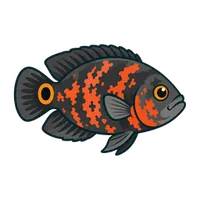
Oscar
Astronotus ocellatus
The classic intelligent "wet pet" cichlid — personable and rewarding, but it hits ~35 cm, lives 10–20 years and needs a big, heavily filtered tank of its own.
Difficulty: Intermediate Cichlid setup ✓ Fact-checked care guide
Quick facts
| Adult size | ~350 mm / 14 in SL |
|---|---|
| Minimum tank | Base of 150 × 60 cm (~540 L / ~143 US gal) for a single adult, more for a pair, per SeriouslyFish |
| Temperature | 20–28 °C / 68–82 °F |
| pH | 6.0–7.5 (captive-bred fish are "not fussy"; wild-caught may need specific conditions) |
| Hardness | 5–20 dGH |
| Filtration & flow | Heavy, efficient filtration; weekly 30–50% water changes; a guarded/external heater |
| Diet | Generalised omnivore — quality cichlid pellet staple plus live/frozen foods (earthworms a favourite) |
| Social | A single adult or a bonded pair; keep only with robust fish too big to be eaten |
| Temperament | Not especially aggressive for its size, but predatory — small fish are food |
| Lifespan | Typical life-span 10–20 years (stated by SeriouslyFish) |
Overview
The oscar (Astronotus ocellatus) is the classic "wet pet" — a big, intelligent, personable Amazonian cichlid also sold as velvet, red, tiger or marble cichlid. SeriouslyFish records a maximum standard length of 350 mm (14 in) and, in the Notes, states that "its adult size and typical life-span of 10-20 years must be taken into account before purchase".
Oscars are famous for recognising their owner and "begging" for food, which makes them enormously rewarding — and also easy to overfeed and easy to under-house. The whole challenge with an oscar is respecting how big it gets and how long it lives.
💷 Costing it out? See how much a oscar really costs to keep — the oscar itself is usually the cheapest part.
Water & tank
Get the water right first. SeriouslyFish gives temperature 20–28 °C (68–82 °F), pH around 6.0–7.5 for the captive-bred fish most people buy ("not fussy"), and hardness 5–20 dGH. Chemistry is the easy part; the hard part is waste and space.
On space, SeriouslyFish lists a base of 150 × 60 cm (~540 L / ~143 US gal) as "just about large enough to house a single adult", with "larger quarters required for a pair or group". Oscars are messy diggers that foul water quickly, so efficient filtration and weekly 30–50% water changes are essential — and they have been known to break in-tank heaters, so an external or guarded heater is wise.
Feeding
SeriouslyFish calls the oscar "a generalised omnivore", with meatier foods preferred. Use a good-quality cichlid pellet as the staple, supplemented with live or frozen foods — live earthworms are "a particular favourite". Two honest cautions from the source: do not overfeed (oscars are "notoriously greedy"), and avoid mammalian/avian meat (like beef heart) and "feeder" fish, which carry disease risk and little nutritional value.
Behaviour & tankmates
SeriouslyFish is measured here: the oscar is "not especially aggressive for a cichlid of this size", but "this species’ predatory nature dictates that it should not be combined with much smaller fishes" — anything that fits in the mouth is food. More importantly, "its adult size also precludes the possibility of it being maintained in a community in all but the largest private aquaria". The limiting factor is scale and appetite, not temper.
Where there is genuine room, SeriouslyFish lists possible tankmates as characids, anostomids, other cichlids, and larger loricariid or doradid catfishes. Oscars form extended pair bonds and are best obtained by growing up a group of six or more youngsters and letting a pair form — after which the others should be removed.
What to expect
Expect a big, bold, interactive fish with real personality — one that rearranges the tank, digs up the substrate, learns feeding routines and can live 10–20 years. Expect, too, a serious housekeeping job: oscars are "among those fishes most-often discarded after growing large". Buy an oscar only if you can commit the tank, the filtration and the years an adult demands.
Myths, kindly busted
“An oscar will be fine in a 55-gallon community tank.”
SeriouslyFish says a ~540 L (150 × 60 cm) tank is "just about large enough to house a single adult", and its size "precludes… a community in all but the largest private aquaria".
“Oscars love feeder goldfish and beef heart.”
SeriouslyFish advises against feeder fish (disease risk, poor nutrition) and against mammalian/avian meat like beef heart; a quality cichlid pellet plus earthworms and frozen foods is recommended.
“Oscars are aggressive monsters.”
SeriouslyFish calls them "not especially aggressive for a cichlid of this size" — the real issues are their predatory appetite for small fish and their adult bulk, not temper.
🐟 Did you know? — Oscar fun facts
Little true delights about the oscar — each one checked against a named source, no pet-shop myths.
- The eyespot on an oscar's tail is thought to mimic its head, so a foraging fish looks as if its head points up when it's actually its tail. Animal Diversity Web
- Those tail eyespots may help limit fin-nipping by piranhas, which share the oscar's natural Amazon waters. Wikipedia
- In its native South America the oscar is often sold as a food fish, and specimens have been reported up to 70 cm long and 9 kg. Wikipedia
When to act
We triage, not diagnose — but these are worth a closer look (starting with a water test):
- Pitting or holes appearing on the head or face — a well-known warning sign in large cichlids often linked to water quality and diet; tighten up water changes and nutrition and seek qualified advice.
- Rapid or laboured breathing, hanging near the surface, or sudden loss of appetite in a greedy fish — check water quality (oscars foul water fast) and filtration first, then consult a knowledgeable source.
- Persistent hiding, darkened colour, or clamped fins — general stress/health warning signs; review tank size, tankmates and maintenance before assuming a specific disease.
Heading to a vet? Print the Oscar vet-prep sheet — what to bring, what to tell them, and the questions to ask.
Sources & further reading
- SeriouslyFish — Astronotus ocellatus (Oscar) — Max ~350 mm SL; base 150 × 60 cm (~540 L / ~143 US gal) "just about large enough" for one adult; temperature 20–28 °C / 68–82 °F; pH 6.0–7.5 (captive-bred not fussy); hardness 5–20 dGH; life-span 10–20 years; predatory (not for small tankmates); avoid feeder fish and beef heart.
Written & fact-checked by The Finfern Team against the sources above — kind, general guidance, not a diagnosis. If something looks wrong, test your water and, if it persists, contact a fish-savvy vet.

Get the free Oscar Starter Kit
The essentials at a glance, a setup checklist and a first-30-days plan for your oscar — what to get right and what to watch for. Join the shoal and we’ll send it over. Free sheets and tools always stay open, no gatekeeping.
Water-first tips and new guides the moment they land. No spam — unsubscribe anytime. See how we handle your data in our privacy notice.