
Species · Catfish & bottom-dwellers
Pictus Catfish
Pimelodus pictus
A fast, night-active, scaleless predator that needs a long tank, a group of its own kind, and rock-steady clean water — not the tankmate for your neon tetras.
Difficulty: Intermediate Tropical community tank ✓ Fact-checked care guide
Quick facts
| Adult size | Around 11-15 cm (roughly 4.5-6 in) body length, plus very long trailing barbels ("whiskers") on top of that. SeriouslyFish lists 120 mm SL; most home fish reach about 12-13 cm. |
|---|---|
| Minimum tank | Keeper-facing minimum for a small group is a 4-foot (120 cm) tank of roughly 240 litres / ~64 US gallons (SeriouslyFish gives a 120 x 45 x 45 cm / ~243 L footprint). Bigger-is-better reality: these are tireless, fast swimmers that shoal, so length and floor space matter more than a tall column — a 5-6 foot tank suits a proper group of 5-6+ far better, and each extra fish wants meaningful added space (community guides scale to 55 US gal / ~208 L for the first fish and up from there). Think swimming runway, not gallons on a box. |
| Temperature | 22-26 °C (72-79 °F). SeriouslyFish gives 22-25 °C; Aquarium Co-Op 22-26 °C. |
| pH | Soft and slightly acidic is ideal — wild-accurate SeriouslyFish range is pH 5.8-6.8. They adapt to neutral, so anywhere in roughly pH 6.0-7.5 is workable if it is STABLE; avoid hard alkaline water and sudden pH swings. |
| Hardness | Soft to moderately hard. SeriouslyFish lists about 1-15 dGH; keep it in the soft-to-medium range and, above all, stable. |
| Filtration & flow | Gentle to moderate flow with well-oxygenated, spotless water. As a scaleless fish it is unusually sensitive to poor quality and to medications, so aim for strong filtration, low nitrate and gentle current rather than a raging torrent. |
| Diet | Omnivorous but meat-leaning micropredator/scavenger. Takes sinking dried foods readily plus live/frozen bloodworm, Tubifex, small earthworms and brine shrimp. |
| Social | Shoaling by nature — keep a group of 6 or more (SeriouslyFish). Kept singly or in twos they tend to be jumpier and more stressed; a real group settles and shows natural behaviour. |
| Temperament | Peaceful toward similar-sized tankmates but a genuine predator — it will eat anything small enough to fit in its mouth. Non-aggressive to equals; extremely active and "frisky" once it smells food. |
| Lifespan | Typically 8-10 years with good water and correct feeding. |
Overview
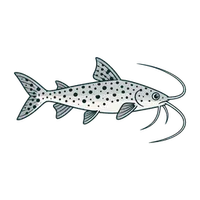
A striking silver, black-spotted South American catfish (Amazon/Orinoco basins) with sail-like fins and extraordinarily long barbels.
Prized for being constantly on the move — it is one of the most active, personality-filled catfish in the hobby, busiest at dusk and after lights-out.
Two traits define its care: it is a scaleless PREDATOR, and it is a SHOALING fish. Get those two right and most other things fall into place.
It is often sold tiny as a cute community fish; in reality it needs space, a group, and careful tankmate choices, so it suits a keeper past their very first tank.
💷 Costing it out? See how much a pictus catfish really costs to keep — the pictus catfish itself is usually the cheapest part.
Water & tank
Water first: target about 22-26 C (72-79 F), soft and slightly acidic-to-neutral water (SeriouslyFish's wild range is pH 5.8-6.8; up to ~7.5 is fine if stable), and hardness on the soft-to-moderate side (~1-15 dGH). Stability matters more than hitting a perfect number.
This is a SCALELESS fish, so it absorbs whatever is in the water more readily than scaled fish. That means it needs a fully cycled tank (ammonia 0, nitrite 0) and low, controlled nitrate. Keep a liquid test kit and do regular partial water changes.
Because it is a busy, fast swimmer that shoals, footprint beats volume: prioritise LENGTH and open swimming floor. A 4-foot / ~240 L (~64 US gal) tank is the sensible starting point for a small group per SeriouslyFish, and a 5-6 foot tank is better for a full group of 6+.
Aim for gentle-to-moderate, well-oxygenated flow and strong filtration to keep nitrate down without blasting the fish around.
Aquascape for a spooky night-swimmer: smooth substrate (it forages the bottom and can graze its long barbels), some driftwood/plant or cave cover to feel secure, and a tight-fitting lid — active catfish can jump. Avoid sharp decor and rough gravel that can damage its scaleless skin.
Never rush it into a brand-new setup; add pictus to an established, stable, matured tank.
Feeding
Offer sinking foods it can find on or near the bottom: quality sinking pellets/wafers plus meaty treats like bloodworm, Tubifex, brine shrimp and chopped earthworm.
It is an enthusiastic, opportunistic eater that will gorge itself — Aquarium Co-Op warns pictus 'will happily gorge themselves to the point of obesity.' Feed variety and portion to a slightly rounded (not bloated) belly.
Adults do not need feeding every day; every couple of days is enough, which also helps keep water clean.
Feed after lights-out or at dusk if shy tankmates are outcompeting them, since pictus are most active in low light.
Behaviour & tankmates
Golden rule: anything small enough to swallow WILL eventually be eaten. Neon/ember tetras, guppies, shrimp and fry are food, not tankmates.
Good matches are robust, similar-or-larger peaceful fish: rainbowfish, larger/medium tetras and other characins, bigger barbs, larger rasboras/danios, and tough catfish such as plecos (Loricariids) or Doradids.
Avoid slow, long-finned or nippy fish, and avoid tiny bottom dwellers; also skip fish that might nip the pictus's long barbels.
Keep it in a group of 6+ of its own kind — a shoal is calmer and less skittish than lone fish.
Handle with care: it has rigid, locking pectoral and dorsal spines that tangle in nets and can give a painful cut. Move it in a rigid container or bag, not a net, for its safety and yours.
Myths, kindly busted
“Pictus catfish are peaceful community fish that are safe with tetras and other small fish.”
They are peaceful only toward fish they can't eat. They are opportunistic predators and will hunt neons, guppies, small rasboras, shrimp and fry overnight. Peaceful does not mean non-predatory.
“A single pictus is fine, or one in a small tank is enough.”
They are a shoaling species; SeriouslyFish advises groups of six or more. Kept singly they're often nervous and hyperactive. Combined with their size, speed and love of swimming, they need a long tank (4 ft+ / ~240 L to start), not a starter cube.
“Just treat them like any other catfish if they get sick.”
Pictus are scaleless and absorb chemicals through the skin, so they react badly to many standard medications — especially copper-based and full-strength ich treatments. Many keepers use reduced doses and avoid copper. Always check that a treatment is safe for scaleless catfish first.
“They eat leftovers and clean the tank, so you barely need to feed them.”
They are not a cleanup crew. They need their own sinking, meaty diet and will actually overeat to obesity if you let them. Feed deliberately every couple of days, not by relying on scraps.
When to act
We triage, not diagnose — but these are worth a closer look (starting with a water test):
- Fish gasping at the surface, sudden hiding, clamped fins or loss of appetite: stop feeding, test the water immediately (ammonia, nitrite, nitrate) and do a partial water change — as a scaleless fish it shows water problems fast.
- Any detectable ammonia or nitrite (should be 0), or creeping high nitrate: increase water changes and check that the tank is fully cycled and not overstocked/overfed.
- White salt-grain spots (ich/white spot) or fuzzy patches on skin: act promptly, but treat as a SCALELESS fish — avoid copper and consider reduced-dose meds; verify the product is safe for scaleless catfish, and seek advice from an aquatic vet or trusted fish source before dosing.
- Reddened skin, cuts or torn barbels: check for sharp decor, rough substrate or a net injury from those locking spines, and improve water quality while it heals.
- A visibly bloated, sausage belly (not just rounded): you're overfeeding — cut back portions and frequency.
- None of this is a diagnosis — if a fish is clearly unwell or declining, test the water first and consult an aquatic vet or an experienced fishkeeping community.
Heading to a vet? Print the Pictus Catfish vet-prep sheet — what to bring, what to tell them, and the questions to ask.
Sources & further reading
- SeriouslyFish — Pimelodus pictus species profile — Primary authority for size (120 mm SL), tank footprint (120x45x45 cm / ~243 L), temperature (22-25 C), pH (5.8-6.8), hardness (1-15 dGH), shoal of six or more, diet, predatory temperament and the rigid/painful fin-spine warning.
- Aquarium Co-Op — Pictus Catfish care — Confirms 4-6 in adult size, 22-26 C, needs a 4-foot+ tank, the obesity/overfeeding warning, tankmate guidance and net/fin-spine handling caution.
- Aquariadise — Pictus Catfish care sheet — Max ~5 in / 12.7 cm, 55 gal/208 L first-fish minimum scaling up per extra fish, scaleless = more disease/injury-prone, sharp spines, and to avoid fish under 5 in and small bottom dwellers.
- Fish Laboratory — Pictus Catfish care guide — Lifespan 8-10 years, shoaling species kept in small groups, scaleless and sensitive to large water-parameter changes.
Written & fact-checked by The Finfern Team against the sources above — kind, general guidance, not a diagnosis. If something looks wrong, test your water and, if it persists, contact a fish-savvy vet.

Get the free Pictus Catfish Starter Kit
The essentials at a glance, a setup checklist and a first-30-days plan for your pictus catfish — what to get right and what to watch for. Join the shoal and we’ll send it over. Free sheets and tools always stay open, no gatekeeping.
Water-first tips and new guides the moment they land. No spam — unsubscribe anytime. See how we handle your data in our privacy notice.