
Species · Catfish & bottom-dwellers
Pygmy Cory
Corydoras pygmaeus
The thumbnail-sized cory that shoals in mid-water as much as it sifts the sand — peaceful and easy, but only happy in a real group (6+, ideally 10+) with tiny food and gentle tankmates.
Difficulty: Beginner–Intermediate Tropical community tank ✓ Fact-checked care guide
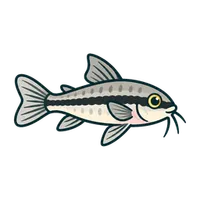
Quick facts
| Adult size | ~3 cm / 1.2 in SL (one of the smallest Corydoras) |
|---|---|
| Minimum tank | ~41 L / 11 US gal for a group — SeriouslyFish recommends a 45 × 30 cm base |
| Temperature | 22–26 °C / 72–79 °F |
| pH | 6.4–7.4 |
| Hardness | 0–8 dGH (soft; SF notes preferably below 8) |
| Filtration & flow | Gentle, cycled filtration; smooth sand substrate for its delicate barbels |
| Diet | Micro-omnivore — small/ground dried food plus small live & frozen (sifted Daphnia, Artemia nauplii) |
| Social | Highly social — buy at least 6, preferably 10 or more; it shoals tightly |
| Temperament | Very peaceful — and easily intimidated by larger fish |
| Lifespan | Commonly cited at ~3 years in the hobby (not stated by the primary source) |
Overview
The pygmy cory (Corydoras pygmaeus) is a tiny South American armoured catfish — at roughly 3 cm one of the smallest corys in the hobby — and it behaves a little differently from its bigger cousins: as well as sifting the sand, it spends a lot of time shoaling in the mid-water in a shimmering little group.
It is peaceful and easy, with one firm rule shared by all corys: it is profoundly social. Kept in ones or twos it hides and pines; a group of six or more (ten-plus is better) is confident, active and delightful to watch.
💷 Costing it out? See how much a pygmy cory really costs to keep — the pygmy cory itself is usually the cheapest part.
Water & tank
Pygmy corys like soft, gently acidic-to-neutral water — pH 6.4–7.4, 0–8 dGH (SeriouslyFish notes preferably below 8), at 22–26 °C / 72–79 °F. As always, the tank must be cycled before they go in.
The substrate must be smooth sand or well-rounded gravel: corys root with delicate barbels, and sharp or dirty gravel wears them down and invites infection. A well-planted, dimly-lit tank of ~41 L / 11 US gal (a 45 × 30 cm base) suits a good-sized group; keep the flow gentle, as this is a small, easily-buffeted fish.
Feeding
The catch with pygmy corys is their tiny mouths: any food must be small enough for them — small-grade dried food (or crushed larger food) plus small live and frozen items such as sifted Daphnia and Artemia nauplii for best colour and condition.
Do not treat them as a leftover-eating clean-up crew — they need their own sinking food to reach the bottom before faster mid-water fish take it.
Behaviour & tankmates
A superb but delicate community citizen — peaceful with everything, but so small that many standard community fish (angelfish, gouramis, larger catfish) will intimidate it, outcompete it for food, or simply eat it. Keep it with other tiny, calm species: small rasboras/tetras, dwarf shrimp, small loaches.
Keep a group of at least six of the same species (ten or more is better) — they shoal with their own kind and gain all their confidence from numbers.
What to expect
A settled group spends its time shoaling in open water and sifting sand together, with occasional dashes to the surface to gulp air (normal — corys can breathe air through their gut). Frantic, repeated surfacing instead points to poor water.
Myths, kindly busted
“A pygmy cory is a bottom-dweller that cleans the tank.”
It shoals in mid-water as much as it sifts sand, and it is not a clean-up crew — it needs its own small food or it slowly starves.
“One or two are fine because they are so small.”
It is one of the most social corys — keep at least six (ideally ten-plus) or it becomes shy and withdrawn.
“Any community tank suits it.”
It is tiny and easily bullied or eaten; house it only with small, peaceful tankmates over smooth sand.
🐟 Did you know? — Pygmy Cory fun facts
Little true delights about the pygmy cory — each one checked against a named source, no pet-shop myths.
- Unlike most bottom-hugging corydoras, the pygmy cory tends to shoal in the middle levels of the water, out in open water. SeriouslyFish
- At only about 30 mm long, the pygmy cory is small enough that angelfish, gouramis and larger catfish may treat it as a snack. SeriouslyFish
When to act
We triage, not diagnose — but these are worth a closer look (starting with a water test):
- Worn, stubby, or missing barbels — usually a substrate/hygiene problem; move to smooth sand and improve water quality.
- Constant frantic surfacing for air (beyond the occasional normal gulp) — test the water; it often signals low oxygen or poor quality.
- A fish hiding away, clamped, or off its food while the group is active — check water parameters and, if it persists, seek fish-savvy advice.
Heading to a vet? Print the Pygmy Cory vet-prep sheet — what to bring, what to tell them, and the questions to ask.
Sources & further reading
- SeriouslyFish — Corydoras pygmaeus (Pygmy Cory) — Adult ~30 mm SL; recommended 45 × 30 cm base (~41 L / 11 US gal); temperature 22–26 °C / 72–79 °F; pH 6.4–7.4; hardness 0–8 dGH (preferably below 8); very peaceful; tiny mouth needs small food; buy at least 6, preferably 10+ (shoals tightly).
Written & fact-checked by The Finfern Team against the sources above — kind, general guidance, not a diagnosis. If something looks wrong, test your water and, if it persists, contact a fish-savvy vet.

Get the free Pygmy Cory Starter Kit
The essentials at a glance, a setup checklist and a first-30-days plan for your pygmy cory — what to get right and what to watch for. Join the shoal and we’ll send it over. Free sheets and tools always stay open, no gatekeeping.
Water-first tips and new guides the moment they land. No spam — unsubscribe anytime. See how we handle your data in our privacy notice.