
Species · Shrimp & snails
Rabbit Snail
Tylomelania gemmifera
If you remember one thing: the rabbit snail is a slow, gentle Sulawesi native that needs warm, rock-steady, hard-alkaline, copper-free water in a mature tank. Get the water right and the snail looks after itself.
Difficulty: Beginner–Intermediate Shrimp / invert tank ✓ Fact-checked care guide
Quick facts
| Adult size | Around 7-8 cm (about 3 inches) shell length for the commonly kept golden/orange form. The wider Tylomelania genus ranges from roughly 2 cm up to 10-12 cm depending on species, so a "mini" or a giant can look very different at full size. |
|---|---|
| Minimum tank | Keeper-facing minimum is about 38 L (10 US gallons) for a single snail, adding roughly 9-10 L (2.5 gallons) per extra snail. Bigger is genuinely better here: a mature, well-established 75 L (20 gallon) or larger tank holds temperature and water chemistry far more steadily, and stability is what keeps their heavy shells intact. They are floor-grazers, so footprint (sand area) matters more than height. |
| Temperature | 24-29 C (about 75-84 F). These are tropical, warm-water snails from equatorial lakes and will not thrive in an unheated "coldwater" tank; the low-80s F (around 27-28 C) is a good target. Native lakes sit at roughly 26-30 C year-round. |
| pH | 7.5-8.5, firmly alkaline. This is non-negotiable: acidic or even neutral water lets their thick shells pit and erode over time. Keep pH stable in the high-7s to low-8s rather than chasing a single number. |
| Hardness | The priority is a solid, stable carbonate hardness (KH) so pH stays alkaline and shells stay hard: most guides land around KH 4-15 dKH, and the native water is alkaline and mineral-buffered. Published GH targets vary widely (roughly 4-15 dGH across sources) because their home lakes are famously "soft yet alkaline"; the reliable rule is steady mineral content plus available calcium, not a chase for maximum GH. Make sure calcium is available (cuttlebone or a mineral/calcium supplement) for shell repair. |
| Filtration & flow | Gentle, mature biological filtration; they prefer calmer water and lower light to blazing flow. A sponge filter (or a well-guarded intake) is ideal so no shrimplets or baby snails get sucked in. Prioritise stable, fully-cycled water quality over strong current. |
| Diet | Omnivorous grazer/detritivore. In the tank it rasps biofilm, soft algae and detritus, but it is too big to live on scraps and needs direct feeding: sinking pellets/wafers, high-quality tablets, and blanched vegetables, plus a calcium source for the shell. |
| Social | Not a shoaling animal, so no schooling minimum: a single snail is perfectly happy. Because they are dioecious (separate males and females, not hermaphrodites), keep a group of at least 3-4 if you hope to breed, to improve the odds of having both sexes. |
| Temperament | Peaceful, slow, and utterly non-aggressive. They will not bother fish, shrimp or other snails; they are shrimp-safe. The only "trouble" is that a hungry snail may rasp soft-leaved plants, and they can climb out of an open-topped tank. |
| Lifespan | Commonly about 3 years with good care, and up to 3-5 years reported in stable, well-maintained tanks. Poor chemistry (soft or acidic water, temperature swings) shortens this considerably. |
Overview
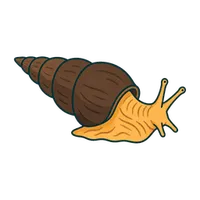
The rabbit snail (Tylomelania gemmifera) is one of the aquarium hobby's most characterful snails: a slow, deliberate grazer with long "rabbit-ear" antennae, a wrinkled elephant-like face, and a bright gold or orange body set against a dark, elongated cone shell.
They come from the ancient lakes of Sulawesi, Indonesia (the Poso and Malili lake systems), which have an unusual water signature the hobby often gets wrong: warm, stable, and alkaline, yet not especially mineral-heavy. That combination is the whole game with this species.
They are peaceful, shrimp-safe, and famously slow to breed, which makes them a favourite living centrepiece for warm nano and planted tanks rather than a pest risk.
This is not a beginner "clean-up crew" snail you can ignore. It rewards a keeper who runs a mature, cycled tank, keeps the water warm and alkaline, feeds it properly, and keeps copper well away.
💷 Costing it out? See how much a rabbit snail really costs to keep — the rabbit snail itself is usually the cheapest part.
Water & tank
Water first, always. Target pH 7.5-8.5 (stable, alkaline), temperature 24-29 C / 75-84 F, and a buffered carbonate hardness (around KH 4-15 dKH) so that pH does not drift. Ammonia and nitrite must read 0; keep nitrate low (ideally under 20 ppm).
The habitat paradox worth understanding: Sulawesi's lakes are "soft yet alkaline." So rather than dosing GH sky-high, focus on holding a steady alkaline pH and keeping calcium available (cuttlebone, crushed coral in the filter, or a mineral supplement) so shells can rebuild. Stability beats extremes.
Cycle the tank fully and let it mature before adding rabbit snails. These are warm-water specialists that dislike swings, and a new, unstable tank is the fastest route to shell erosion and stress.
Give them a soft sand bed. They plough and half-bury themselves, and sharp gravel makes movement exhausting and can damage them. Sand also suits the biofilm-grazing they do all day.
Size for stability and floor space: 38 L (10 gallons) minimum for one, +~9-10 L (2.5 gal) per extra snail, but a mature 75 L (20 gal)+ holds chemistry far more steadily. Keep a tight-fitting lid, because they can and do climb out.
Warmth and lid go together: because they want the mid-70s to low-80s F, a heater is usually needed, and a covered top helps hold both heat and humidity.
Feeding
Feed them directly, do not rely on leftovers: offer sinking pellets, algae/spirulina wafers, and quality tablets a few times a week.
Add blanched vegetables such as courgette (zucchini), cucumber, carrot or bell pepper; weigh them down and remove uneaten pieces before they foul the water.
Provide a steady calcium source (cuttlebone or a mineral/calcium supplement) so the snail can maintain and repair its heavy shell.
If they start rasping your soft-leaved plants, that is usually a sign they are underfed: increase feeding. Tougher plants like anubias are generally left alone.
Never introduce copper-based foods, plant ferts, or medications; even trace copper is dangerous to invertebrates.
Behaviour & tankmates
Peaceful and shrimp-safe: excellent companions for dwarf shrimp (they will not hunt them), and for other calm snails.
Match them to their water, not just their temperament: ideal tankmates also enjoy warm, alkaline, hard water, such as rasboras, danios, ricefish (medaka), rainbowfish, and small peaceful catfish.
Avoid snail-eaters and fin-nippers: pufferfish, most loaches (e.g. clown/yoyo), assassin snails, crayfish and crabs will attack or eat them; boisterous or cold-water fish (like goldfish) are a poor match.
Breeding is slow and undramatic: they are livebearers that release just one or two fully-formed babies at a time, often only every few weeks, so a population creeps up gently rather than exploding.
Expect a calm, slow tank inhabitant that grazes and burrows; they appreciate hiding spots and are not bothered by tankmates so long as those tankmates leave them alone.
What to expect
A slow, deliberate grazer that spends its time ploughing sand, rasping biofilm and half-burying itself: restful to watch, never frantic.
Real personality for a snail: the long rabbit-ear antennae and bright gold or orange bodies make them a genuine nano-tank centrepiece.
Very low-drama breeding: at most a baby or two every few weeks, so you will not wake up to an infestation.
A commitment to warm, hard-alkaline, copper-free water and a mature tank. Get that right and they are hardy and long-lived; get it wrong and shell erosion shows up first.
Myths, kindly busted
“They're a hands-off clean-up crew that lives on leftovers.”
They graze biofilm and detritus but are not tank janitors. They are big-bodied grazers that need direct feeding (sinking foods, blanched veg, calcium). Underfeed them and they may start rasping softer plants.
“Any freshwater snail is fine in a normal community tank.”
Rabbit snails are warm, hard-alkaline specialists from Sulawesi's ancient lakes. They need tropical temperatures (mid-70s to low-80s F) and stable alkaline water (pH 7.5-8.5, buffered KH). Cool or acidic/soft water erodes their shells and shortens their lives.
“They breed like other snails and will overrun the tank.”
The opposite: they are slow-breeding livebearers that need both a male and a female and release only one or two babies at a time, often weeks apart. They are one of the least invasive snails you can keep.
“A little copper-based ich medication won't hurt.”
Copper is potentially fatal to all invertebrates, including rabbit snails and shrimp. Never dose copper in their tank; if fish must be treated with it, move them to a separate hospital tank.
“They need extremely hard, high-GH water.”
Their native lakes are actually soft yet alkaline. What matters most is a stable, alkaline pH held by adequate KH plus available calcium for the shell, not maximising GH.
When to act
We triage, not diagnose — but these are worth a closer look (starting with a water test):
- Shell pitting, thinning, white eroded patches or a crumbling tip: usually a chemistry problem. Test pH and KH; if pH is drifting below ~7.5 or KH is low, raise buffering and add a calcium source, and review your water changes.
- Snail stays sealed in its shell and isn't moving or grazing for days: check temperature (too cold slows them right down) and immediately test ammonia, nitrite and nitrate. Any ammonia or nitrite above 0 calls for water changes now.
- A snail or shrimp death shortly after adding any medication, plant fertiliser or new tap water: suspect copper or another invert-toxic additive. Do large water changes with dechlorinated, copper-free water and remove the source.
- A snail repeatedly climbing to the very top or right out of the water: often a sign of poor water quality or low oxygen. Test the water and confirm the tank is fully cycled and not overstocked (and keep a tight lid, as they escape).
- A foul smell or an empty, gaping shell with the animal not withdrawn: the snail has likely died. Remove it promptly, because a large decomposing snail can spike ammonia and endanger the rest of the tank.
- None of the above is a diagnosis. When in doubt, test your water first, then ask an aquatic vet or an experienced local fish shop for hands-on help.
Heading to a vet? Print the Rabbit Snail vet-prep sheet — what to bring, what to tell them, and the questions to ask.
Sources & further reading
- Practical Fishkeeping — Snails from Sulawesi (Tylomelania habitat, temperature, pH, size) — Authority feature: native lakes, water chemistry (pH 7.5-8.5, 26-30 C / 79-86 F), shell size roughly 2-12 cm, diet, dioecious livebearing reproduction.
- Aquarium Co-Op — Top 7 Helpful Snails (rabbit snail temperature, pH, size, behaviour) — Reputable educator/retailer: prefer 80-86 F / 27-30 C, demand high pH (above 7.5) and mineralized water, ~3-5 in, very peaceful, slow livebearers (one baby every 4-6 weeks), can climb out.
- The Shrimp Farm — Golden/Orange Rabbit Snail (Tylomelania gemmifera) care — Species-specific: ~3 in adult size, min 10 gal (37.9 L) +2.5 gal per snail, 76-85 F, pH 7-8.5, lifespan up to 3-5 years, sandy substrate, shrimp-safe, livebearer with few offspring.
- Shrimp and Snail Breeder (aquariumbreeder.com) — Rabbit Snail care/diet/breeding — Detailed care sheet: temperature 26-30 C, pH 7.8-8.2 (tolerable 7.3-8.5), KH/GH ranges, lifespan figures, extreme copper sensitivity, livebearing (1-3 babies every 4-6 weeks), sand substrate, alkaline water to prevent shell erosion.
- Shrimpy Business — Rabbit Snail Species Spotlight (soft-yet-alkaline habitat, copper warning) — Keeper spotlight clarifying the unusual soft-yet-alkaline native chemistry, alkaline-pH requirement for shell integrity, calcium needs, and the fatal copper/medication sensitivity of Tylomelania.
- Buce Plant — Rabbit Snail Care Guide (tank size, parameters, tankmates) — Retailer care guide: adult ~3 in, recommended 20 gal (75.7 L) / 10 gal for one, pH 7.2-8.5, lifespan 3+ years, shrimp-safe tankmate list, avoid puffers/loaches/assassin snails, sand or smooth substrate.
Written & fact-checked by The Finfern Team against the sources above — kind, general guidance, not a diagnosis. If something looks wrong, test your water and, if it persists, contact a fish-savvy vet.

Get the free Rabbit Snail Starter Kit
The essentials at a glance, a setup checklist and a first-30-days plan for your rabbit snail — what to get right and what to watch for. Join the shoal and we’ll send it over. Free sheets and tools always stay open, no gatekeeping.
Water-first tips and new guides the moment they land. No spam — unsubscribe anytime. See how we handle your data in our privacy notice.