
Species · Tetras & rasboras
Rosy Barb
Pethia conchonius
One of the hardiest small cyprinids — and a subtropical one: it thrives at 16–24 °C, so it suits an unheated or lightly heated tank. Keep a school of 8–10 and the "nippy" reputation disappears.
Difficulty: Beginner Tropical community tank ✓ Fact-checked care guide
Quick facts
| Adult size | ~100 mm / 3.9 in SL |
|---|---|
| Minimum tank | Base of at least 100 × 30 cm (~90 L / ~24 US gal), per SeriouslyFish |
| Temperature | 16–24 °C / 61–75 °F (subtropical — comfortable at room temperature) |
| pH | 6.0–8.0 |
| Hardness | 5–20 dGH |
| Filtration & flow | An active swimmer that wants length and moderate flow; no heater needed in a warm room |
| Diet | Generalised omnivore — live/frozen foods plus quality dried flakes/granules with plant or algal content |
| Social | A schooling species — ideally 8–10 or more |
| Temperament | Generally peaceful, but active and prone to fin-nipping if kept in too small a group |
| Lifespan | Commonly cited at ~5 years in the hobby (not stated by the primary source) |
Overview
The rosy barb (Pethia conchonius) is one of the hardiest small cyprinids in the hobby — SeriouslyFish calls it "an excellent choice for the beginner". What surprises most people is that it is a subtropical fish: its stated range is 16–24 °C (61–75 °F), cooler than the tropical community norm, and it does not actually need a heater cranked to 26 °C. It is also bigger than beginners expect at 100 mm (3.9 in) standard length.
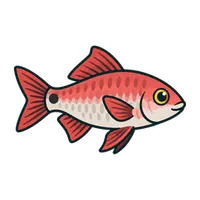
Males are the showy ones — smaller, slimmer and far more colourful than females, especially in spawning condition. Give them the space and the group they need and the colour largely takes care of itself.
💷 Costing it out? See how much a rosy barb really costs to keep — the rosy barb itself is usually the cheapest part.
Water & tank
Target 16–24 °C (61–75 °F), pH 6.0–8.0, and hardness 5–20 dGH. That temperature range is the headline: rosy barbs are subtropical and genuinely comfortable at room temperature, which makes them a good unheated-or-lightly-heated species rather than a warm-water tropical. They place no special demands on water chemistry, so they suit a wide range of tap water.
On space, SeriouslyFish is firm: "Base dimensions of at least 100 × 30 cm / 39 × 12 in or equivalent are required", giving roughly ~90 litres (~24 US gal). This is an active, full-bodied 4-inch fish that needs length to swim — not a nano or a 10-gallon fish.
Feeding
It is a generalised omnivore that in the wild eats "worms, insects and other small invertebrates, as well as plant material and organic detritus". In the tank it is easily fed on small live and frozen foods — bloodworm, Daphnia, Artemia — plus quality dried flakes and granules, "at least some of which should include additional plant or algal content". That vegetable component matters; do not run them on pure protein.
Behaviour & tankmates
SeriouslyFish rates it "generally peaceful and an ideal resident of the well-researched community aquarium", pairing well with other small cyprinids, tetras, livebearers, rainbowfishes, anabantoids, catfishes and loaches. The important caveat is group size: it is "a schooling species by nature and ideally should be kept in a group of at least 8-10 specimens", and doing so "will not only make the fish less nervous" but lets males colour up as they compete.
In too small a group, active barbs get nervous and boisterous, and their well-known tendency to nip fins is far more likely — so a proper school of 8–10 is the real fin-nipping insurance, and keep them away from slow, long-finned tankmates.
What to expect
Expect an energetic, robust, room-temperature fish that fills a tank with movement. Kept properly — a group of 8–10 in a metre-long tank at 16–24 °C — the males intensify to a deep rosy red and behave themselves. Kept short-numbered in a small tank they are jumpy, pushy and nippy. This is a fish where the mistakes (too few, too small, too warm) all cause the same "barbs are aggressive" reputation that good stocking simply prevents.
Myths, kindly busted
“Rosy barbs are tropical fish that need a heater around 26 °C.”
SeriouslyFish lists them at 16–24 °C (61–75 °F) — they are subtropical and comfortable at room temperature.
“Barbs are just aggressive fin-nippers.”
They are rated generally peaceful; the profile ties good behaviour to keeping a proper school of at least 8–10, which curbs the nipping.
“A small tank is fine for a few rosy barbs.”
The profile requires a base of at least 100 × 30 cm (~90 L) — this is an active ~4-inch fish that needs length.
🐟 Did you know? — Rosy Barb fun facts
Little true delights about the rosy barb — each one checked against a named source, no pet-shop myths.
- The rosy barb is native across South Asia, ranging from Pakistan through India, Nepal and Bangladesh. SeriouslyFish
- Escaped rosy barbs have established feral populations far from home, including in Singapore, Australia and Mexico. SeriouslyFish
- The genus name Pethia comes from the Sinhala (Sri Lankan) vernacular word for small cyprinids. SeriouslyFish
When to act
We triage, not diagnose — but these are worth a closer look (starting with a water test):
- Persistent chasing and torn or ragged fins on tankmates — usually a too-small group or overcrowding; increase school size and rehome slow, long-finned targets.
- A lone or paired-down barb hiding and darkening — nervous behaviour tied to inadequate numbers; observe and correct stocking.
- Sluggishness, loss of colour, or gasping — check temperature and water quality first; get a diagnosis before reaching for any medication.
Heading to a vet? Print the Rosy Barb vet-prep sheet — what to bring, what to tell them, and the questions to ask.
Sources & further reading
- SeriouslyFish — Pethia conchonius (Rosy Barb) — Max ~100 mm SL; minimum base 100 × 30 cm (~90 L / ~24 US gal); temperature 16–24 °C / 61–75 °F (subtropical); pH 6.0–8.0; hardness 5–20 dGH; "one of the hardiest small cyprinids"; schooling, ideally 8–10+; fin-nipping reduced by keeping a proper school.
Written & fact-checked by The Finfern Team against the sources above — kind, general guidance, not a diagnosis. If something looks wrong, test your water and, if it persists, contact a fish-savvy vet.

Get the free Rosy Barb Starter Kit
The essentials at a glance, a setup checklist and a first-30-days plan for your rosy barb — what to get right and what to watch for. Join the shoal and we’ll send it over. Free sheets and tools always stay open, no gatekeeping.
Water-first tips and new guides the moment they land. No spam — unsubscribe anytime. See how we handle your data in our privacy notice.