
Species · Tetras & rasboras
Scissortail Rasbora
Rasbora trilineata
If you remember one thing: give them a cycled tank with real swimming LENGTH (a 48 in / 120 cm footprint is the sweet spot) and keep them in a shoal of at least 6 (8-10+ is better) - these are fast, active mid-sized fish, not a tiny nano rasbora.
Difficulty: Beginner–Intermediate Tropical community tank ✓ Fact-checked care guide
Quick facts
| Adult size | Realistically about 3.5 in (9 cm) for most home-tank fish, with well-fed adults in spacious tanks reaching 4-5 in (10-13 cm). SeriouslyFish lists a species maximum of 150 mm / 6 in standard length, but that full size is rarely seen in aquariums. Either way, plan for a mid-sized, active fish rather than a nano species. |
|---|---|
| Minimum tank | Keeper-facing minimum for a proper shoal is about 114 L (30 US gal). You will see 75 L (20 gal) quoted, and a small young group can start there, but the honest bigger-is-better reality is that these are strong, restless swimmers: SeriouslyFish recommends a 120 x 45 cm (48 x 18 in) footprint for adults, roughly 240 L (64 gal). Swimming LENGTH matters far more than raw volume - a long 90-120 cm tank beats a tall one every time. |
| Temperature | 22-26 C (72-79 F). SeriouslyFish gives 22-25 C; most keeper guides sit around 23-26 C. Aim for a stable point in the low-to-mid 20s C rather than chasing the extremes. |
| pH | Around 6.5-7.5 is ideal (roughly neutral, leaning slightly acidic; ~6.6 is often cited as a sweet spot). The species tolerates a wider 5.0-8.0 depending on wild origin, but a stable value in the ideal band beats a "perfect" number that swings. |
| Hardness | Soft to moderately soft: GH about 2-12 dGH. They adapt to a fair range, but genuinely soft, slightly acidic water shows them at their best. |
| Filtration & flow | Gentle-to-moderate flow suits them well - a filter that turns the surface over and hints at a gentle stream current is ideal (a light powerhead is fine in a long tank). Keep them well filtered on a fully cycled tank; they are active and need clean, oxygenated water, but you do not need whitewater. |
| Diet | Omnivore leaning micro-predator. In the wild they eat small invertebrates and insects; in the tank they readily take quality flake or micro-pellet as a staple, best supplemented with small frozen/live foods. |
| Social | Shoaling - keep a group of at least 6, and 8-10 or more looks far better and calmer. Kept in twos or threes they turn nervous, skittish, and stressed. |
| Temperament | Genuinely peaceful and non-aggressive - not a fin-nipper. The catch is energy: they are fast, busy, near-constant swimmers, so their activity can unsettle slow or long-finned tankmates even though they never intend harm. |
| Lifespan | Typically 5-7 years in a stable, well-kept tank; some healthy fish reach 8. A few guides quote 4-7. Clean cycled water, a real shoal, and low stress push them toward the top of that range. |
Overview
The Scissortail Rasbora (Rasbora trilineata), also called the three-lined rasbora, is a hardy, silvery, torpedo-shaped shoaling fish from the flowing streams and peat-swamp forests of Southeast Asia.
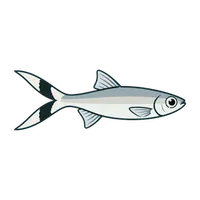
Its trademark is the deeply forked black-and-white banded tail that flicks open and shut like a pair of scissors as the fish swims - a genuinely eye-catching motion in a shoal.
It is often recommended as beginner-friendly, and it is forgiving on water chemistry, but the honest catch is size and energy: this is an active mid-sized fish that needs a long tank and a real group, not a 40 L (10 gal) nano setup.
💷 Costing it out? See how much a scissortail rasbora really costs to keep — the scissortail rasbora itself is usually the cheapest part.
Water & tank
Water first: get the tank fully cycled before any fish go in. Test that ammonia and nitrite both read 0 ppm and nitrate stays low (aim under ~20-40 ppm) via regular water changes. A new, uncycled tank is the most common way these fish are lost.
Target parameters: temperature 22-26 C (72-79 F), pH around 6.5-7.5 (soft, slightly acidic to neutral is ideal; the species tolerates 5.0-8.0 by origin), and GH roughly 2-12 dGH. Stability matters more than hitting an exact decimal.
Footprint over volume: because they are fast, restless swimmers, prioritise swimming LENGTH. A ~114 L (30 gal) tank is a sensible working minimum for a small shoal, but SeriouslyFish recommends a 120 x 45 cm (48 x 18 in) footprint (~240 L / 64 gal) for a full adult group - a long tank always beats a tall one here.
Flow and oxygen: provide gentle-to-moderate current and good surface movement to mimic their stream origins and keep oxygen up; a light powerhead is fine in a long tank but whitewater is not needed.
Lid, lid, lid: Scissortails are accomplished jumpers and are easily startled. A tight-fitting cover or lid is essential - carpet-jumping is a real and preventable cause of death.
Aquascape: a darker substrate, some driftwood and plants, and open swimming lanes down the middle show off their colour and shoaling behaviour; leave the central length clear for them to cruise.
Feeding
Feed a quality tropical flake or micro-pellet as the everyday staple - sized small enough for their mouths.
Supplement several times a week with small frozen or live foods such as daphnia, brine shrimp (artemia), bloodworms or mosquito larvae to bring out the best colour and condition.
Feed small amounts once or twice a day - only what they clear in a couple of minutes. They do not need much, and overfeeding fouls the water fast.
They feed mostly in the upper-to-mid water column and are enthusiastic, quick eaters, so make sure slower or shyer tankmates still get their share.
Behaviour & tankmates
A peaceful, sociable community fish that spends its day cruising the open middle-to-upper water in a loose shoal.
Excellent, well-matched tankmates include similar-sized peaceful community fish: other rasboras, tetras, danios, barbs, livebearers, rainbowfish, gouramis and anabantoids, corydoras catfish and peaceful loaches.
Best kept with fish of roughly its own size and speed. Their fast, busy swimming can stress slow or long-finned fish (fancy goldfish, long-finned bettas) and can overwhelm tiny nano species like chili rasboras, ember tetras or celestial pearl danios.
Avoid large or aggressive fish and dedicated fin-nippers; while Scissortails are not aggressive themselves, they can be intimidated or picked on.
In too small a group (two or three) they become jumpy and stressed, and stressed fish are more likely to dash, hide, or jump - keep the shoal at 6+ so they feel secure and behave naturally.
Not fully shrimp-safe: this active micro-predator will eat dwarf-shrimp fry and shrimplets (and tiny fish fry), though sturdy adult shrimp are usually left alone.
What to expect
A lively, always-on-the-move silver fish whose forked tail flashes its black-and-white bands like scissors as it swims - most striking in a group.
A shoal that cruises confidently in the open middle-to-upper water rather than hiding, once you keep 6 or more together.
A forgiving, beginner-friendly fish on water chemistry - as long as you respect the size, provide swimming length, and keep a tight lid.
Several years of company: expect 5-7 years, sometimes 8, from well-kept fish in stable, cycled water.
Myths, kindly busted
“It is a nano fish that is happy in a small 40 L (10 gal) tank.”
No. It is an active mid-sized rasbora (typically ~3.5 in / 9 cm, up to 5-6 in) that needs real swimming length. Plan for a long ~114 L (30 gal) minimum for a shoal, with a 48 in / 120 cm footprint ideal for adults.
“A pair or a trio is enough.”
It is a shoaling species. Kept in ones, twos or threes it turns nervous and skittish. Keep at least 6 (8-10+ is better) so the shoal feels secure and shows natural, confident behaviour.
“Scissortails are fin-nippers because they are so active.”
They are not aggressive and do not nip fins. The real issue is their speed and restless energy, which can stress slow-moving or long-finned tankmates even with no aggression involved - match them with fish of similar size and activity.
“You can leave the tank open-topped.”
Do not. They are strong jumpers and are easily startled. A tight-fitting lid is essential - an open or ill-fitting top is a common, avoidable cause of death.
When to act
We triage, not diagnose — but these are worth a closer look (starting with a water test):
- Fish gasping at the surface, hanging near the filter outflow, or unusually lethargic - stop feeding, test the water immediately (ammonia, nitrite, nitrate) and do a water change; gasping often means an ammonia/nitrite spike or low oxygen.
- The whole shoal clamping fins, going pale, hiding, or dashing/glancing off objects - a stress or water-quality/parameter-swing signal; check temperature, test parameters, and review recent changes rather than assuming disease.
- A fish found on the floor or repeatedly leaping - your lid is not sealing; close every gap around cords and filters at once.
- White spots (like grains of salt), fuzzy patches, rapid gill movement, or persistent flicking/scratching - possible signs of common illness like ich; isolate/observe, keep water pristine, and seek advice from a qualified aquatic vet or a trusted fishkeeping source. This is triage, not a diagnosis.
- Sudden loss of appetite in a normally eager eater, or a fish hanging apart from the shoal - treat it as an early warning: test the water first, then watch closely.
Heading to a vet? Print the Scissortail Rasbora vet-prep sheet — what to bring, what to tell them, and the questions to ask.
Sources & further reading
- SeriouslyFish - Rasbora trilineata — Primary authority: size (150 mm SL), 120 x 45 cm footprint, temp 22-25 C, pH 5.0-8.0 (6.5-7.5 ideal), hardness 2-12 dH, shoal of at least 6, peaceful, diet, tankmates, known jumper.
- AquariumStoreDepot - Scissortail Rasbora Care Guide — Adult size 5 in (13 cm), typical 4-4.5 in; lifespan 5-7 (up to 8); 30 gal (114 L) minimum; 23-26 C; pH 6.0-7.5; 2-10 dGH; group of 6+; known jumpers; peaceful.
- Aquarium Source - Scissortail Rasbora Care — Adult ~3.5 in (up to ~5 in in spacious tanks); lifespan 5-7 (reports of 8); active swimmers needing a long/rectangular tank and moderate flow; shoal of at least 6; fast activity can stress slow/long-finned or tiny nano species (not fin-nippers).
- Fishkeeping World - Scissortail Rasbora Care Guide — Adult ~3.5 in (can reach 6 in); lifespan 4-7; 20 gal quoted; 73-78 F (23-25 C); pH 6.6-7.0; 2-12 dGH; shoal of at least 6; peaceful; easily startled and prone to jumping, keep covered; benefits from gentle stream-like current.
Written & fact-checked by The Finfern Team against the sources above — kind, general guidance, not a diagnosis. If something looks wrong, test your water and, if it persists, contact a fish-savvy vet.

Get the free Scissortail Rasbora Starter Kit
The essentials at a glance, a setup checklist and a first-30-days plan for your scissortail rasbora — what to get right and what to watch for. Join the shoal and we’ll send it over. Free sheets and tools always stay open, no gatekeeping.
Water-first tips and new guides the moment they land. No spam — unsubscribe anytime. See how we handle your data in our privacy notice.