
Species · Bettas & gouramis
Sparkling Gourami
Trichopsis pumila
A tiny, jewel-like labyrinth fish that actually croaks — peaceful and full of character, but small and delicate: it needs gentle water, a covered tank with an air gap, and only tiny, calm tankmates.
Difficulty: Beginner–Intermediate Tropical community tank ✓ Fact-checked care guide
Quick facts
| Adult size | ~4 cm / 1.6 in SL |
|---|---|
| Minimum tank | ~41 L / 11 US gal for a pair or small group — SeriouslyFish recommends a 45 × 30 cm base |
| Temperature | 22–28 °C / 72–82 °F |
| pH | 5.0–7.5 |
| Hardness | 1–12 dGH (soft) |
| Filtration & flow | Gentle only (air-powered sponge filter); a lid + air gap for its labyrinth breathing |
| Diet | Micropredator — small live/frozen (Daphnia, Artemia, bloodworm); will take small dried foods once recognised |
| Social | Best in a pair or small group |
| Temperament | Peaceful and shy — a nano fish, easily intimidated |
| Lifespan | Commonly cited at ~4–5 years in the hobby (not stated by the primary source) |
Overview
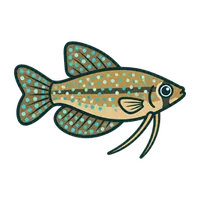
The sparkling gourami (Trichopsis pumila) is a tiny anabantoid — a labyrinth air-breather like the betta — at only about 4 cm, iridescent with blue-green flecks and red-edged fins. Its party trick is genuine: using a special muscle-and-swim-bladder mechanism it makes an audible "croaking" or purring sound, usually when displaying or courting.
It is peaceful, curious and full of personality, but it is a small, gentle fish — best thought of as a nano centrepiece for a calm, well-planted tank rather than a robust community fish.
💷 Costing it out? See how much a sparkling gourami really costs to keep — the sparkling gourami itself is usually the cheapest part.
Water & tank
Sparkling gouramis want soft, gently acidic-to-neutral water — pH 5.0–7.5, 1–12 dGH — at 22–28 °C / 72–82 °F. Because they come from sluggish, still waters, keep the flow very gentle: an air-powered sponge filter is ideal, and strong currents should be avoided. Cycle the tank first.
Two setup essentials come from its labyrinth breathing: keep the tank well-covered (it is an excellent jumper) and do NOT fill it to the very top, because it needs to reach a layer of warm, humid air above the water to breathe. A heavily-planted 45 × 30 cm tank (~41 L / 11 US gal) with surface cover and leaf litter suits a pair or small group.
Feeding
A micropredator: in the wild it eats insects and small invertebrates. Offer plenty of small live and frozen foods — Daphnia, Artemia and bloodworm — for the best colour and condition.
It will usually learn to take small dried foods once it recognises them as edible, but it should not be kept on dried food alone.
Behaviour & tankmates
Peaceful but timid — keep it in a pair or small group, alone or only with very peaceful, similarly tiny species. Bigger or more vigorous tankmates will both intimidate it and outcompete it for food. Good companions include small rasboras (Boraras, Trigonostigma) and small loaches (Pangio).
It is a labyrinth fish, so expect gentle displaying and croaking between individuals. One honest caveat: some keepers report it preys on baby freshwater shrimp (Caridina, Neocaridina), so pair it with a shrimp colony with care.
What to expect
A settled fish is a subtle, jewel-like presence that hangs in the mid-water among plants and croaks softly when courting or squabbling. New fish are often shy for a week or two before they colour up and explore.
Myths, kindly busted
“The croaking sound means the fish is sick or in distress.”
Croaking is a normal, healthy communication sound — usually courtship or a mild territorial display, produced by a specialised mechanism.
“As a labyrinth fish it does not need good water or filtration.”
Breathing air does not excuse poor water; it still needs a cycled, clean, gently-filtered tank — the air-breathing is a supplement, not a substitute.
“It is a bulletproof nano fish for any community.”
It is small, shy and easily bullied or starved by bigger tankmates — keep it only with tiny, peaceful species in a gentle, planted tank.
🐟 Did you know? — Sparkling Gourami fun facts
Little true delights about the sparkling gourami — each one checked against a named source, no pet-shop myths.
- The sparkling gourami “croaks” audibly by stretching and plucking modified pectoral-fin tendons like guitar strings — a mechanism unique among labyrinth fishes. SeriouslyFish
- During courtship the female makes “purring” sounds to initiate spawning — one of very few fish known to do this. SeriouslyFish
- Rival males can settle disputes without fighting by sizing each other up through visual and acoustic “croaking” signals. SeriouslyFish
When to act
We triage, not diagnose — but these are worth a closer look (starting with a water test):
- A fish gasping hard at the surface beyond its normal air-gulps, or sitting clamped on the bottom — test the water for ammonia/nitrite and check temperature and oxygen.
- Staying pale, hidden and off its food while tankmates are active — often stress from flow, bullying, or poor water; review the setup.
- White spots, ragged fins, or reddened/cloudy patches — signs of a water or health problem; review conditions and, if it persists, seek fish-savvy advice.
Heading to a vet? Print the Sparkling Gourami vet-prep sheet — what to bring, what to tell them, and the questions to ask.
Sources & further reading
- SeriouslyFish — Trichopsis pumila (Sparkling Gourami) — Adult ~40 mm SL; recommended 45 × 30 cm base (~41 L / 11 US gal); temperature 22–28 °C / 72–82 °F; pH 5.0–7.5; hardness 1–12 dGH; keep in a pair/small group with very peaceful, similarly-sized fish; micropredator (small live/frozen); avoid strong flow; needs a lid + surface air gap (labyrinth breather, good jumper); some keepers report predation on small shrimp.
Written & fact-checked by The Finfern Team against the sources above — kind, general guidance, not a diagnosis. If something looks wrong, test your water and, if it persists, contact a fish-savvy vet.

Get the free Sparkling Gourami Starter Kit
The essentials at a glance, a setup checklist and a first-30-days plan for your sparkling gourami — what to get right and what to watch for. Join the shoal and we’ll send it over. Free sheets and tools always stay open, no gatekeeping.
Water-first tips and new guides the moment they land. No spam — unsubscribe anytime. See how we handle your data in our privacy notice.