
Species · Bettas & gouramis
Three-spot Gourami
Trichopodus trichopterus
The hardiest gourami in the trade — sold in blue, gold, opaline and marbled forms — that adapts to almost any water. The real catch is temperament, not chemistry.
Difficulty: Beginner–Intermediate Tropical community tank ✓ Fact-checked care guide
Quick facts
| Adult size | ~150 mm / 6 in SL |
|---|---|
| Minimum tank | ~81 L / ~21 US gal — a 90 × 30 cm base, per SeriouslyFish |
| Temperature | 24–30 °C / 75–86 °F |
| pH | 5.5–8.5 |
| Hardness | 3–35 dGH |
| Filtration & flow | Undemanding; a labyrinth air-breather that likes floating cover and open water |
| Diet | Generalised omnivore — most foods accepted; include a vegetable/algae component |
| Social | Keep with robust tankmates; watch male-on-male squabbling |
| Temperament | Territorial — individuals vary from peaceful to "very spiteful"; males aggressive when breeding |
| Lifespan | Commonly cited at ~4–5 years in the hobby (not stated by the primary source) |
Overview
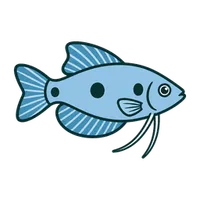
The three-spot gourami is one of the trade’s true survivors — a labyrinth fish that gulps air at the surface and shrugs off water conditions that would trouble fussier fish. Almost everything you will see for sale (the opaline, blue, gold, cosby, marbled and silver forms) is a selectively-bred colour variety of the same species; the wild fish is a plain blue-grey fish with two spots that, with the eye, make "three".
It has a reputation as an easy beginner fish, and in terms of hardiness that is fair. The honest catch is temperament: SeriouslyFish recommends it to beginners "with reservations regarding it’s temperament", and that reservation is the whole story with this fish.
💷 Costing it out? See how much a three-spot gourami really costs to keep — the three-spot gourami itself is usually the cheapest part.
Water & tank
Get the water right first, then relax — this is a genuinely unfussy fish. SeriouslyFish gives a wide window: temperature 24–30 °C (75–86 °F), pH 5.5–8.5, and hardness 3–35 dGH. That range spans soft-and-acidic to hard-and-alkaline, which is why it adapts to most tap water. Aim for the middle and keep it stable rather than chasing a number.
For space, the profile lists a base of 90 × 30 cm (~81 L / ~21 US gal). It reaches 15 cm (6 in), so it is a solid, deep-bodied fish that wants swimming room. A planted tank with some floating cover and open water suits it — the floating plants matter, because a stressed or bullied gourami retreats upward.
Feeding
Feeding is the easy part. Wild fish are generalised omnivores that graze plants, algae, small invertebrates, zooplankton and detritus, and in the tank it "will accept most foods offered". Give a good staple plus an algae-based/vegetable food, and vary it for the best condition.
Behaviour & tankmates
Here is the honest part. This fish is "often recommended as a community fish" but SeriouslyFish flatly says "this is not always so". Some individuals become "very spiteful as they mature", males are territorial and squabble among themselves, and any of them can turn "very aggressive when breeding". Temperament is individual — you may get a peaceful one, you may not — so do not count on the label.
Stock it with robust tankmates that can hold their own: barbs, larger characins, loricariids (plecos), loaches and other medium-to-large gouramis. Avoid tiny, slow or long-finned fish that a spiteful male can harass. If you keep more than one gourami, watch for male-on-male squabbling and give enough space and sightline breaks (plants, wood) to defuse it.
What to expect
Expect a hardy, air-breathing fish that will likely outlast your worries about water chemistry — but keep expectations honest about personality. You may raise a mellow community member, or a bossy one that rearranges the pecking order. Plan the tank around the worst case (robust tankmates, cover, space) and a calm fish is a bonus rather than a gamble that went wrong.
Myths, kindly busted
“Gouramis are peaceful community fish, safe with anything.”
SeriouslyFish says the community-fish label "is not always so" — some individuals turn "very spiteful", and males are territorial and "very aggressive when breeding". Choose robust tankmates.
“The blue, gold and opaline gouramis are different fish.”
They are all selectively-bred colour forms of the single species Trichopodus trichopterus; the natural fish is the blue-grey three-spotted form.
“It’s fragile and needs perfect water.”
SeriouslyFish calls it "one of the hardiest fish commonly available" that adapts across a very wide range (pH 5.5–8.5, hardness 3–35 dGH); its real challenge is temperament, not water.
🐟 Did you know? — Three-spot Gourami fun facts
Little true delights about the three-spot gourami — each one checked against a named source, no pet-shop myths.
- The blue, gold, opaline, cosby, marbled and silver gouramis are all one species — selectively bred colour forms of the wild blue-grey three-spot. SeriouslyFish
- It is a bubble-nester: the male builds a floating nest of bubbles and plant bits, then guards the eggs and fry alone after driving the female off. SeriouslyFish
- Around the central and lower Mekong, populations migrate into flooded forest in the wet season and return to the river as the water recedes. SeriouslyFish
When to act
We triage, not diagnose — but these are worth a closer look (starting with a water test):
- Hanging at the surface gulping hard, clamped fins or listlessness in an air-breather can signal water-quality or gill trouble — test water and review conditions rather than self-medicating.
- A fish that stops eating (this species normally "will accept most foods offered") is an early warning worth investigating — check water first.
- Torn fins, chased or hiding tankmates, or a fish wedged in a top corner point to bullying — separate or rehome before injuries set in.
Heading to a vet? Print the Three-spot Gourami vet-prep sheet — what to bring, what to tell them, and the questions to ask.
Sources & further reading
- SeriouslyFish — Trichopodus trichopterus (Three-spot Gourami) — Max ~150 mm SL; base 90 × 30 cm (~81 L / ~21 US gal); temperature 24–30 °C / 75–86 °F; pH 5.5–8.5; hardness 3–35 dGH; "one of the hardiest fish commonly available"; territorial — some become "very spiteful", males "very aggressive when breeding"; keep with robust tankmates; blue/gold/opaline are colour forms of this one species.
Written & fact-checked by The Finfern Team against the sources above — kind, general guidance, not a diagnosis. If something looks wrong, test your water and, if it persists, contact a fish-savvy vet.

Get the free Three-spot Gourami Starter Kit
The essentials at a glance, a setup checklist and a first-30-days plan for your three-spot gourami — what to get right and what to watch for. Join the shoal and we’ll send it over. Free sheets and tools always stay open, no gatekeeping.
Water-first tips and new guides the moment they land. No spam — unsubscribe anytime. See how we handle your data in our privacy notice.