
Species · Loaches
Zebra Loach
Botia striata
The best community Botia — but only in a mature tank, in a group of 5–10+, and never bought as snail pest-control.
Difficulty: Intermediate Tropical community tank ✓ Fact-checked care guide
Quick facts
| Adult size | ~90 mm / 3.5 in SL |
|---|---|
| Minimum tank | ~108 L / ~29 US gal — a 120 × 30 cm base minimum, per SeriouslyFish |
| Temperature | 21–26 °C / 70–79 °F |
| pH | 6.0–7.5 |
| Hardness | 1–10 dGH |
| Filtration & flow | A mature, stable, spotless, well-oxygenated tank; smooth cover; a tight lid (it jumps) |
| Diet | Chiefly carnivorous omnivore — varied dried, live/frozen foods plus fresh vegetables |
| Social | Gregarious — keep at least 5–6, preferably 10 or more; never singly |
| Temperament | Peaceful and one of the best community loaches — kept in numbers |
| Lifespan | Commonly cited at ~10–15 years in the hobby (not stated by the primary source) |
Overview
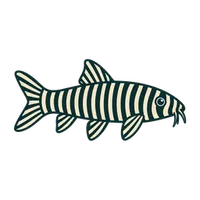
The zebra loach is, per SeriouslyFish, "perhaps the best choice of Botia sp. for the general community" thanks to its modest adult size and peaceable nature. It is a striped, red-mouthed, endlessly social little loach with a genuinely complex inner life — the source documents "greying out", "shadowing", clicking sounds and the famous "loachy dance".
But it comes with two firm conditions the source keeps returning to: it needs a mature, stable tank, and it needs company. This is not a fish to add to a new set-up or to keep alone.
💷 Costing it out? See how much a zebra loach really costs to keep — the zebra loach itself is usually the cheapest part.
Water & tank
Get the water right first — and mean it, because this fish is fussier about stability than chemistry. SeriouslyFish lists temperature 21–26 °C (70–79 °F), pH 6.0–7.5, and hardness 1–10 dGH. More important than any single number is the source’s insistence on spotless, well-oxygenated water: it says these loaches are intolerant of organic waste, should never go into a biologically immature tank, and need routine weekly water changes of 30–50%.
On space, the source sets a minimum base of 120 × 30 cm (~108 L / ~29 US gal) — a bigger footprint than most tetras, reflecting its size and activity. Provide plenty of cover, smooth rocks and crevices (nothing sharp), and a tight-fitting lid, because the source warns these loaches jump.
Feeding
SeriouslyFish describes a chiefly carnivorous but flexible feeder whose natural diet includes aquatic molluscs, insects and worms. In the aquarium it wants a varied menu: quality dried foods, live or frozen bloodworm, Tubifex and Artemia, plus fresh vegetables such as cucumber, melon, blanched spinach or courgette. It is a bold feeder that will rise into midwater at mealtimes once settled.
Behaviour & tankmates
The source is emphatic that Botia are gregarious, form complex social hierarchies, and should be kept in groups of at least 5 or 6, preferably 10 or more. Kept singly they can turn withdrawn or aggressive; kept as a pair or trio, the dominant fish may bully the others until they stop feeding. A real group is a welfare requirement, not a nicety.
It is peaceful with the right tankmates but the source warns against much smaller fish and slow, long-finned species such as bettas and guppies (whose fins can be nipped). Good matches are peaceful, open-water cyprinids and, in larger tanks, other Botia. Crucially, it "should never be considered the answer to a snail infestation" — it eats some snails but is not an obligate snail-eater, so buying it as pest control is the wrong reason.
What to expect
Expect a fascinating, social, personality-rich loach that thrives in a mature tank with a proper group — and struggles badly without either. Given 5–10+ companions, stable spotless water and plenty of cover, zebra loaches are long-lived and endlessly watchable. Newly-imported stock is especially prone to "skinny disease", so buy healthy, established fish and quarantine well.
Myths, kindly busted
“Get a zebra loach and it’ll clear your snail infestation.”
SeriouslyFish says it "should never be considered the answer to an infestation", as botiids are not obligate molluscivores — they eat some snails but won’t solve the problem.
“One or two zebra loaches are fine.”
The source says keep groups of at least 5 or 6, preferably 10 or more; singly or in a trio they turn withdrawn or aggressive and can be bullied off their food.
“It’s a hardy loach you can add to a new tank.”
The source says they "should never be introduced to biologically immature set-ups" and adapt most readily to stable, mature aquaria.
🐟 Did you know? — Zebra Loach fun facts
Little true delights about the zebra loach — each one checked against a named source, no pet-shop myths.
- The zebra loach's name striata is Latin for “striped”, describing the many dark bars running along its body. SeriouslyFish
- It's a social Botia native only to fast, forested hill rivers of India's Western Ghats. SeriouslyFish
- Inquisitive and prone to squeezing into crevices, these loaches are also known jumpers, so their tank needs a tight-fitting lid. SeriouslyFish
When to act
We triage, not diagnose — but these are worth a closer look (starting with a water test):
- Visible weight loss / a pinched, thin body ("skinny disease" per the source), especially in new imports — isolate, ensure it is actually eating, and review sourcing/quarantine.
- A loach kept alone or in a trio hiding constantly, or one dominant fish stopping the others from feeding — increase the group size; this is a social-stress warning, not a treatment case.
- Loaches gasping or hanging listlessly after being added to a newer tank — check that the tank is fully mature and the water spotless and oxygenated; act on conditions.
Heading to a vet? Print the Zebra Loach vet-prep sheet — what to bring, what to tell them, and the questions to ask.
Sources & further reading
- SeriouslyFish — Botia striata (Zebra Loach) — Max ~90 mm SL; minimum base 120 × 30 cm (~108 L / ~29 US gal); temperature 21–26 °C / 70–79 °F; pH 6.0–7.5; hardness 1–10 dGH; "best choice of Botia for the general community"; gregarious — keep 5–6+ (preferably 10+); needs a mature tank + tight lid; NOT snail pest-control; prone to "skinny disease" when newly imported.
Written & fact-checked by The Finfern Team against the sources above — kind, general guidance, not a diagnosis. If something looks wrong, test your water and, if it persists, contact a fish-savvy vet.

Get the free Zebra Loach Starter Kit
The essentials at a glance, a setup checklist and a first-30-days plan for your zebra loach — what to get right and what to watch for. Join the shoal and we’ll send it over. Free sheets and tools always stay open, no gatekeeping.
Water-first tips and new guides the moment they land. No spam — unsubscribe anytime. See how we handle your data in our privacy notice.