
Species · Tetras & rasboras
Lambchop Rasbora
Trigonostigma espei
Get the water right first (soft, warm, gently filtered, fully cycled) and keep them in a real shoal of 8-10+ in a tank with swimming length, and this tiny copper jewel is one of the easiest, most rewarding community fish you can own.
Difficulty: Beginner Tropical community tank ✓ Fact-checked care guide
Quick facts
| Adult size | About 3 cm / 1.2 in standard length (SeriouslyFish gives 30 mm SL); including the tail most hobby fish top out around 3.5-4 cm (~1.5 in). It is a genuinely small fish, so people consistently overestimate its size. |
|---|---|
| Minimum tank | Keeper-facing minimum: a 60 x 30 cm footprint tank, roughly 54 L / about 14 US gal (11.5 imp gal), per SeriouslyFish. You will see pet shops say "a 10 gallon (40 L) is fine for six" - it technically survives there, but the honest, bigger-is-better reality is that this is a shoaling swimmer that looks and behaves far better in a 54-75 L (14-20 US gal) tank with open swimming length. Prioritise LENGTH (a longer, shallower tank) over tall tanks - they cruise side to side, not up and down. |
| Temperature | 23-28 C / 73-82 F (SeriouslyFish). A stable temperature around 24-26 C / 75-79 F is ideal; they are tropical and need a heater in most homes. |
| pH | 5.5-7.5 (SeriouslyFish). Soft, slightly acidic to neutral water is ideal; stability matters more than chasing an exact number. |
| Hardness | Soft to moderately soft: GH 1-10 dGH (SeriouslyFish); other keeper guides cite ~2-11 dH, which agrees. They tolerate a range but colour and long-term health are best in soft water. |
| Filtration & flow | Gentle to moderate flow. SeriouslyFish suggests turnover around 4-5x tank volume per hour (e.g. a filter rated ~215-270 lph on a ~54 L tank). Avoid strong currents - a small internal, sponge, or baffled hang-on-back filter suits them well, and a sponge filter is ideal if you ever want fry to survive. |
| Diet | Omnivorous micropredator. In the wild it eats tiny insects, larvae and zooplankton. |
| Social | Shoaling - keep a group of at least 8-10 (SeriouslyFish recommends "at least 8-10 specimens"). Six is the absolute floor some shops quote; below that they become nervous, wash out in colour, and hide. More is genuinely better. |
| Temperament | Very peaceful and non-aggressive (SeriouslyFish describes them as "very peaceful"). Slightly timid - they may dart for cover if you approach the glass suddenly, especially when kept in too-small groups. |
| Lifespan | Typically 3-5 years in a well-maintained aquarium (multiple keeper care guides, e.g. Fish Laboratory). |
Overview
The Lambchop Rasbora (Trigonostigma espei) is a tiny, peaceful copper-orange schooling fish from slow, soft blackwater streams and pools in Thailand, Cambodia and Phu Quoc Island (Vietnam).
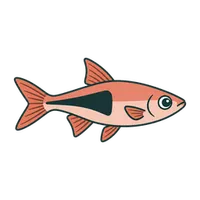
It is named for the dark, cleaver- or lambchop-shaped mark along its rear half - thinner and more hook-like than the broad triangular wedge of its cousin the Harlequin Rasbora (T. heteromorpha).
It is one of the best true community fish for a small-to-medium planted tank: hardy once the water is right, non-aggressive, and stunning in a tight shoal against green plants and a dark substrate.
Taxonomy note: older sources (SeriouslyFish) list it under family Cyprinidae; current classifications place it in Danionidae, subfamily Rasborinae. Either way it is a small cyprinid-type 'rasbora'.
💷 Costing it out? See how much a lambchop rasbora really costs to keep — the lambchop rasbora itself is usually the cheapest part.
Water & tank
Water first, always: this fish thrives on soft, warm, stable water - aim for 23-28 C / 73-82 F, pH 5.5-7.5, and GH 1-10 dGH (SeriouslyFish). It handles a range but rewards soft, slightly acidic water with deeper colour.
Cycle the tank BEFORE any fish go in. Run a fishless nitrogen cycle until ammonia and nitrite both read 0 ppm and nitrate is rising - only then add fish, and add the whole shoal over a week or two, not all at once. Lambchops are small and sensitive to ammonia/nitrite spikes, so a mature filter is non-negotiable.
Footprint over volume: a 60 x 30 cm base (~54 L / ~14 US gal) is the sensible minimum (SeriouslyFish). Choose LENGTH over height - they swim laps side to side. A 54-75 L (14-20 US gal) tank lets a proper 8-10+ shoal spread out and behave naturally.
Keep flow gentle to moderate (roughly 4-5x volume/hour turnover; SeriouslyFish). A sponge or baffled filter avoids blasting these light-bodied fish around the tank.
Aquascape for security: live plants, some floating cover, driftwood and a darker substrate. Botanicals/leaf litter (a light blackwater tint) mimic their native streams, lower the pH gently and bring out the copper-red. A dense-plant edge with an open central swimming lane is the ideal layout.
Fit a tight-fitting lid. They are small and can jump, especially if startled or newly added.
Maintenance: test the water regularly and do modest weekly water changes (around 20-30%) with dechlorinated, temperature-matched water to keep nitrate low and parameters steady. Consistency beats big swings.
Feeding
Feed a good-quality micro/small dried food (crushed flake, nano pellets or micro-granules) as the daily staple - their mouths are tiny, so match the food size.
Rotate in small live and frozen foods several times a week: daphnia, baby brine shrimp (Artemia), cyclops, microworm and finely chopped or small bloodworm. This is when their colour really lifts (SeriouslyFish: a micropredator taking small live/frozen foods).
Feed small amounts once or twice a day - only what they clear in a minute or two. Overfeeding fouls water fast in a small tank and is a common cause of problems.
A varied diet plus soft, clean water is the real secret to the intense copper-orange these fish are bought for - not any single 'colour-enhancing' product.
Behaviour & tankmates
A model community fish: very peaceful and safe with other calm, similarly-sized species (SeriouslyFish).
Great tankmates: other small rasboras and the Harlequin, small tetras (neon, cardinal, ember), pygmy/dwarf Corydoras and other small catfish, peaceful loaches (e.g. kuhli), Otocininclus, and small livebearers. They also pair well with peaceful dwarf cichlids in a larger, soft-water setup.
Keep them OUT of tanks with large, boisterous, or fin-nipping fish, and anything big enough to eat a 3 cm fish (larger cichlids, big barbs, angelfish in small tanks).
Shrimp: adult lambchops generally ignore adult dwarf shrimp, but like most fish they will eat baby shrimp - fine for a display shrimp colony you are not trying to breed, less so for a dedicated shrimp-breeding tank.
Shoaling behaviour is the whole point: in a group of 8-10+ they school loosely, show natural colour and confidence, and use the open water. In too-small groups they turn shy, pale and skittish - so the group size IS a welfare parameter, not decoration.
Breeding bonus: in soft, mature water they scatter eggs on the undersides of broad plant leaves (e.g. Cryptocoryne); eggs hatch in roughly 24-48 hours (SeriouslyFish). Females are rounder and slightly larger; males are slimmer and more intensely coloured.
Myths, kindly busted
“Six is plenty for a happy shoal.”
Six is the bare survival floor some shops quote. SeriouslyFish recommends at least 8-10, and more is better - larger groups are calmer, bolder and far more colourful. Understocking the shoal is a leading cause of stress, hiding and washed-out colour.
“They only need a 10-gallon (40 L) 'nano' tank.”
They survive in a 10 gallon, but they are active shoaling swimmers. The welfare-consensus footprint is ~60 x 30 cm / ~54 L (~14 US gal) minimum, and a 14-20 US gal tank prioritising swimming LENGTH is where a proper group truly thrives.
“Lambchop and Harlequin rasboras are the same fish.”
They are different species. T. espei is slimmer, more copper/orange-red, with a thin hook/cleaver-shaped 'lambchop' mark; T. heteromorpha (Harlequin) is deeper-bodied, pinker, with a broad triangular wedge. They can be kept together but are not interchangeable.
“They're 'hardy beginner fish', so water quality doesn't matter much.”
They are hardy ONCE established in stable, cycled, soft water - but they are small and genuinely sensitive to ammonia/nitrite and big parameter swings. A fully cycled tank and steady maintenance matter more than their hardy reputation suggests.
When to act
We triage, not diagnose — but these are worth a closer look (starting with a water test):
- Fish gasping at the surface, clamped fins, sudden hiding, or deaths soon after adding them - stop, test the water immediately for ammonia and nitrite (both should be 0 ppm). Any reading above 0 usually means the tank wasn't fully cycled or is overstocked; do a water change and address the cycle.
- Colour washing out to pale/grey, constant skittishness or fish scattered and hiding - most often too-small a group (add more to reach 8-10+), too-strong flow, or no cover. Review shoal size, flow and planting before assuming illness.
- White spots like grains of salt (suspected ich), fuzzy cottony patches, red streaks, ulcers, rapid breathing, or a bloated/pineconed body - these signal a health problem. Check and correct water first, quarantine if you can, and seek advice from an aquatic vet or an experienced fishkeeping community. (Triage only - this is not a diagnosis.)
- Fish jumping or found on the floor - confirm you have a tight-fitting lid; startled lambchops can jump.
Heading to a vet? Print the Lambchop Rasbora vet-prep sheet — what to bring, what to tell them, and the questions to ask.
Sources & further reading
- SeriouslyFish - Trigonostigma espei (Lambchop Rasbora) — Primary science-based source for size (30 mm SL), footprint (60x30 cm / ~54 L), temp 23-28 C, pH 5.5-7.5, GH 1-10 dGH, group 8-10, temperament, diet, filtration turnover, and breeding.
- Aquarium Co-Op - Care Guide for Harlequin and Lambchop Rasboras — Reputable retailer/keeper guide: min group of 6+ (stress in smaller schools), ~76 F / 24 C, soft water, peaceful/timid temperament, omnivorous diet, community tankmates incl. Harlequins and tetras.
- Fish Laboratory - Lambchop Rasbora Ultimate Care Guide — Corroborates lifespan 3-5 years, temp 73-83 F / 23-28 C, hardness ~2-11 dH, recommended group 8-10, and community tankmate list; notes caution with shrimp/small tankmates.
- Wikipedia - Trigonostigma espei — Taxonomy (family Danionidae, subfamily Rasborinae), native range (Thailand, Cambodia, Phu Quoc/Vietnam), origin of the 'lambchop' name, IUCN Least Concern.
Written & fact-checked by The Finfern Team against the sources above — kind, general guidance, not a diagnosis. If something looks wrong, test your water and, if it persists, contact a fish-savvy vet.

Get the free Lambchop Rasbora Starter Kit
The essentials at a glance, a setup checklist and a first-30-days plan for your lambchop rasbora — what to get right and what to watch for. Join the shoal and we’ll send it over. Free sheets and tools always stay open, no gatekeeping.
Water-first tips and new guides the moment they land. No spam — unsubscribe anytime. See how we handle your data in our privacy notice.