
Species · Tetras & rasboras
X-Ray Tetra
Pristella maxillaris
Get the water right and the group right, and the X-ray tetra is one of the most forgiving, genuinely happy little community fish you can keep: cycle the tank first, keep at least 6 (ideally 10+), and give them length to swim.
Difficulty: Beginner Tropical community tank ✓ Fact-checked care guide
Quick facts
| Adult size | About 4.5 cm (1.8 in) standard length, up to roughly 5 cm (2 in) total length including the tail. A small, slim tetra, and the see-through body makes them look even daintier. |
|---|---|
| Minimum tank | The keeper-facing floor is a 60 x 30 cm (24 x 12 in) footprint, about 54 litres / roughly 14-15 US gallons, which is the smallest tank SeriouslyFish lists for a proper shoal. You will see "10 gallons / 38 L" quoted a lot; that is tight for a group that swims this actively. The honest reality is that bigger, and especially LONGER, is better. A 75-90 L (20-24 gal) tank around 60 cm+ long lets you keep a confident group of 8-10 and gives them the horizontal swimming space that matters far more than raw volume. Footprint (swimming length) beats height every time for a shoaling tetra. |
| Temperature | 22-28 C (72-82 F). Most keepers settle around 24-26 C (75-79 F). Stable beats perfect: use a reliable heater plus a thermometer rather than chasing a single degree. |
| pH | 6.0-7.5 is ideal, and they are genuinely tolerant of 6.0-8.0. Unusually for a tetra, they do fine in neutral-to-slightly-alkaline tap water. |
| Hardness | Very adaptable. GH of roughly 2-20 dGH is the comfortable range (SeriouslyFish), and they tolerate harder water up to about 25-30 dGH. Stability matters more than a specific number; aim for the lower end only if you plan to breed them. |
| Filtration & flow | A cycled filter running gentle-to-moderate flow. They come from slow clearwater streams and flooded savannah, not torrents, so aim for a calm current with a few sheltered spots. A gentle sponge or baffled hang-on-back filter is ideal; avoid a fierce outflow that pins them to one end of the tank. |
| Diet | Omnivorous micropredator. In the wild it eats small invertebrates; in the aquarium it readily takes good-quality flake and micro-granules as a staple, plus regular small live or frozen foods (daphnia, brine shrimp/Artemia, bloodworms) for condition. |
| Social | Shoaling: keep a minimum of 6, and 10 or more is noticeably better. A bigger group is calmer, more colourful, and spends more time out in the open. |
| Temperament | Peaceful and easygoing. Not a fin-nipper when kept in a proper group, but a stressed, undersized group can get twitchy and pick at each other or at slower tankmates. |
| Lifespan | Around 4-5 years in a well-kept, cycled aquarium, and some live a little longer. Short lives usually trace back to a rushed, uncycled setup rather than the fish being fragile. |
Overview
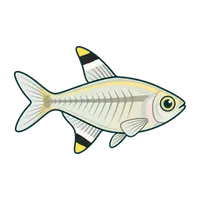
The X-ray tetra (Pristella maxillaris) is a small, peaceful, semi-transparent characin from the coastal waters of Venezuela, Guyana, Suriname, French Guiana and northern Brazil. The see-through body, tipped with black-and-white fin flags and a red tail, is where the 'x-ray' name comes from.
It is deservedly popular as a beginner and community fish: hardy across a wide range of water chemistry, active without being aggressive, and happy in a standard heated community tank.
The two things people most often get wrong are keeping too few of them and adding them to an uncycled tank. Fix those and it is a genuinely easy, long-lived, rewarding fish.
💷 Costing it out? See how much a x-ray tetra really costs to keep — the x-ray tetra itself is usually the cheapest part.
Water & tank
Water first: this fish belongs in a fully cycled, filtered, heated aquarium. Before any fish go in, run a fishless cycle until the tank can convert ammonia and nitrite to zero. Target 22-28 C (72-82 F), pH 6.0-7.5 (tolerant to 8.0), and GH around 2-20 dGH. It genuinely handles neutral-to-hard tap water, which is unusual for a tetra.
Once stocked, keep ammonia and nitrite at 0 ppm at all times and nitrate low with regular partial water changes (roughly 25% weekly is a sensible rhythm). Always dechlorinate tap water and match temperature before adding it.
Tank footprint matters more than raw litres. A 60 cm+ (24 in+) long tank gives this active shoaler room to swim from end to end; the practical minimum is a 60 x 30 cm / ~54 L (about 14-15 gal) tank, but a 75-90 L (20-24 gal) tank is far better for a group of 8-10.
Aquascape for security: they show their best colour and behaviour in a well-planted tank with some shade, driftwood and darker substrate, and open swimming space in the front. A nervous, pale group usually means too little cover or too few fish, not sick fish.
Keep flow gentle to moderate and provide a secure lid: like many small tetras they are capable jumpers, especially when first settling in.
Feeding
Staple: a good-quality flake or micro-granule sized for small mouths, fed once or twice a day in amounts they finish in a couple of minutes.
Variety: offer small live or frozen foods a few times a week (daphnia, brine shrimp/Artemia, bloodworms) to keep colour and condition up.
Feed little and often rather than one big meal, and remove uneaten food, since overfeeding is a leading cause of the nitrate and water-quality problems that stress this fish.
Behaviour & tankmates
An active mid-water shoaler that spends most of its time out in the open once it feels secure in a group of 6+.
Excellent peaceful community fish. Ideal tankmates are other small, calm South American species: other small tetras, pencilfish, hatchetfish, Corydoras and small plecos/Loricariids, plus peaceful dwarf cichlids such as Apistogramma.
Also mixes well with other easygoing community fish like small rasboras, danios, harlequins, white cloud mountain minnows and honey/dwarf gouramis, and it generally leaves shrimp and snails alone (though very small shrimp fry may be eaten).
Avoid large, boisterous or fin-nipping tankmates (big barbs, aggressive cichlids, anything that sees a 4-5 cm fish as food); this gentle species will be outcompeted and stressed.
What to expect
Week 1: expect them to look pale and dart for cover; this is normal settling-in. Keep the lid on (they jump), keep lights modest, and let them find the group.
Once settled: an active, out-in-the-open mid-water shoal that flashes silver and shows off the black-white-red fin flags, especially at feeding time.
Long term: an easy, low-drama fish. The main ongoing job is boring-but-vital water maintenance (weekly ~25% changes, 0 ammonia/nitrite, low nitrate), which is what turns a 1-year fish into a 4-5 year one.
Myths, kindly busted
“They are bulletproof beginner fish, so a small bowl or a brand-new tank is fine.”
They are hardy across a wide pH and hardness range, but they still need a fully cycled, filtered, heated aquarium with stable water. 'Hardy' means forgiving of hard tap water, not immune to ammonia poisoning. Most X-ray deaths are new-tank, uncycled-water deaths, not the fish being delicate.
“Tetras need soft, acidic blackwater, so hard tap water will kill an X-ray.”
That is true for many tetras but not this one. Pristella maxillaris naturally lives where water chemistry swings seasonally, so it happily handles neutral-to-hard tap water (up to about 25-30 dGH) and pH up to roughly 8.0. You only need soft, acidic water if you are trying to breed them.
“A few is plenty; you do not really need a big group.”
This is a shoaling species. Kept in ones, twos or threes they become nervous, pale and prone to nipping. Six is the minimum and 10+ is noticeably calmer and more colourful. The group is not decoration, it is how they feel safe.
When to act
We triage, not diagnose — but these are worth a closer look (starting with a water test):
- Clamped fins, hiding, faded or washed-out colour, or flashing (rubbing on decor): first response is to TEST THE WATER (ammonia, nitrite, nitrate) and do a partial water change. This is almost always a water-quality or stress signal, not a diagnosis.
- Gasping at the surface or rapid gill movement: check temperature, aeration and flow, and test for ammonia and nitrite immediately; do a partial water change while you investigate.
- White salt-grain spots (possible ich), cottony growths, ragged fins, or a bloated body with raised scales: keep water pristine, remove stressors, and seek guidance from an aquatic vet or an experienced fishkeeping source rather than blindly dosing. Early water-quality correction resolves many outbreaks.
- Persistent nipping or one fish being chased: this usually means the group is too small or the tank too cramped. Increase the shoal toward 10+ and add cover before assuming the aggression is an individual problem.
Heading to a vet? Print the X-Ray Tetra vet-prep sheet — what to bring, what to tell them, and the questions to ask.
Sources & further reading
- SeriouslyFish - Pristella maxillaris — Primary authority. Source for 45mm SL size, 60x30cm (~54L/14gal) minimum footprint, 22-28C/72-82F, pH 6.0-7.5, 2-20 dGH, group minimum 6 (preferably 10+), peaceful temperament, diet, habitat and breeding parameters.
- Fishkeeping World - Pristella Tetra Care & Species Profile — Cross-check for adult size (~2 in), temperature 75-82F/24-28C, pH tolerance to 8.0, minimum school of 6, peaceful community temperament, tankmates and diet.
- Fishkeeper (Maidenhead Aquatics) - X-Ray Tetra — UK retail care sheet. Cross-check for 5cm/2in max size, 24-28C, pH 6.0-8.0 with hardness tolerance up to ~25 degrees, group of at least 6, peaceful community, and diet.
- The Vet Desk - Pristella Tetra Care Guide — Cross-check for adult size 4.5cm/1.8in, minimum tank ~15 gal/57L, temperature 74-82F/23.3-27.8C, pH 6.0-8.0, hardness 2-30 dGH, lifespan ~4-5 years, school of at least 6.
Written & fact-checked by The Finfern Team against the sources above — kind, general guidance, not a diagnosis. If something looks wrong, test your water and, if it persists, contact a fish-savvy vet.

Get the free X-Ray Tetra Starter Kit
The essentials at a glance, a setup checklist and a first-30-days plan for your x-ray tetra — what to get right and what to watch for. Join the shoal and we’ll send it over. Free sheets and tools always stay open, no gatekeeping.
Water-first tips and new guides the moment they land. No spam — unsubscribe anytime. See how we handle your data in our privacy notice.